Berkshire Education Task Force Sets Strategy for Outreach
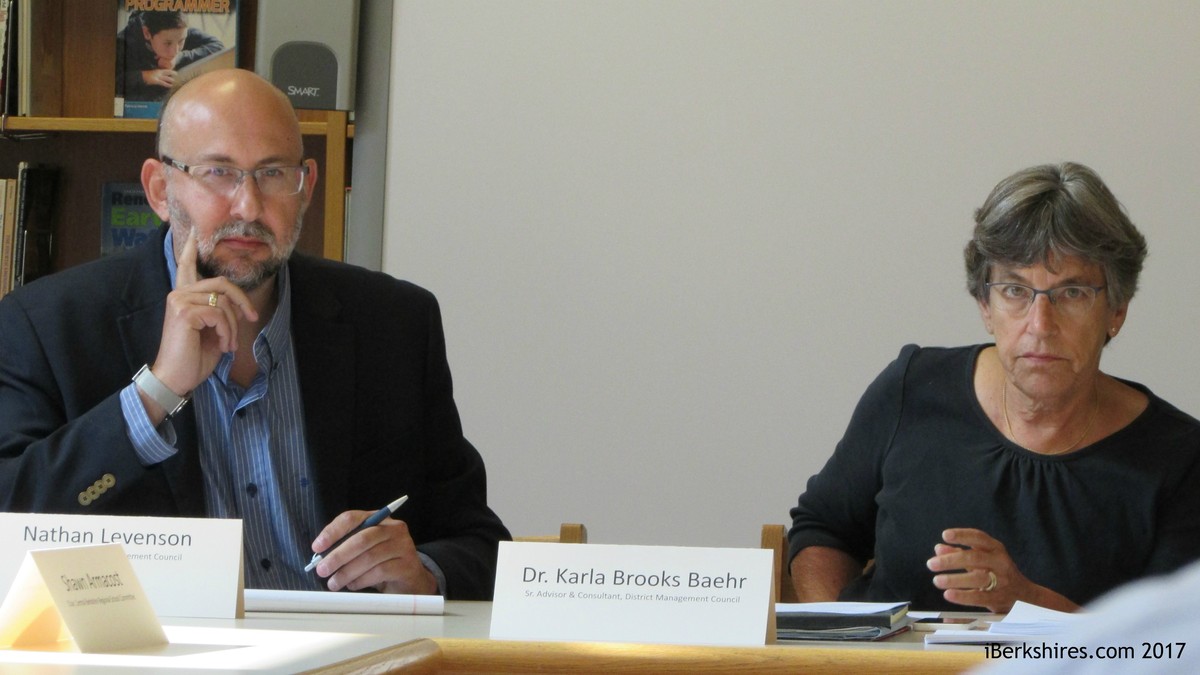
Nathan Levenson and Karla Brooks Baehr of District Management Group facilitate Saturday's meeting at Nessacus Middle School.
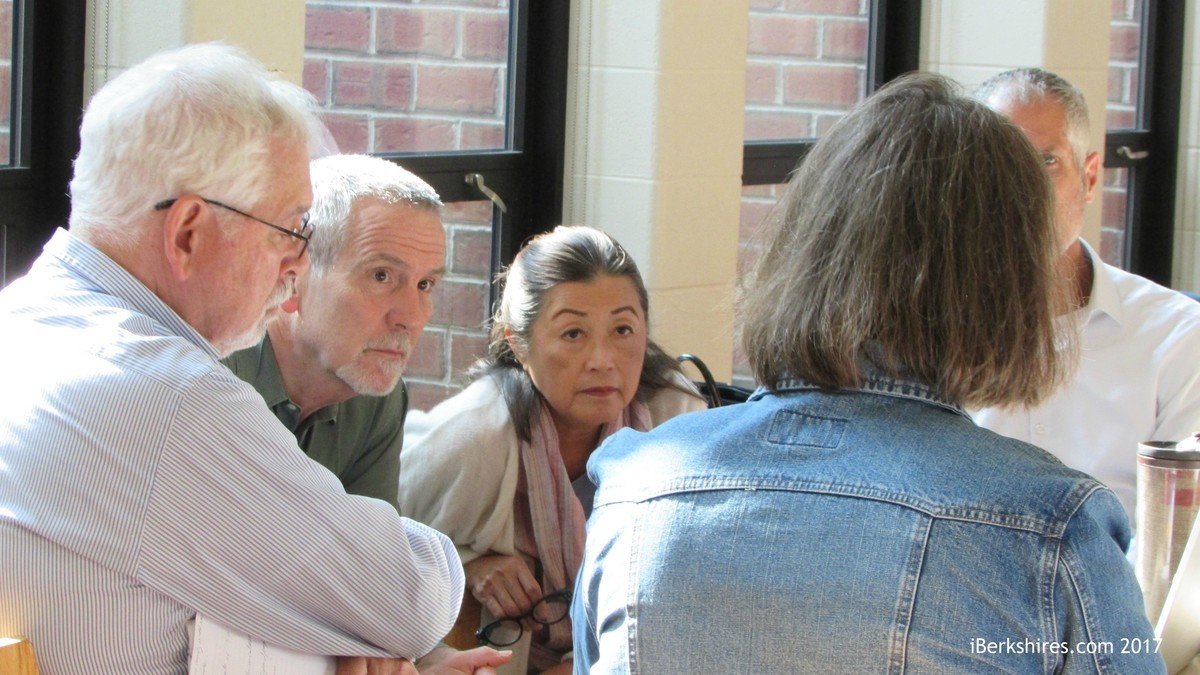
At a meeting on Saturday facilitated by the task force's consultants from Boston's District Management Group, the panel hammered out the language it will use to guide task force members as they make presentations to select boards, city councils and school committees throughout the county this fall.
The first presentation will come in the form of a webinar for school superintendents, principals and teachers union representatives on Sept. 19.
The task force will use the opportunity to run through the data compiled and analyzed in Phase 2 of its multiyear study and explain how the group arrived at a recommendation that the county should aspire to the goal of a unified school district to serve all 30 towns and the cities of Pittsfield and North Adams.
Task force members also provided DMG with feedback on a draft frequently asked questions document that will be added to the task force's website, where visitors also can read the full report.
The committee spent considerable time discussing language around what likely will be one of the first questions residents ask: Does a single school district for the county mean closure for schools?
As drafted, the FAQ reads, "The Phase II Study does not assume school closings or busing children long distances. If and how any given school is closed or merged is not a decision of the Task Force. Instead, it will be negotiated and worked out by the local communities as they work through the details of regional agreements. It is far more likely that schools will be reconfigured to assure optimal class sizes to enhance student learning. For example, a regional district may decide to turn two K-6 elementary schools into one prek-2 school and one school serving Grades 3-6. A countywide district is better able to support small local schools than the current configuration."
At least one member of the task force suggested that language went too far.
"There could be a context where school closings might make sense, and several communities have gone through the turmoil of school closings," Berkshire Hills Regional School District Superintendent Peter Dillon said. "To imply a pass to other communities seems problematic."
To be clear, no one on the task force -- including Dillon -- is advocating for school consolidation or implying that it is an inevitable outcome of a unified district. On the other hand, the task force members do not want to make promises about what such a district could look like.
In fact, at nearly every turn on Saturday, task force members emphasized that it is the body's role to study the county's education system and make recommendations to the elected officials and, ultimately, voters who would need to implement any changes.
"In the second sentence [of the draft FAQ], I think to say, 'not a decision of the task force,' implies there are decisions for the task force to make," Mount Greylock Regional School Committee member Carolyn Greene said. "We don't make any decisions."
Nevertheless, the possibility of closing schools in a time of declining population and rising costs remains a potentially explosive issue, DMG President Nathan Levenson noted, and he advocated for language in the FAQ that keeps the unified school district conversation from getting bogged down in talk of closed schools.
"We know that school closure -- and this is true in every community in the United States -- is the third rail," Levenson said. "We don't have a strong enough metaphor for how anxious it makes people. In a thousand years, I would not have thought anyone would read the report and think it will mean one elementary school, one middle school or one high school for the whole county.
"My sense is if we can't put people at ease very quickly on the school closing and school choice issues, it will be hard for people to hear us, and it will generate a lot of vocal opposition. We have to address it."
And the task force can point to a Phase 2 report that makes no mention of school closures as it attempts to put people at ease, Levenson said.
"I agree it's definitely not this committee's purview to say we will or we won't," he said. "But at least in our report all the baseline assumptions … did not require schools to close. Every educational benefit was possible to some degree without closing schools."
North Adams School Superintendent Barbara Malkas agreed.
"That would be my recommendation -- to make it more specific to the study," she said. "The Phase 2 study did not call for closings. If schools are merged, it will be worked out by the local communities."
A former superintendent of the Pittsfield Public Schools and current dean at the Massachusetts College of Liberal Arts noted that the kind of cost sharing promoted by the task force's recommendations will help make local schools more sustainable.
"I wonder if we can frame the issue of school closings differently," Howard "Jake" Eberwein said. "Does the movement to a collaborative help us to slow or eliminate school closings?"
Levenson picked up on his point.
"There's a lot of financial benefit to be had from the consolidation of leadership," he said. "There are lots of benefits both academic -- in offering of services -- and financial, without having to close a school.
"My sense from having talked to people … is there was an assumption that the primary lever of improvement was, 'We're going to have to close a lot of schools.' The message the report delivered was that, short of closing schools, there are tons of things we can do and tons of benefits."
Before adjourning on Saturday, the task force doled out assignments for members to organize the public outreach campaign and get the task force members on the agendas of school committees and select boards throughout the county.
It also touched on a topic that likely will loom larger in its next meeting, tentatively scheduled for Sept. 16: the role of the task force going forward.
"Once this information is rolled out, there has to be something driving this forward and bringing towns together and school districts together," said acting Chairman William Cameron, the retired superintendent of the Central Berkshire Regional School District. "But what role we have in that, we need to understand."
Tags: education task force,