Mount Greylock Building Timeline, Demolition on Track
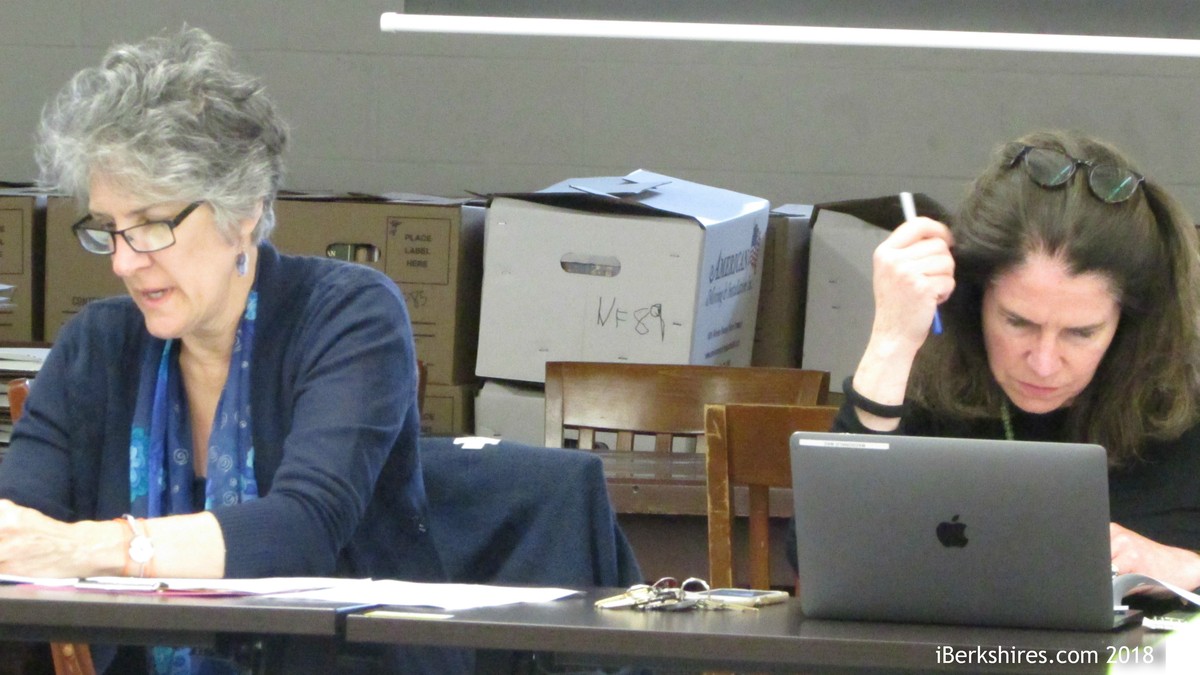
Mount Greylock School Building Committee co-Chair Paula Consolini, left, runs Tuesday's meeting as Principal Mary MacDonald follows along.
On Tuesday, the School Building Committee heard a confident update from the district's construction manager, Turner Construction.
"We're hopeful that with the work we've done over the last couple of months we've built up the confidence of the community to move forward with the plan," project manager Mike Giso said.
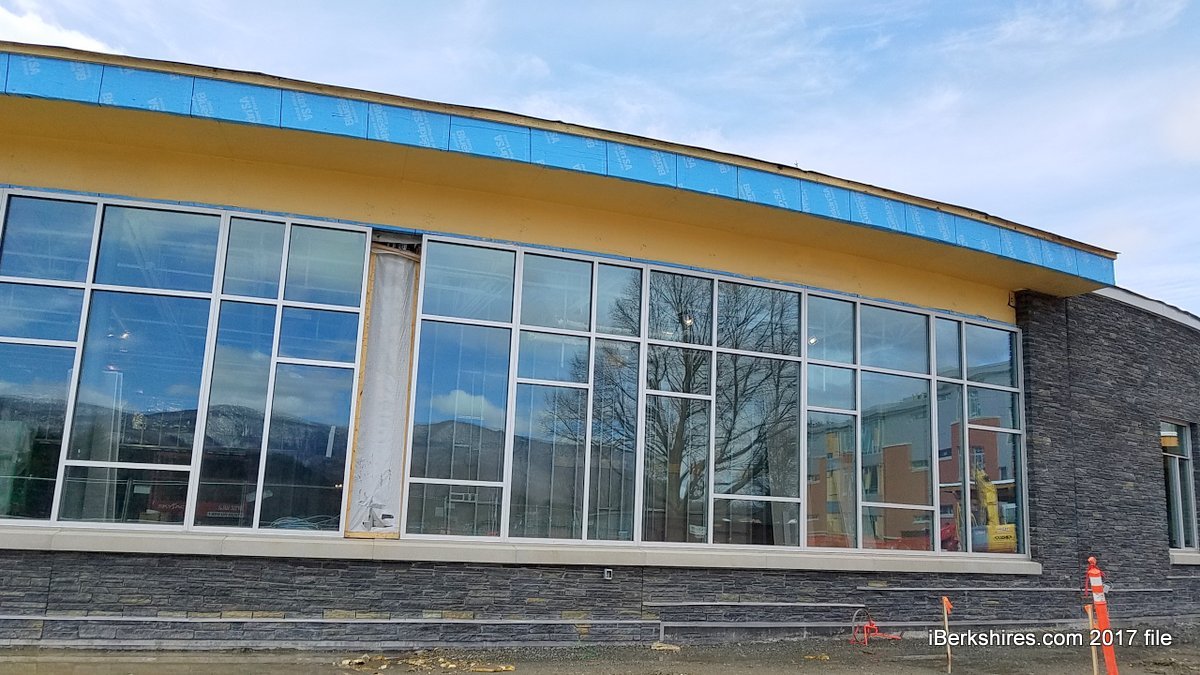
Giso walked the committee through an activities report that shows that the project is proceeding at a rate that allows Turner to move up projected completion dates in several areas of the building.
The last time the committee met, the new three-story classroom wing, central core and cafeteria had completion targets of July 6, Aug. 2 and July 26, respectively. Those dates have been adjusted to July 3, July 17 and July 24.
The school's new kitchen remains on track to be completed on June 27. The last piece of the renovated spaces, the auditorium, will lag a little bit later than expected, shifting from Sept. 7 to Sept. 18.
The late finish in the auditorium should not affect plans to have a temporary certificate of occupancy in place for the school in time for teachers to have access to classrooms in August.
Tuesday's report will come as good news to the district's Transition Committee, which meets on Thursday evening. That committee was concerned about whether the project — which originally slated April 2018 for moving into the academic wing — would be far enough along to allow demolition to begin on the current classrooms later this month; the school year ends on June 25.
The School Building Committee declined to vote an official recommendation to the Transition Committee, instead allowing the absence of a vote to delay demo to speak for itself. But individual members expressed their satisfaction with the progress the project has made.
Hugh Daley, who at the last meeting pressed the construction team for a frank assessment of the chances to complete the project, appeared to sum up the reaction on Tuesday.
"Right now, we're on schedule with the billing cycle," he said. "The project looks a lot further along. I think confidence is high we're going to hit the dates."
In keeping with Daley's request from the May 8 meeting, Giso came armed with three potential threats to the schedule to keep an eye on, but he stressed the dangers were negligible.
One possibility is a delay in certifying the building's life-safety systems.
"Right now, we have tested [the academic wing] for the fire alarm and sprinkler systems," Giso said. "Did we see anything that's going to come back and bite us? Nothing we can anticipate."
Other typical hang-ups that come in the late stages of a project include problems with inspections by the town's health inspector and issues that come up with Americans with Disabilities Act compliance.
But the local inspectors have been doing preliminary walk-throughs during the project and providing feedback to the construction team, Giso said.
Toward the end of the meeting, Daley sought assurances that the construction manager was continuing to apply all resources to meeting the schedule.
"We're still not taking anything for granted," Giso said. "We're still running full steam ahead."
With demolition around the corner, the School Building Committee on Tuesday faced a decision point about who to hire for hazardous materials and dust monitoring.
Architect Dan Colli from Perkins-Eastman told the committee that his firm reached out to three potential vendors that Perkins-Eastman has experience with. Two of those vendors returned quotes, and their price tags for the project were very different.
Eco-Genesis, which has provided monitoring services to the district at other phases of the building project, quoted a price (including Perkins-Eastman's markup) of $113,520. Smith and Wessel came in at $54,802.
The delta came from the two vendors' very different assessments of the workload for the project. Eco-Genesis quoted its price based on 165 monitoring shifts; Smith & Wessel estimated it would need 60 monitoring shifts.
The per-shift cost was higher for Smith & Wessel — $600 vs. $485 for Eco-Genesis. But with fewer than half the shifts, the price difference came out in favor of Smith and Wessel.
"I can't tell you which is right and which is wrong," Colli said. "They both feel like they can do the job. They both have talked to the contractor. In my opinion, it comes down to how much risk we want to manage.
"Eco-Genesis is obviously a risk-free approach. They'll be here to monitor it constantly. Smith and Wessel thinks they'll be able to get the job done [with 60 shifts] and can add shifts if they need to. … I'm having trouble seeing how two people could see it so differently."
In answer to questions from the committee, Colli reiterated that he had experience with both vendors on other projects and had no reason to suggest Smith and Wessel was underestimating — or Eco-Genesis overestimating — the workload.
He did recommend that if the district went with the low bid, Smith and Wessel, that it budget a $15,000 contingency in case more manpower is needed.
Committee member Carolyn Greene suggested that Eco-Genesis' familiarity with the existing building — from past monitoring work — gave it the upper hand when it came to assessing the project's needs. She also pointed out that the project has in the past had a problem with delays because of a shortage of labor among subcontractors.
Colli said Smith and Wessel, based out of central Massachusetts, assured him it could supply the additional manpower if needed and would not be the cause of a delay in demolition.
Committee member Thomas Bartels said the committee had no real basis for saying that the 60-shift estimate from Smith and Wessel is off the mark.
"I don't feel comfortable spending an extra $60,000 because I feel, for totally unfounded reasons, that 165 is the number of shifts needed," Bartels said.
Daley made a motion to award the job to Smith and Wessel.
"The truth is, even if they [double their shifts], they're still under the Eco-Genesis base estimate," Daley said. "Overall, it seems like this is the best path.
"I think, as Thomas pointed out, we have a qualified bidder with a lower price. We understand why the prices is lower. We should take the lower bid."
Greene abstained from an otherwise unanimous vote to award the bid to Eco-Genesis Smith and Wessel with an additional $16,500 added to the monitoring and testing line item as a buffer.
With the way clear for demolition at the old middle-high school at the end of the month, the School Building Committee set its next meeting, on July 12, for the cafeteria at Williamstown Elementary School.
Tags: MGRHS school project,