Community TV Stations: Proposed FCC Rule Could Gut Funding
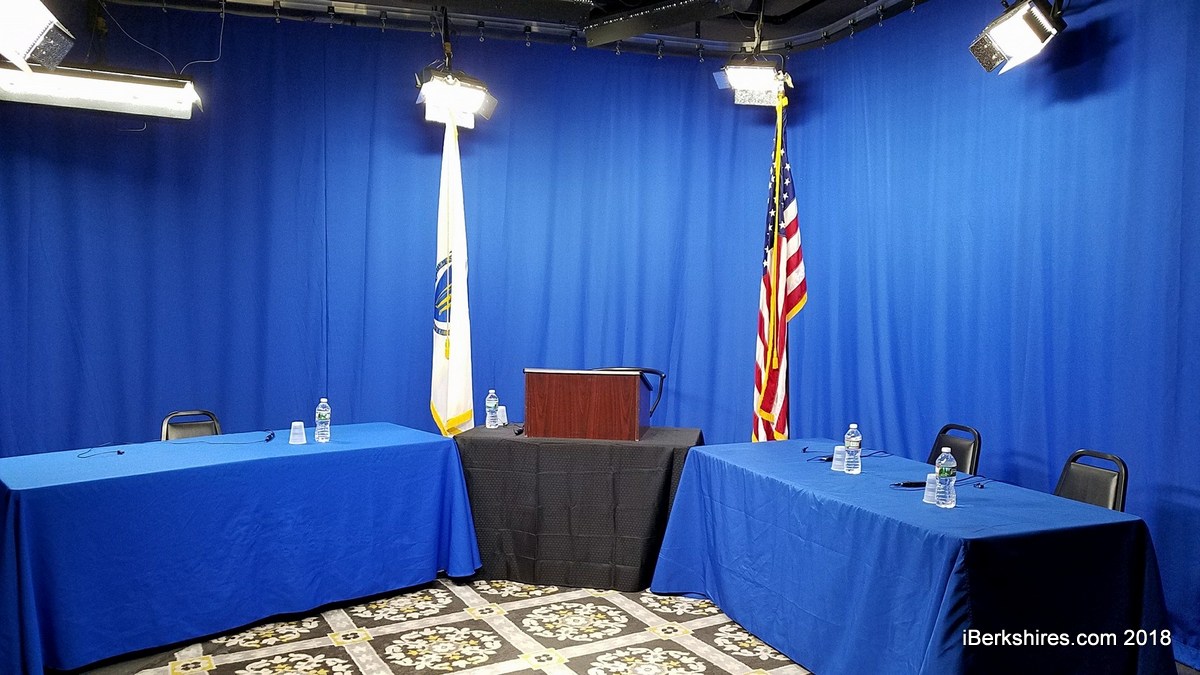
The studio at NBCTV set up for a debate. The local access television station says its revenue from the local cable company has been dropping yearly. A proposed change before the FCC could cut into its ability to provide local programming and possibly force it to close.
Public, educational, and government access (PEG) stations are mostly funded through franchise fees that cable subscribers pay in their monthly bill. Communities negotiate those fees, typically every 10 years.
The county has four local access stations: Northern Berkshire Community Television, WilliNet in Williamstown, Pittsfield Community Television and Community Television for the Southern Berkshires.
Editor's note: Lanesborough also has a public television channel, as a commenter has reminded us.
But now, a proposal in front of the FCC would allow cable companies to charge "in-kind" services to those fees. Local stations don't know exactly what those in-kind fees charged against their funding will be, but see an easy path through which cable companies could gut their operating funds.
"It would be devastating without that cable franchise money. I don't know how we'd survive," said Pittsfield Community Television Executive Director Shawn Serre.
The issue dates back to the Cable Communications Policy Act of 1984 when Congress established laws requiring cable companies to provide up to 5 percent of their gross income to support public access. The companies created the infrastructure to support PEG stations, studios were built, stations started doing more and more in the community -- from covering elections to city council meetings to local sports to local interest shows.
"It is our primary source of funding," said Northern Berkshire Community Television Executive Director David Fabiano.
The proposed rule change would allow cable companies to charge the costs of much of the basic infrastructure to keep the channels on against the franchising fees. Serre said there are cable drops at various places throughout the city, infrastructure the stations use to record meetings at schools or city hall, the tree lighting ceremony, or others and maintenance of those could be charged against the fee because the company maintains them. He said there are institutional network points allowing for live feeds from various places, and the cable company could do the same.
"The other thing could be the value of the channels themselves, the very nature of PEG access channels -- the channels people have to find us now on 1301, 1302, and 1303," Serre said.
Serre said the company could have the ability to say those channels could be leased to someone else for a certain price and that price would be charged against the franchise fee.
"By the end of the day, they won't be paying any operating money for PEG access TV and we'll have to shut down," Serre said.
According to the FCC filing on the issue, the rule is an attempt to keep cities and towns from negotiating above what is statutorily a 5 percent cap on franchise fees. The argument is that various services negotiated to be provided by cable companies are on top of the monetary payment and that puts cable companies on a competitive disadvantage to online providers.
Fabiano's biggest concern with the proposed rule, however, is a lack of definition of what can be charged and how much.
"It's an unknown. There is no set description as to what passes as an in-kind service," Fabiano said.
Local access stations are already fresh off a battle with local cable company Spectrum after it switched the channel numbers from low digits to in the 1300s. Spectrum said it was to keep conformity across its nationwide system but local stations say the move eliminated many viewers who had found the station by browsing, whereas now the stations are mostly found by physically using the remote to get to them.
When looking at the possibilities the rules open up for cable companies, Serre said: "if they are allowed to, they definitely will."
And the issue has some urgency.
"If it goes through the way it is proposed right now, the contract wouldn't be nullified but they would essentially be doing an end run around it. They would still have to pay the fees but they would put on some spreadsheet somewhere and say here are the fees they would have paid and by the way here are the value of the things we provided in-kind," Serre said.
Fabiano said the ruling would allow the companies to start charging against that franchise fee even in the middle of the agreement. Fabiano said it is "not quite fair" to change the process in the middle of the contract when local stations are looking for predictability in their funding.
Northern Berkshire Community Television serves four communities and franchise fees have already become "volatile." As more people move away from cable, the franchise fees go down.
"In the past few years we are starting to see a 1 to 2 percent drop each year, whereas in the past it was 1 to 2 percent increase each year," Fabiano said.
However, the cable company has been raising prices so the impact hasn't been as dramatic as it could be. Serre has experienced something similar but since the decrease has been slower, it hasn't quite impacted the organization in a major way.
"As time goes on, the numbers will probably shrink. That is part of the reason why we started independent fundraising efforts of our own," Serre said. "We've stepped up our efforts in the last year under many different categories to bring in dollars that are not connected to cable subscriptions. But the problem is, even if we were to do that and over the next five years we were able to make up 20 percent of the amount of money we're getting currently, we would never be able to support what we do here."

A PCTV volunteer operating the camera at a Spectrum hearing earlier this year. The station has been fundraising but says it can't raise enough to keep operating without the 5 percent franchise fee its gets from the cable company.
Fabiano said his organization has done the same. He said NBCTV does fundraise but it is nowhere near enough to sustain itself.
Both organizations say they are not flush with cash. Fabiano has three employees while Serre in the much larger city of Pittsfield has seven. And they both have offices to staff, equipment to replace, utilities, phones, and all of the necessary items to sustain a business.
Fabiano added that the importance of local access television has a greater importance to Berkshire County because of the lack of television news. Elections and meetings don't get the attention of New York or Springfield news stations -- and certainly wouldn't get the "gavel to gavel" coverage PEG stations boast.
North Adams Mayor Thomas Bernard wrote to the FCC about the importance local public access stations have to the civic well-being of the community.
"In particular, live and recorded coverage of North Adams City Council meetings and other public events provides residents with a direct connection to information, issues, and concerns that directly affect their lives. Beyond local government, PEG programming and the access corporation's facilities and expertise create opportunities for true and meaningful citizen engagement in the community. The FCC's proposed rule threatens the future of PEG programming," Bernard wrote.
Serre said PCTV is members of national and statewide community access organizations ready to oppose the ruling.
"We've been in contact with them and they've been on the front lines of this fighting it every step of the way," he said.
Tags: cable television, NBCTV, PCTV, public television,