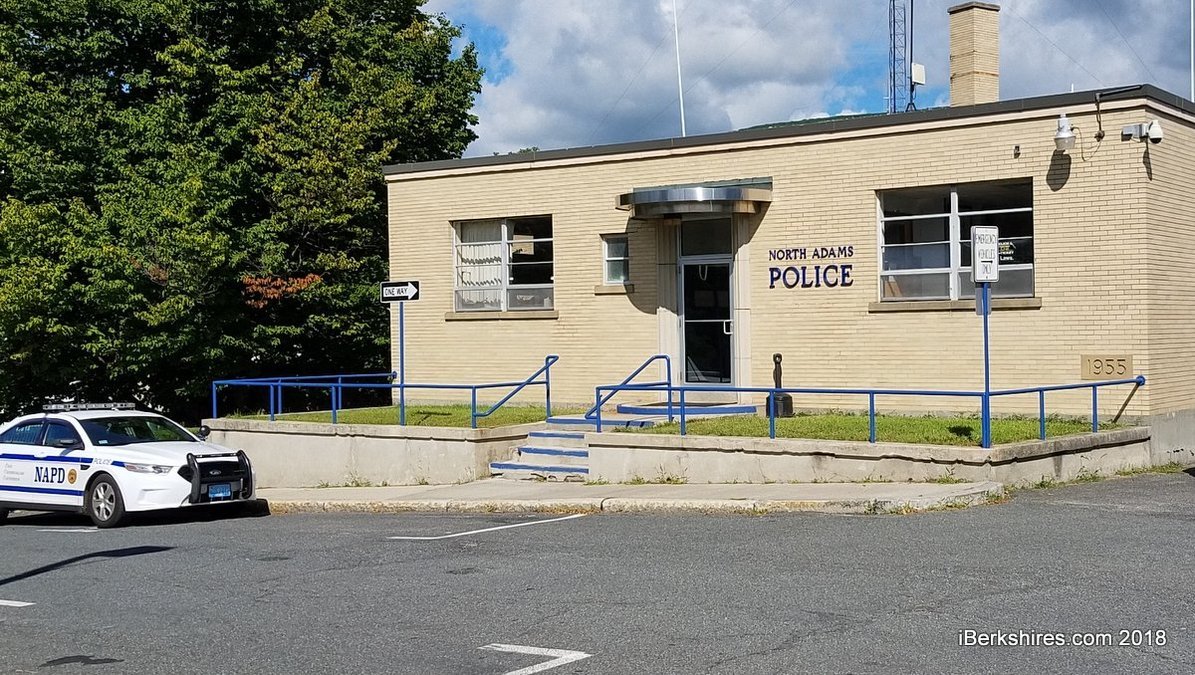
Coding Error Pushed North Adams' Violent Crimes Stats Higher
A coding error discovered last month in the software used in crime reporting designated all assaults as felonies. Fixing it has dropped the number of aggravated assault cases so far this year by at least a third.
It's not that the incidents didn't happen, officials say, but rather the severity of the classification.
"Regardless of how you code these things, the total number of incidents we're dealing with isn't changing," Mayor Thomas Bernard said on Monday. "We're not reclassifying these things so they're not crimes. They're not violent crimes according to the definition that the FBI and DOJ use in the Uniform Crime Report."
The Federal Bureau of Investigation collects crime statistics each year from more than 18,000 participating communities, universities and tribal nations and releases the report annually the following fall.
The years 2016 and 2017 found North Adams, the state's smallest city, at the top of the ranking for the most number of violent crimes per capita in Massachusetts.
Police Director Michael Cozzaglio said on Friday that the department had done a "deep dive" into the cases and reporting because officers weren't seeing that level of felonies.
"We saw it the first time in 2016 and we thought it was an anomaly," Cozzaglio said last week. "Then the 2017 report came out and we thought, something is wrong."
In a letter to command staff and the mayor dated Nov. 20, Lt. Jason Wood explained that he had discovered the error after going back through all 111 recorded aggravated assaults that had occurred between Jan. 1 and Oct. 31.
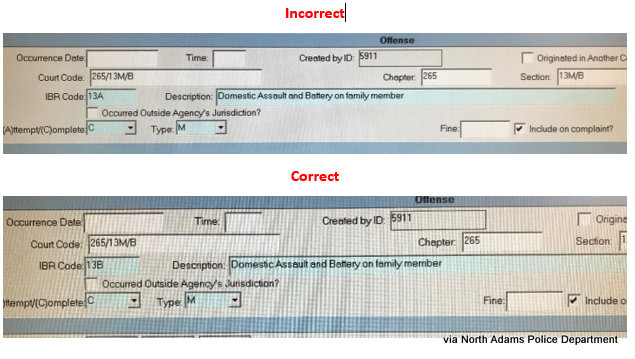
He found that the common offense listed as "Domestic Assault and Battery on a Family Member" without aggravating factors, under Chapter 265 Section 13/M/B, was being tagged with IBR Code 13A (felony) and not Code 13B (misdemeanor).
"By making corrections where the elements to satisfy the 13A code were not met, I reduced the reported number of 111 to 76," he wrote. "Which if my calculation is correct is a 46 percent number reduction."
The difference, however, seems closer to about 31 percent.
The city uses IMC software by Central Square, a popular public safety software used throughout the state. The application is customized for each community or department and is routinely updated.
Wood said he found the discrepancy in the IBR code in the city's system and is manually correcting it but did not know if other departments were having the same issue.
"It could be isolated to just us, or it is possible other departments are affected and are not aware yet," he said in an email.
The error appears to be limited to assaults. During this same period, the department also recorded six robberies, 27 rapes and similar offenses, and one murder.
Wood's research found that in the 76 cases that met the felony charge, only five listed the offender as a stranger. In the other 71, both suspect and victim knew each other. Including all the cases, again only five came up with the suspect as a stranger.
"The City of North Adams is not a dangerous city by any means. These numbers are predominately generated by a small circle of individuals with a high tendency to offend multiple times," he wrote. "Furthermore, these individuals are victimizing known associates. The average law-abiding citizen usually has little to no contact with this small section of our population."
Officials are also noting that the FBI cautions about using the UCR for comparing communities because it only releases data for the crimes and population and does not take into account factors such as socioeconomic conditions, density, geography or the size or type of law enforcement.
"The offenses that we're seeing are related to the opioid and drug epidemic," Bernard said on Monday. "We can pinpoint the where, why, how and the who because there are some people in those statistics that are responsible for multiple data points."
The city has been putting into action programs officials hope will help reduce domestic violence and drug abuse. Part of that is an emphasis on community policing, working with the Brien Center to address mental health issues in the community, partnering with organizations to provide drug recovery programs and developing tools to address domestic violence.
Public safety officials are anticipating a drop in violent crime reports in next fall's UCR. But there's probably no backtracking for years 2016 and 2017. Bernard said he did not think the FBI would be open to changing those years but the city would be inquiring about amending this year's reporting.
"We also have to say we're not going to look away, we're not going to shy away from the fact that we do have crime in this community as every community does," the mayor said.
Update: it is not clear how the 46 percent referenced was calculated. We have updated that with a different amount.
Tags: Crime,