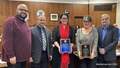
Farley-Bouvier Pushes Bill to Raise Tipped Workers Minimum Wage
BOSTON — State Rep. Tricia Farley-Bouvier is calling for the elimination of a lower wage for tipped workers.
The Pittsfield Democrat joined other lawmakers and Restaurant Opportunities Center this past Wednesday at the State House to introduce a bill that will gradually raise the minimum wage for tipped workers until it matches the minimum wage for all other industries.
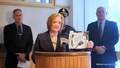
"This bill will raise the minimum wage to the prevailing wage by 2027 in Massachusetts. In doing so, it would bring thousands of workers out of poverty, reduce sexual harassment in the workplace, and decrease the wage gap between male and female tipped workers," Farley-Bouvier said at the press conference.
So far, seven other states have made such moves to eliminate the practice of paying tipped workers a lower wage. Farley-Bouvier said poverty among tipped workers and harassment cases have decreased in those states. She added that restaurant sales have increased.
"Paying our workers does not equate to hurting the restaurant industry, it is actually the opposite," Farley-Bouvier said.
The press conference was held on Feb. 13 to symbolize the $2.13 current federal minimum wage for tipped workers. That is a figure that hasn't changed in decades. Massachusetts' current tipped wage is $4.35 an hour.
The "One Fair Wage" bill has numerous co-sponsors. Second Middlesex state Sen. Patricia Jehlen filed the bill on the Senate side.
"There are thousands of food service workers in Massachusetts who struggle to make ends meet for themselves and their families because they are living off tips. And if you’re dependent on tips, you depend on your manager for good shifts, you depend on cooks and other staff members to help you do your job, and you depend on customers' whims," said Jehlen in a statement.
"The sub-minimum wage creates too many opportunities that can be exploited by predators. This needs to end."
The legislators said nearly 70 percent of the tipped workforce are women and that they are earning 70 percent of the wages men get and that for African-American women, the disparity is even greater.
"The women who put food on our tables cannot afford to put food on their own family's tables," Farley-Bouvier said. "This is an issue that disproportionately affects women, as well as people of color and immigrants."
The lawmakers also said the tipped wage system leads to increase sexual harassment, discrimination, and economic instability
"Wearing lipstick or not wearing lipstick should not determine our wages. Having short hair, long hair, or no hair should not determine our wages. The color of a woman's skin should not be the factor in earning a livable wage versus an unlivable wage. Someone not liking the way you look should never determine what you go home with in wages. Point blank: being a woman should not play a factor in whether or not we can afford to thrive independently or provide for our families," said server Emma Ruff at the press conference.
Similar bills are being introduced in 15 states and on the federal level. U.S. Rep. Joe Kennedy filed a similar bill on the federal level.
"Tiered worker protections are a hallmark of deeply unequal economies. A living wage should not be conditional based on the career you choose," said Kennedy. "In a commonwealth that prides itself on progress and a tireless work ethic, it is time that we address these systemic inequities that plague too many of our communities."
Joining @rocunited @roc_boston for their national day of action #1FairWage https://t.co/99Rvp34mIU
— Sen. Pat Jehlen (@senjehlen) February 13, 2019
Tags: Farley-Bouvier, minimum wage, State House,