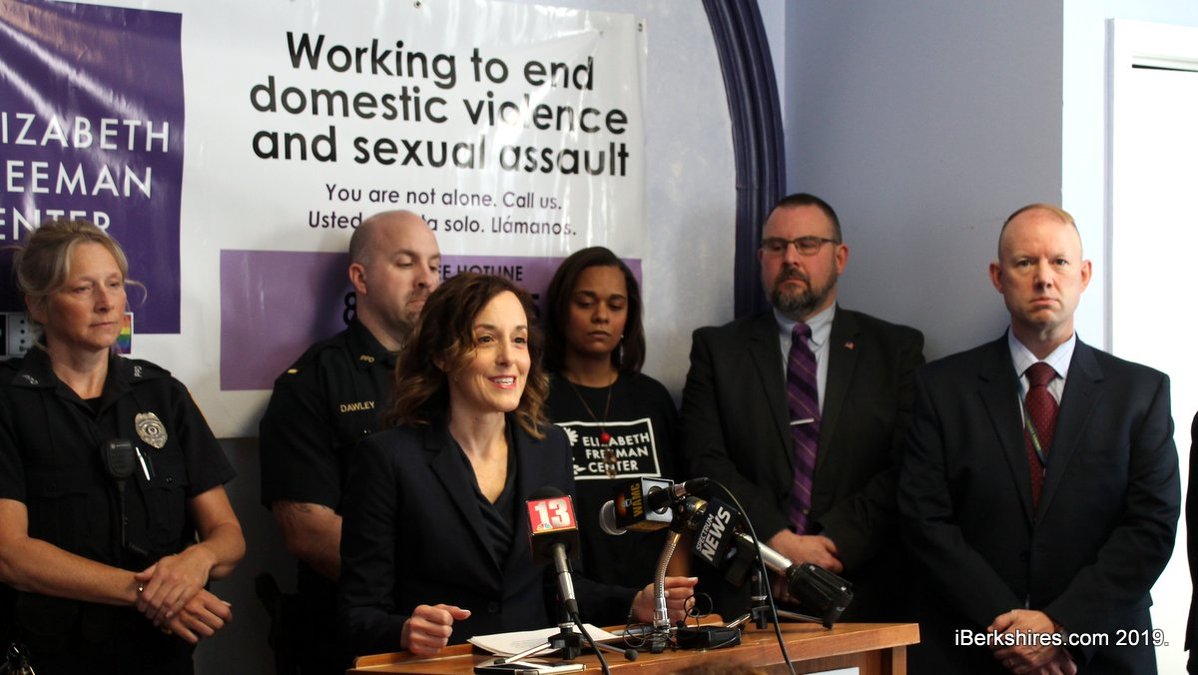
Harrington Launches Plan to Address Domestic, Sexual Violence
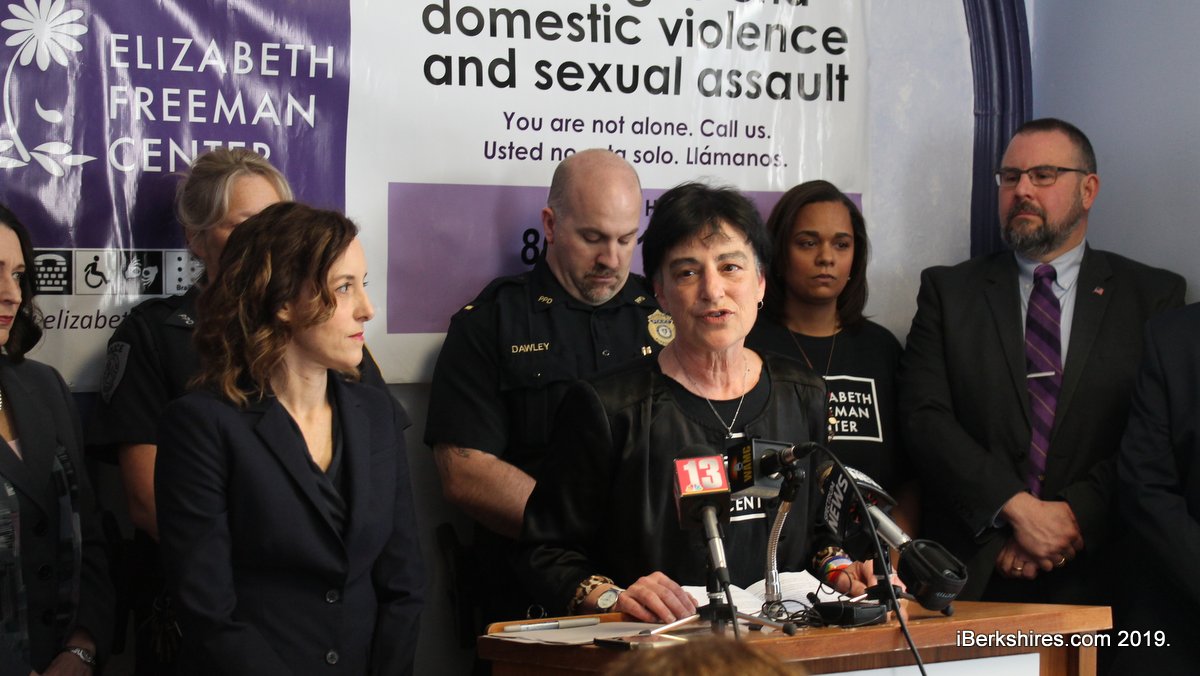
Freeman Center Executive Director Janis Broderick said domestic and sexual assault has been a growing problem in recent years and a lot more can be done.
On Tuesday, she announced a new countywide Berkshire Domestic and Sexual Violence Task Force that will focus on curbing what is now growing numbers of sexual and domestic violence cases.
The task force will focus on outreach, securing new resources, and providing education and training throughout the Berkshires in an effort to prevent such crimes from happening.
"Domestic and sexual violence has reached a crisis point in Berkshire County. Together we will confront this growing crisis by building a healthy Berkshire County where we all can live safely and thrive," Harrington said.
Elizabeth Freeman Center Executive Director Janis Broderick said the number of restraining orders requested in the county has grown by 15 percent since 2015, with 1,107 filings in 2018. That rate is 36 percent higher than the state average.
Stockbridge, Adams, Pittsfield, and North Adams ranked first, third, fifth, and sixth in 2017 among the highest rate of rape per population, she said, and Pittsfield Police refer about 800 cases a year to the non-profit organization.
Further, from 2015 through 2018, there have been six cases in which a woman was murdered by a husband or ex-boyfriend, she said. The last domestic murder prior to that was in 2009, she said.
"Though it is hidden in homes, down long country roads, or it is silenced by shame, we in the Berkshires should know all too well that violence happens here, that it happens a lot, that it can happen to anyone, that it is horrific, it is terrifying, it is sometimes lethal and it needs to be stopped," Broderick said.
The new internal task force will be guided by an 18-member steering committee. The initial membership of that steering committee is comprised of Harrington and Broderick and:
- State Sen. Adam Hinds
- Pittsfield Mayor Linda Tyer and North Adams Mayor Thomas Bernard
- North Adams City Councilors Benjamin Lamb and Marie Harpin
- Pittsfield Police Officer Cheryl Callahan
- Assistant District Attorney Megan Tesoniero
- Director of Special Projects Helen Moon and Director of Victim Assistance Advocates Lisa McCue, from the DA's office
- Meg Bossong, Williams College's director of sexual assault prevention and response
- William Ballen, executive secretary of the Berkshire County Superintendents Roundtable
- Ann Marie Carpenter, director of social emotional learning and student support for Pittsfield Public Schools
- Elizabeth Freeman Center Shelter Director Jennifer Goewey
- Railroad Street Youth Project Executive Director Ananda Timpane
- Karran Larson, children's specialist and deaf recovery coach supervisor for the Massachusetts Committee for the Deaf and Hard of Hearing
- Berkshire Medical Center Director of Emergency Services Kerri Hallas
"The task force and steering committee will enact a strategic plan to prevent domestic and sexual violence across our community and engage our community in action across multiple disciplines. Stakeholders will secure resources, raise awareness through outreach, education, and training," Harrington said.
The group will look to implement new strategies in the district attorney's office and build relationships among organizations currently working in the field.
"The district attorney's office will track sexual assault cases starting when they are filed, instead of when charges are brought. On-call advocates and prosecutors from the DA's office will be available to support police and medical providers in assisting victims of domestic and sexual assault. I have formed an internal team that is working to identify unindicted sexual assaults from the past with the intention of prosecuting perpetrators," Harrington said.
She said the efforts will focus on taking a "trauma-informed approach" and the implementation of a "high-risk initiative model" in Berkshire County. The group will take aim at training people throughout the county to recognize when someone is at risk of being either a victim or an abuser.
"Each day, we in the district attorney's office receive overnight reports from throughout Berkshire County documenting the trauma inflicted by domestic and sexual violence. These reports come with alarming and heartbreaking frequency," Harrington said.
"My team in the DA's office is committed to prosecuting abusers and is working to create a culture where victims are believed."
She said the office will be rolling out new training for law enforcement and advocates to better recognize signs of human trafficking and exploitation. Next month, 11 staff members will be certified as application assistants for the address confidentiality program -- a statewide program allowing victims of stalking, domestic violence, or sexual assault, to mask addresses with a fake one and limit information about someone's actual location.
"To better serve and protect victims of domestic and sexual violence, my office is collaborating with Secretary of State [William Galvin] to bring services to Berkshire County that have not yet been utilized in the past," Harrington said.
She added that she is working with the governor's office in developing a domestic violence fatality review with the goal of identifying areas where homicides could have been prevented.
Broderick said the additional focus on the issue has been "a long time coming." Despite the Freeman Center having officers all over the county, having a presence in the courts and with Pittsfield Police and Adams Police, and assisting 1,800 survivors last year, she said a lot more needs to be done. The organization has been in existence since 1974 addressing both emergency and ongoing needs to domestic violence victims.
"This is not enough. All of us who do this work know this is not enough," she said.
Broderick particularly highlighted that the effort is both countywide and strategic. The announcement came fittingly in April, which is Sexual Assault Awareness Month.
Tags: district attorney, domestic violence, sexual assault, task force,