Williamstown Select Board Weighs Membership in Woodlands Partnership
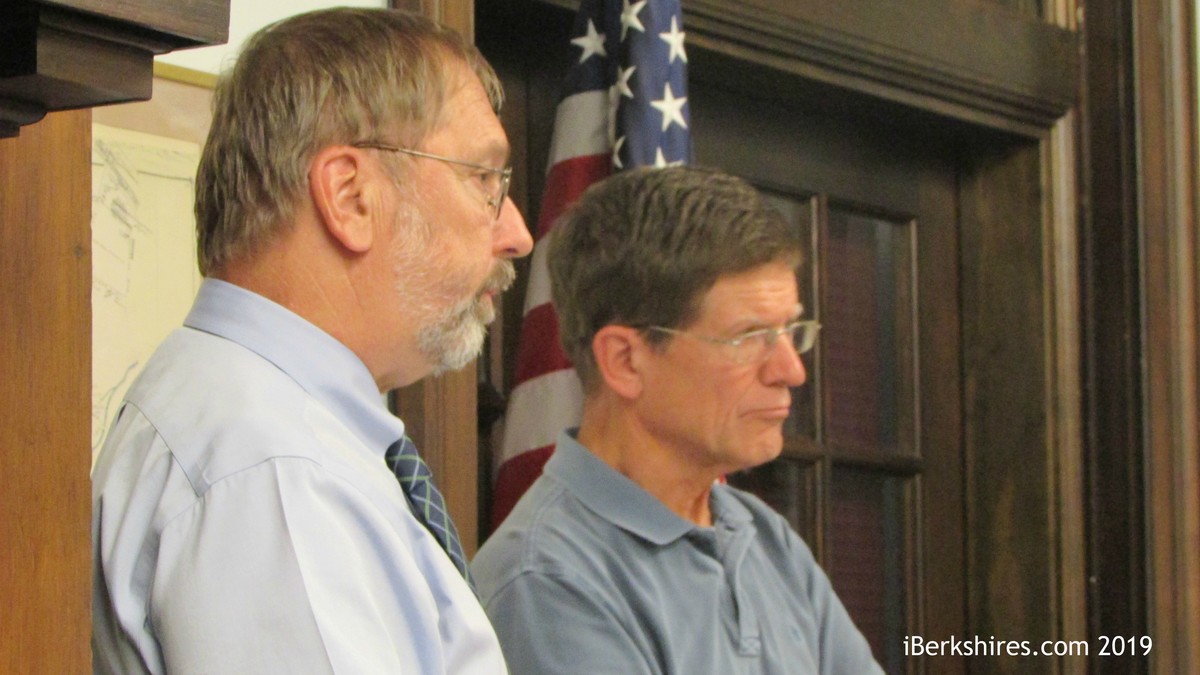
Tom Matuszko, left, and Hank Art appear before the Select Board to discuss the Mohawk Trail Woodlands Partnership.
For six years, representatives of the 20 towns and city of North Adams eligible to participate in the partnership have been working on plans for the initiative, which seeks to marry sustainable forest management with economic development opportunities.
In 2018, the partnership was codified in an act of the Legislature. Earlier this year, the 11th municipality agreed to participate in the partnership, bringing its number to more than half of the eligible and allowing it to begin seeking funding from state and federal sources.
Williamstown resident Hank Art and Berkshire Regional Planning Commission Executive Director Tom Matuszko were at Town Hall on Monday to encourage the Select Board to add Williamstown to the roll of participating communities.
"This is a Northern Berkshire, western Franklin County consortium put together to bring resources and expertise to sustainable forestry practices and have, at the same time, sustainable economic development happen while taking care of our most precious resource," Art said.
"Current forest management is hit or miss, and it may or may not include sustainable forestry practices at all as goals."
Part of the problem is that much of the forests in the affected region — which tracks the Mohawk Trail or Route 2 — is divided into relatively small parcels, Art said. The owners may not have the inclination or resources to bring in experts in sustainable forestry to advise them.
"The idea is to bring resources — expertise as well as money from federal and state sources — without cost to the actual towns and foster better management in a sustainable fashion," said Art, a long-time member of Williamstown's Conservation Commission and an emeritus professor of environmental studies and biology at Williams College.
"What the partnership is designed to do is to bring sustainable forest management practices, make them available to municipalities, non-governmental organizations and individual land owners, through a variety of programs. One of those programs is actually buying conservation restrictions, which would allow forestry to continue but with sustainable forest management."
Two things the partnership is not designed to do: allow construction of a biomass manufacturing facility or the acquisition of forest land by the U.S. Forest Service.
The partnership also is not designed to create rules or regulations that member municipalities must follow.
"The legislation is specific," Matuszko said. "It does not take away from communities any of the legal responsibilities they have now. That was a concern early in the discussion: that this group could supersede local laws."
The enabling legislation reads, in part: "Nothing in this section shall be construed to diminish, enlarge or modify any right of the federal government, the commonwealth or any political subdivision thereof, to exercise civil and criminal jurisdiction or to carry out federal, state or local laws, rules, and regulations within the lands and waters included in the Mohawk Trail Woodlands Partnership Eligibility Area."
As for biomass, the last paragraph of the legislation begins, "No funding received or expended by the partnership shall be used for: (i) the construction or operation of a wood pellet or biomass manufacturing facility."
Select Board member Anne O'Connor said it was her understanding that the decision not to include new biomass facilities as part of potential economic development came after the partnership's advisory group encountered criticism on the issue.
"Is the language about ‘no funding' strong enough to prevent our forests from being a course of stock for biomass plants that already exist?" O'Connor asked Matuszko and Art. "That's a concern."
"I believe the language is strong enough for our area, but it's not going to prohibit [wood] from being taken out of our area," Matuszko said. "The intent is to get landowners to deal with their land in a sustainable manner. It's not clear-cutting.
"A property owner could do that now if they wanted to, but this program wouldn't help that. What we're trying to do is prevent that through education and sustainable forestry."
O'Connor countered by asking what experts will be employed by the partnership and what their agendas might be.
Matuszko said that the partnership has not gotten to the point of identifying consultants yet. By law, the partnership's board will include — in addition to a representative from each participating community — members from the Deerfield River Watershed Association and Hoosic River Watershed Association and two members from the faculty of the University of Massachusetts at Amherst with specialties in public health and ecosystem functions.
"The question for us is: Do we join this group or not," Select Board member Andrew Hogeland said. "If we want to influence who is chosen as the [forest management] advisers, we'd have no voice if we don't join."
Select Board Chairman Jeffrey Thomas told his colleagues that Art tentatively has agreed to be the town's representative on the board if Williamstown joins the partnership.
The town has until August 2020 to join the partnership or face a five-year waiting period before new members can be added to the initial group, Matuszko said.
No one on the board Monday made a motion to decide on whether the town should join, in part because O'Connor said Williamstown resident and climate change authority William Moomaw, who was out of the country at a conference, wants to address the Select Board before it makes a decision.
Tags: forestland,