North Adams Councilors Review Potential Eagle Street Designs
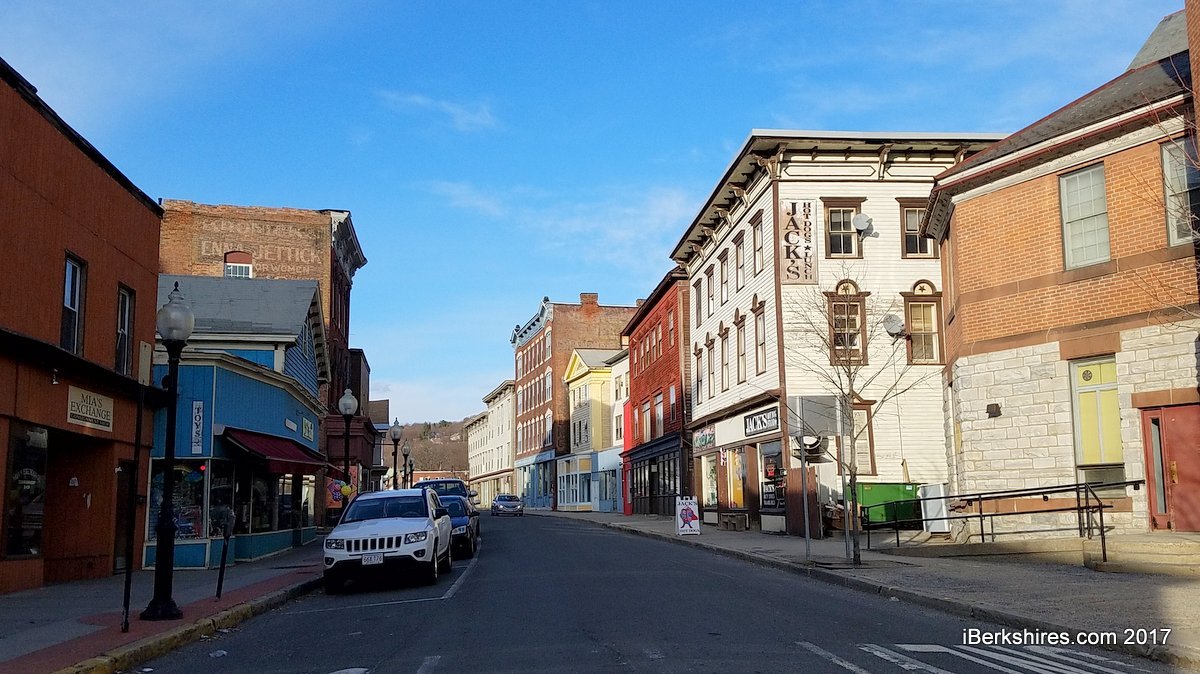
The city has been talking about making historic Eagle Street a pedestrian mall for at least a century.
The proposal would transform the busy and historic one-way street into a people friendly way by reducing the lane width, expanding sidewalks and putting in more plantings and gathering areas. Woonerf is a Dutch name for "living street" in which modes of transportation share the roadway with pedestrians.
The presentation by Eammon Coughlin, senior transportation planner with the Berkshire Regional Planning Commission, reviewed three designs presented to the public over the summer and two modifications based feedback.
All the designs had some form of expanded sidewalk with variations on the amount of parking available — from none to all 17 existing spots. The also all reduced the lanes to two on the south end, eliminating the lefthand turning lane. The travel lane is 17 to 18 feet wide; narrowing it to 10 or 12 feet would calm and slow traffic and allow much wider sidewalks.
"We're just trying to illustrate that there's a lot of flexibility in these designs," Couglin said. "And you know that nothing's really set in stone, there's ability to kind of bend them and change them as as the city sees fit."
The Chicane (or serpentine road) would have up to 10 parking spots staggered on each side with bumpouts to slow traffic; the Neckdown would keep parking on the east side with larger bumpouts in between similar to the portable parklet; No Parking would be a single narrow lane with plenty of trees, benches and tables, and wide sidewalks.
"Basically under this concept, every restaurant along the street could add six to 10 extra tables as part of their business if they so desire," Coughlin said of the third design. "You could have street trees basically long entire length from both sides of the street. ... the sky's the limit in terms of what you want to do or what you could do."
Fewer parking spots means larger areas for the public, plantings and sidewalk cafes; keeping parking to the north end or eliminating them would also aid in centering a fire lane that is now shifted toward the east to allow fire trucks to get through. But merchants on the street felt eliminating parking would hurt their businesses, especially in the winter.
The public could comment on the designs during the Downtown Celebration and one of the DownStreet Art evenings. The presentations were set up by First Baptist Church on Eagle Street and people could register their likes and dislikes and concepts were also reviewed by the Eagle Street merchants association and 100 people responded to a survey in June.
Of those responding to the survey, more than half wanted to see the expanded sidewalks, landscaping and lighting, and were willing to see some parking be removed. But only 20 percent thought there was too much parking. Coughlin noted there are 175 parking spots within a 10th of a mile of Eagle Street.
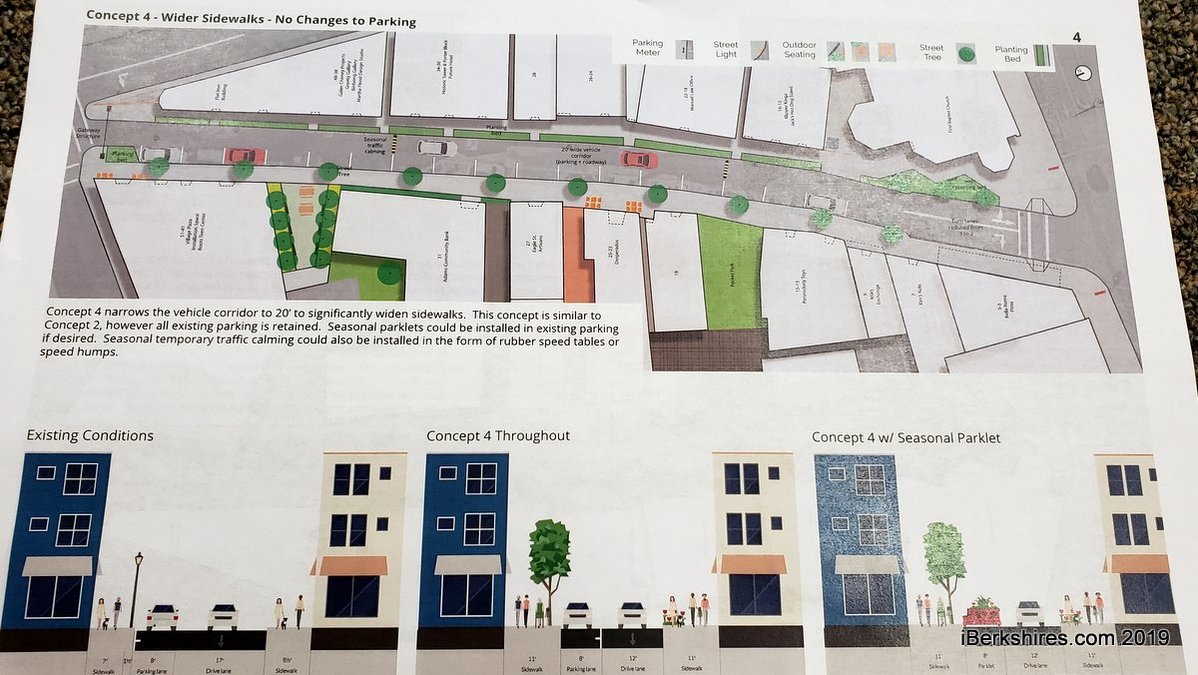
Based on the feedback, BRPC developed two modified designs: 3A that incorporated some of third design's spacious public areas but which added a small amount of parking on the north end of the street and Concept 4 that put in wider sidewalks and left the parking as is.
"For me, this project really boils down to your attitude toward parking. If there's no appetite for removing any parking, Concept 4 is where to go," Coughlin said. "You can utilize seasonal parklets as well as seasonal traffic calming to create the woonerf and you'll end up with much wider, more generous sidewalks as well.
"If getting rid of some parking is acceptable, or all parking, concept 3 or 3A are kind of the way to go. The benefits for pedestrians would be tremendous. And you know, as I said, these two concepts are a really, really great opportunity for a one-of-a-kind streetscape in North Adams."
The idea of making Eagle Street more pedestrian friendly goes back at least a century. Councilor Benjamin Lamb, who spearheaded the Eagle Street Initiative that created the parklet, benches, artwork and other amenities, said local historian Joe Manning had a handbook from 1921 outlining a very similar idea.
"So even 100 years ago they were talking about stuff like this and just hadn't really gotten that depth of traction," he said.
Community Development Director Michael Nuvallie said the topic has come up regularly over the years.
"When I first came on in May of 1987, there was this big rendering on a wall. I don't know if it was a painting or a stencil, but it shows the whole Eagle Street as a pedestrian way. It was really cool," he said.
The city in 2013 went for a Massachusetts Downtown Initiative grant to study the concept of a woonerf, put there wasn't funding and it again was put off to the side. When Lamb began working with the Eagle Street merchants about improvements, it popped up again.
The study was funded with $25,000 in fiscal 2018 Community Development Block Grant monies.
The presentation also offered general recommendations with or without the woonerf to update and unify building facades, work toward full building occupancy, and incentivize ground floor retail to increase foot traffic. Respondents also thought a coffee shop would be suitable, and while outside the city's purview, a temporary kiosk or bicycle coffee vendor could work, Coughlin said.
Other suggestions were creating more signage and a prominent "gateway" between the Center Street parking lot and Eagle Street and adding a second parklet on the grassy area next to Adams Community Bank.
"I think it's a good long term goal for the city, continuing to use the kind of experimental, what's called a 'tactical urbanism,' approach to implementing changes on the street," he said, referring to the Eagle Street Initiative. "I think the city has a really strong track record with parklets, and with pocket parks along Eagle Street."
Should the city decide to move forward, it would need to chose a concept and consider topography and traffic studies to refine the design. Nuvallie said the funding for the work could come from a MassWorks grant or the city's CDBG grant.
Tags: BRPC, Eagle Street, pedestrians,