image description
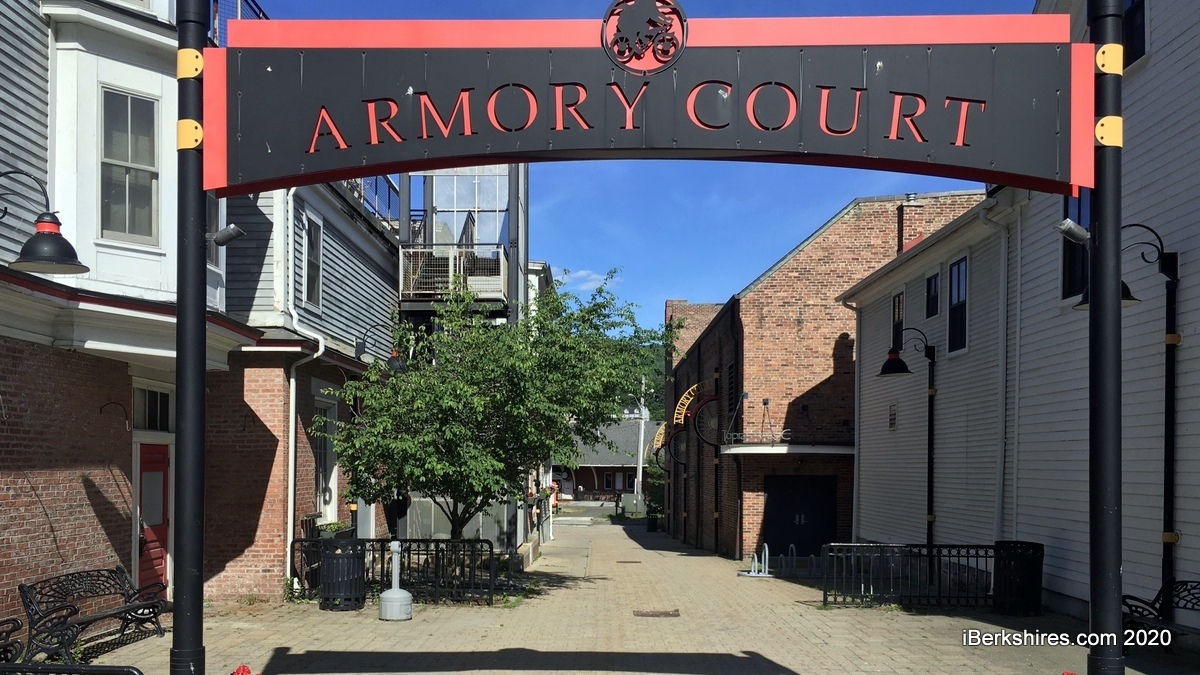
Armory Court on park St. The brick courtyard has been mentioned as a possible outdoor dining spot for The Daily Grind.
image description
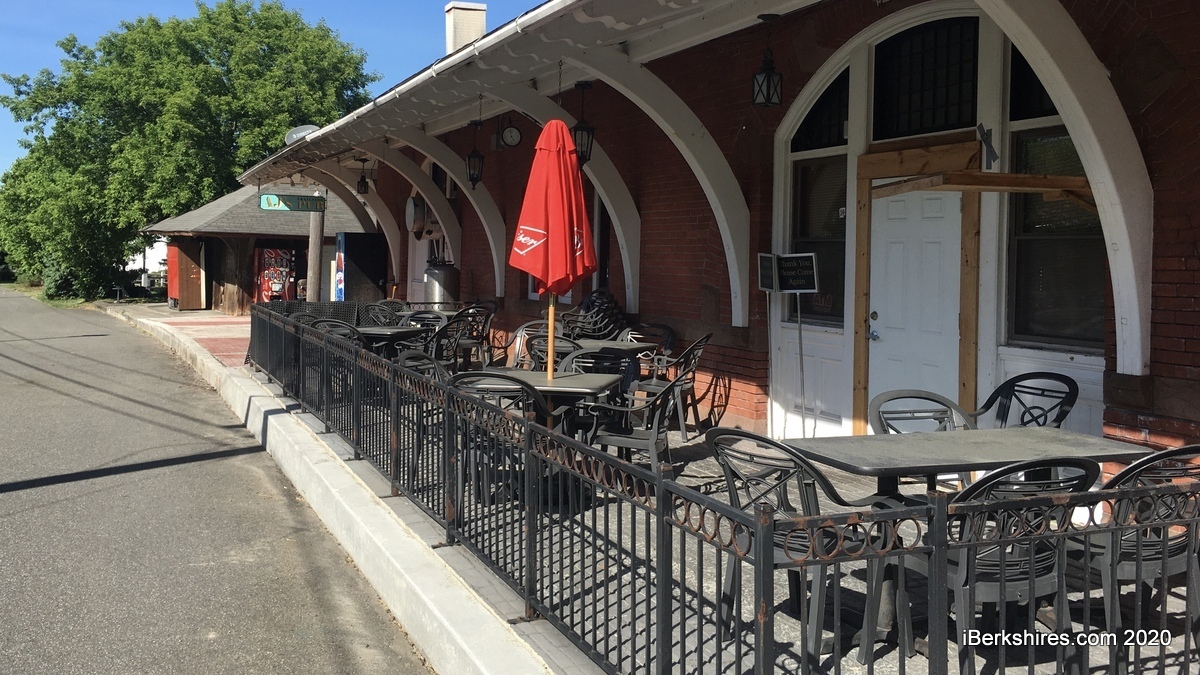
The patio at AJ's Trailside Pub is already set up for limited outdoor dining.

Adams Preparing For Outside Dining
By Jeff SnoonianiBerkshires Correspondent
Print Story | Email Story

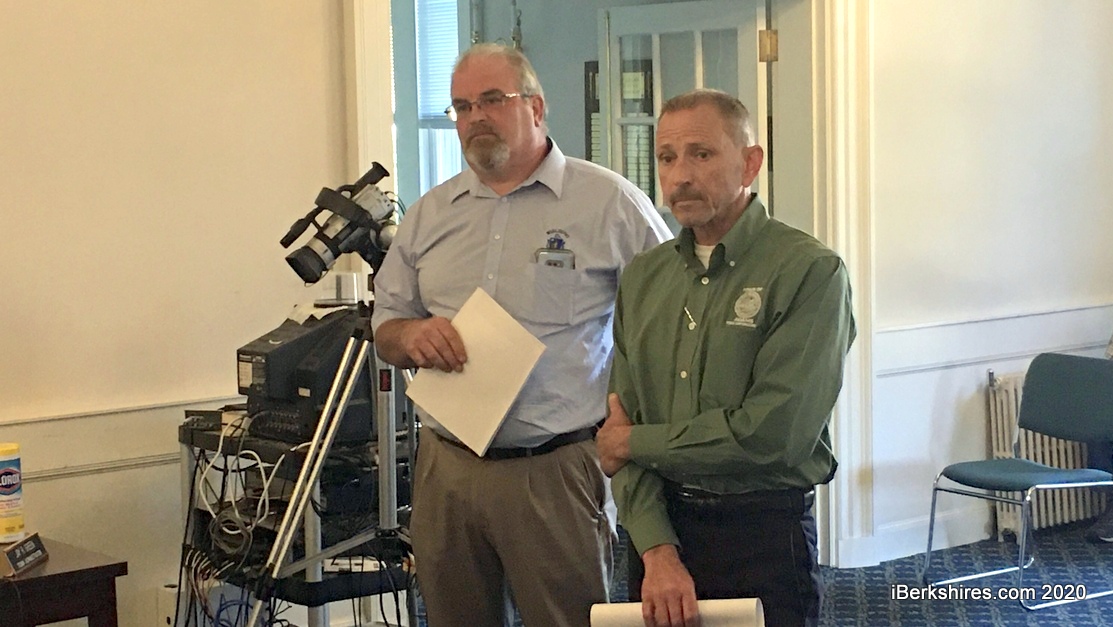
Building Commissioner Gerald Garner and Code Enforcement Officer Mark Blaisdell helped craft an application to streamline the reopening process for Adams restaurants.
ADAMS, Mass. — The state's Phase 2 reopening on Monday includes provisions for restaurants to begin outdoor dining. 
 
Restaurants have been limited to take out and delivery since the onset of the COVID-19 pandemic in March. The reopening plan is great news for an industry that, according to the National Restaurant Association, lost a total of $80 billion in sales and over 5 million jobs in March and April alone because of the global pandemic.
 
It will not be as simple as sweeping the sidewalk and setting up tables however. As much as municipalities would like to facilitate the process and get credit card charges, not to mention local meals tax revenue, flowing again they must still follow several guidelines set forth by the state. There is also the local inspectional services department that has rules to be satisfied.
 
The Adams Board of Selectmen tackled all of this at Monday night's meeting.
 
"We put together this form with guidance from ... the governor's office, and the ABCC (Alcohol Beverage Control Commission). It asks for a diagram from the establishment as far as what their outside seating will look like. It's going to include measurements ... for capacity, any impediments to a public way, whether or not the outside seating will be on a public way. If it is on a public way they are going to have to have an insurance rider (to indemnify the town)," Code Enforcement Officer Mark Blaisdell told the board.
 
The form itself is a step in the right direction as Gov. Charlie Baker has granted power to the local licensing authorities to issue outdoor seating licenses and amendments to current liquor licenses to accommodate a rapid turnaround for restaurants to start serving outdoors. Decisions normally made by local zoning boards or at the state level are now being given leeway to be made locally by the town. 
 
"When the governor issued his order on Saturday he streamlined the process to allow for outdoor seating," Town Administrator Jay Green explained. "Normally an outdoor seating request ... is handled through the zoning office and the town will have a bylaw in place. We are not so equipped in the town of Adams. The legislature and governor's office knew this and the order specifically exempts, through Nov. 1, such a process.
 
"The reason why we're having this conversation this evening is because the executive order states that a ... town's chief executive officer, which in our case is the Board of Selectmen, has to just approve a simplified process to allow table seating outside. The form you have in front of you is only for outdoor seating, separate from alcohol."
 
Green made it clear that any restaurant that currently holds an outdoor seating and alcohol serving license and that meets current social distancing guidelines set forth by the state could open as of Monday. If an establishment wishes to expand its current outdoor serving footprint or create one from scratch, Green said that is where the town gets involved and explained the process. 
 
"A restaurant will contact inspectional services, [Building Commissioner Gerald Garner] and Mark will go out, they'll look at what the desired premises are, the details the business owners pitch. They will look at it from a safety lens, from an ADA compliance lens ... also through the sanitation lens," he said. "Mark and Gerry will look at it through their two respective code enforcement areas ... then make the recommendation back to approve or not and essentially approve it right then and there."
 
Green said it was the most streamlined they could make it in a way that would also balance safety and allow an eatery to do what it needed from a business model.
 
Serving alcohol outdoors under the current executive order also gets a bit confusing. An establishment that currently holds a license to serve alcohol outdoors may begin doing so but still must adhere to thhe safety guidelines (maintaining a 6 foot distance from the public, partitions, safe restroom access, among others). 
 
Eateries that hold a liquor license but currently cannot serve outside may apply for the right to do so. Normally this process takes several months as, upon approval by the local authority, it has to go for a final review and approval by the state's ABCC. Under the new streamlined process, should the town grant the change to a liquor license, it must merely inform the ABCC of its ruling. The amendment will be temporary and will expire Nov. 1. Any establishment that currently does not hold a liquor license does not qualify for any of the temporary changes and must go through the normal application process.
 
One of the major hurdles in reopening and specifically serving alcohol outside will be maintaining a 6-foot buffer between patrons themselves and also the public. Maintaining a 3-foot sidewalk path for pedestrians will also be an impediment for cafe-style dining. A quick walk down any of Adams' streets and it's apparent that a table of any reasonable size will encroach on that distance.
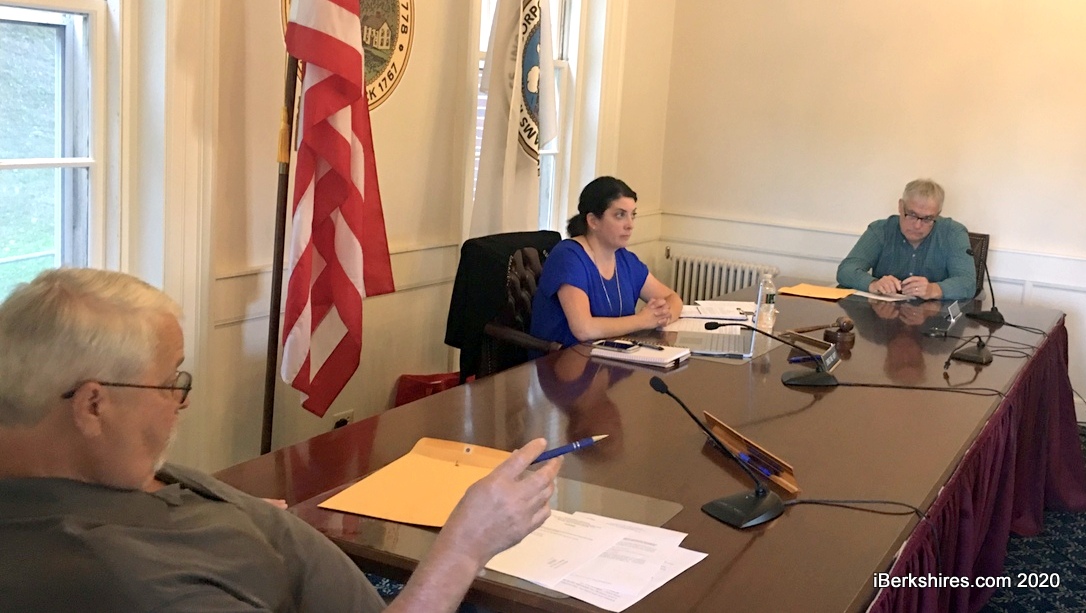
 

Selectmen James Bush, Christine Hoyt, and John Duval discuss the town's Phase II reopening.
Despite the challenges, several restaurants have already begun preparing for phase II as power washers, paint cans, and brooms were a familiar site around Adams this past week. One local, longtime restaurateur said he is obviously looking forward to the additional income but the reopening holds deeper benefits as well.
 
"Not only do we want to get back to normal business, outdoor dining is the only way we can do it right now. Not only for the success of the restaurant and all of the employees but we actually miss all of our customers," said David Nichols of Bounti-fare. "Some of whom have become very good and close friends. It's almost going to be like a reunion this week." 
 
When asked by Selectman John Duval about the projected turnaround time for this process, Blaisdell didn't hesitate with his response.
 
"A matter of hours. More than likely [if called] we will be out that day and then our approval by the end of that day and then Jay's office for a final sign off for issuance the next day," he said.
 
 Deb Dunlap, the administrative assistant for the town administrator, stepped up and requested that the fee for the amended licenses be waived. Normally the cost to change a liquor license is $100.
 
"I'm asking for consideration from the board to think about whether we can waive the fees," she said. "Right now these businesses have not been able to bring in money so is that a possibility?"
 
The board voted 5-0 in favor of waiving the fee.

Tags: COVID-19,   outdoor seating,   restaurants,   


More Coronavirus Updates

Keep up to date on the latest COVID-19 news:


If you would like to contribute information on this article, contact us at info@iberkshires.com.

Cheshire Debates Transfer Station Blue-Bag Abundance

By Breanna SteeleiBerkshires Staff

CHESHIRE, Mass. — The town is trying to remedy the transfer stations pay-as-you-throw model as the trash tonnage per permit is significantly higher than what it is supposed to be because of an abundance of blue bags last purchased in 2021.

Resident Mary Ellen Baker brought up at a prior meeting that she saw on Facebook that the transfer station will be requiring extra stickers for the 33-gallon blue bags starting July 1.

The town had switched from color-coded bags to stickers four or five years ago; one sticker was good for an 11-gallon bag and three trash tags for 33-gallon bags. But the blue bags were still being accepted as one trash tag. 

"We paid for those blue bags in good faith, and it seems that those of us who do more composting, recycling, reusing are being penalized, because we don't bring as much down as those who used them up faster. So I really would like you to reconsider that," she said.

The board noted that it was not aware of the decision and brought it forth at their April 7 meeting.

At that meeting, Department of Public Works Director Corey McGrath gave the board comparable numbers from other towns based on their permits and tonnage reported in January from Casella Waste Management.

He said Adams has 500 permit holders and reported 13.12 tons of solid waste. Dalton has 600 permits and 22.8 tons, and Williamstown had 1,043 permits and reported 15 tons, noting it is a very strict pay-as-you-throw community.

He said Cheshire has 600 permits and reported 36.10 tons.

After compiling a list of permit holders, he found 39 percent of residents did not purchase tags with their permits because they had leftover tags from last year or blue bags. He was unsure how many blue bags there could be left over. The first three days of April, he counted how many blue bags were tossed.

"That's a total of 63 blue bags, which is also a total of 187 allowable 11-gallon trash bags. Right? You're allowed to put 33-gallon blue bag, that's three 11 [gallon] kitchen bags. So that's the allowable. So it's 187 kitchen bags on a blue bag that was included with a permit. So, our numbers are absolutely horrible, and we've adopted the pay-as-you-throw but we don't abide by it," he said.

Northern Berkshire Solid Waste Program Director Linda Cernik was able to give the history of the blue bags that stopped being sold in 2021.

"You started your pay-as-you-throw program in 1990, $80 per for the permit, 52 free bags, and it was still going on in 2006 so you've never stopped getting free bags. So you have multitudes of free bags out there," she said.

While the bags were not "free" they were discounted and residents have been getting bags for years, most recently through a package deal.

"It was cheaper if you bought it as a package. It was essentially a 50 percent discount. If you think about it, it's an incentive to buy it as a package. If you were a family, we would see it all the time. If you're a family that knew that you were going to go through more than 52 bags a year, or the equivalent bag tag amount, they would just buy it in one fell swoop and that was an additional $100," said Board of Health Chair Christopher Garner.

"So we would do the permit is $100, $150 for the permit and the year's worth of bags or tags. And if you needed more, you could buy them at that time or anytime in the future you could come down and spend another $100 and buy an additional year's worth of bags or now tags."

He also said since they never put an expiration date on the bags, they are just going to have to try and deal with that.

Some board members were shocked by the amount of blue bags still out in the community.

"I was always under the assumption that if you buy your sticker, you get 52 bags, one per week. That's what you're allowed. That's what we allow. How we've allowed it to get to this point is insane," said board member Raymond Killeen. "We haven't given out bags since 2021 and I understand there's a chance where you could have a few bags left over and carry them over, but we have gone so far where we still got the blue bags going on." 

Cernik also finds it hard to believe there are that many blue bags out there, but that people need to be more educated on diverting their waste into the many different programs at the transfer station.

It's suggested some are abusing the blue bags and stuffing them as much as they can in them.

Baker said she is worried about being penalized because she does recycle, donate, and compost, using not that many blue bags.

"You're a very rare case. Mary Ellen, I had somebody say to me, I have yellow stickers. And when I have my kitchen bag, I put one sticker on it, I take it down. But if I have five or six of them, I throw them in a blue bag," said Town Administrator Jennifer Morse. "People are jamming those blue bags, and they're abusing the system. And unfortunately, not everyone is doing what you guys are doing." 

Cernik said the station is losing grant money because of the program is not really a pay-as-you-throw anymore. Based on a point system the station gets when applying for grants, the transfer station only receives around $3,000, when it could have gotten around double. 

It was also suggested some of the employees let people throw bags without a sticker on them.

"Obviously there's still certain people that work there that enforce things that others don't, and that's an internal issue. But you know, aside from that, and we obviously have to do a better job. So with a deficit of $61,000.15, 100 households, that's $41 per household,"  said board member Michelle Francesconi, noting Cernik said it will go up next year. "So even a household that doesn't have anything to do with the transfer station, which is 900 households, and 900 households are paying $41 per household for trash to be discarded that they don't have anything to do with." 

The board members debated on how they should go about the change, whether to do an exchange program for the bags, have a set date where the bags are no longer allowed, and what costs they should set for permits, tags, and stickers.

It was repeatedly mentioned that people accurately reduce waste and increase recycling to save money.

"We have to get a handle on this, because in five years, I'm gonna be retired, but you guys are going to be paying, I don't even know … it's gonna be out of control. You won't be able to afford it," said Cernik. "I'm serious, it's $130 now we have a five- to three-year contract, and then you have to go up two years, and we'll renegotiate, and it's going to go up because the trucking, everything has to go to another state, because we don't have vehicles."

The board tabled the discussion to get more numbers on how much it waste disposal could cost and how much they should be pricing the permits, and how many tags must be on a 33-gallon bag as currently it is two (although the change in 2021 stated three).

View Full Story

More Adams Stories