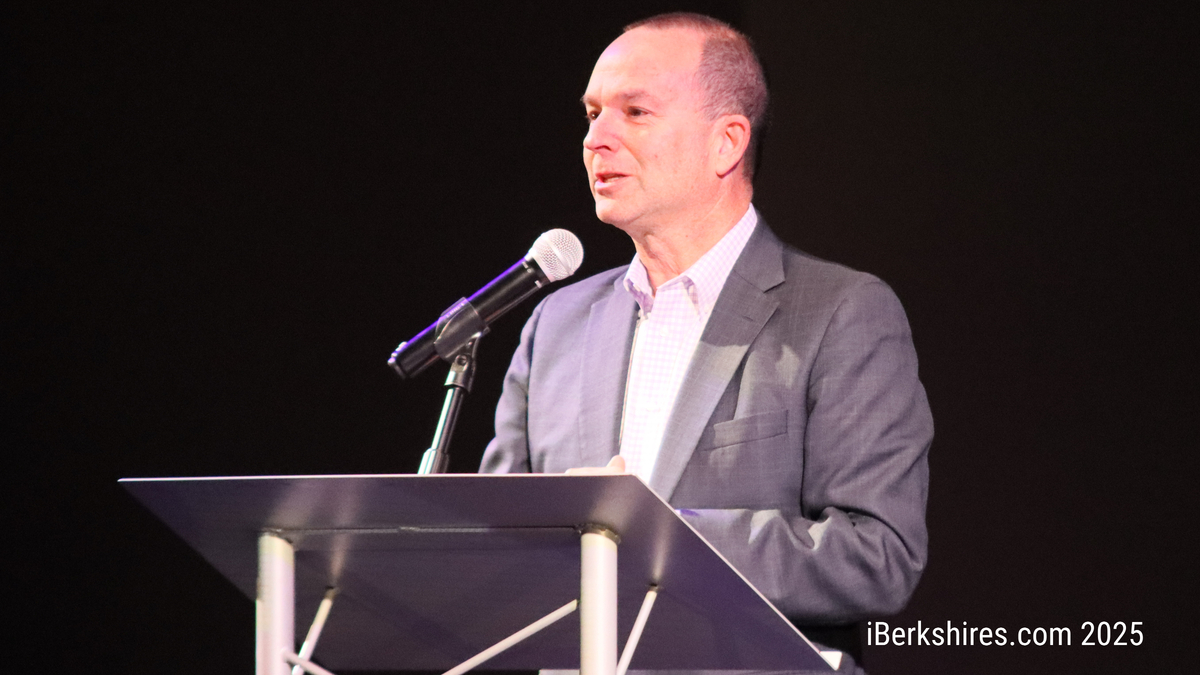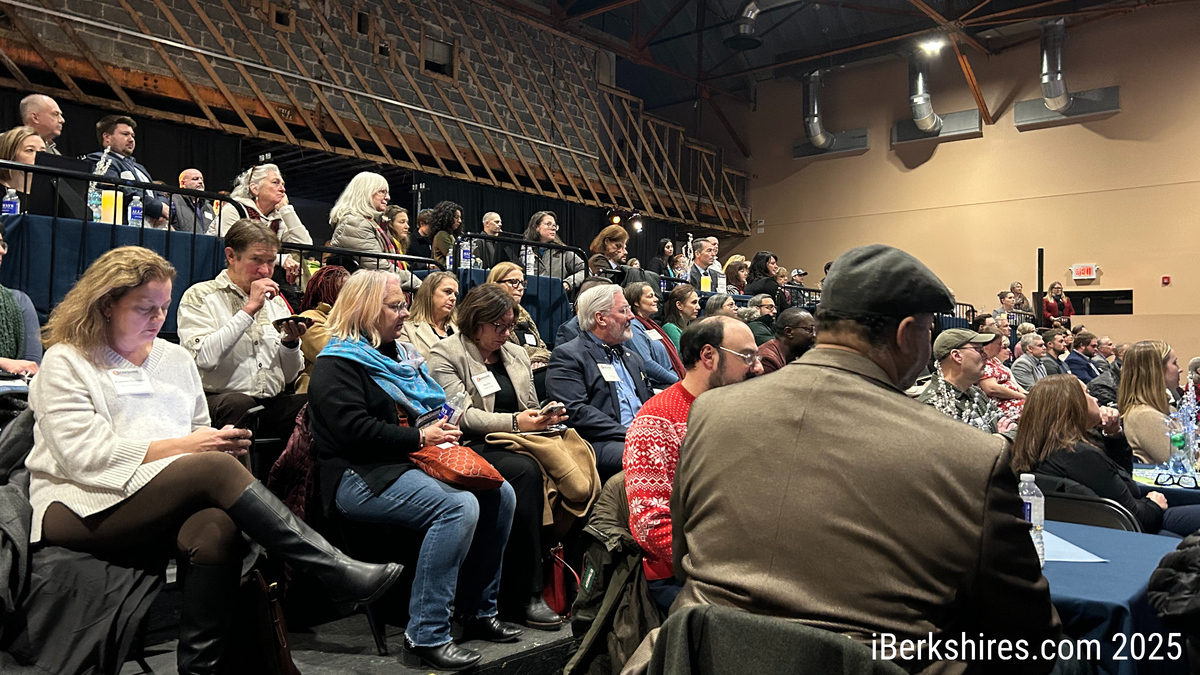
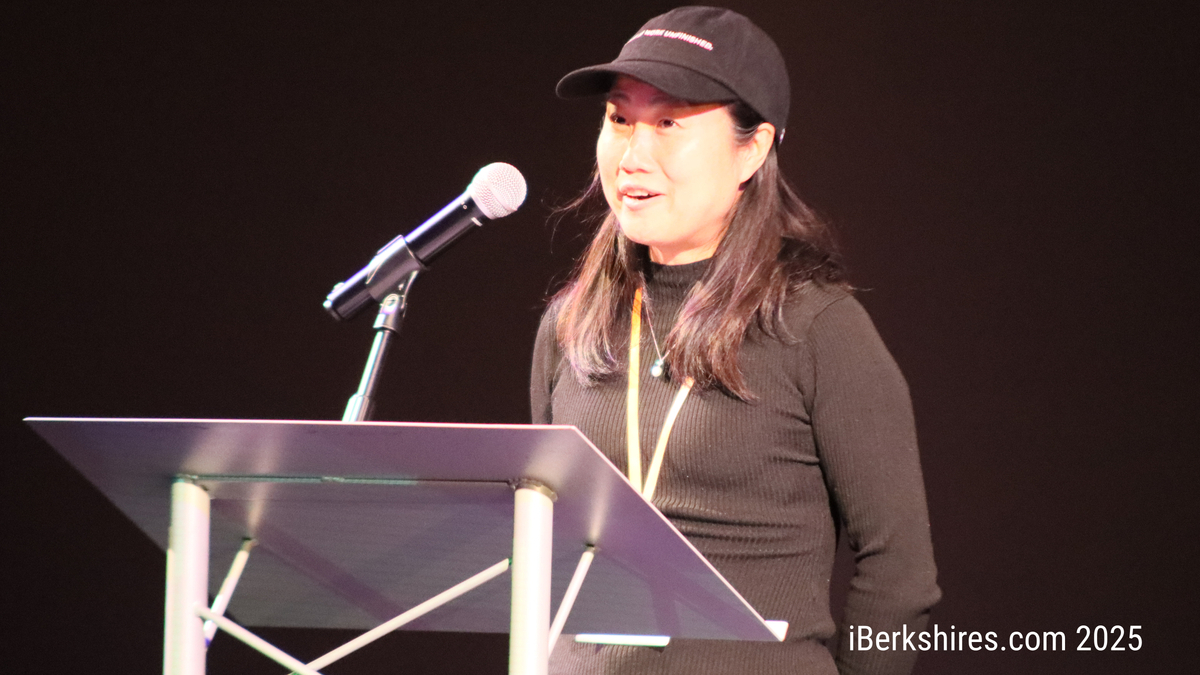
1Berkshire members attend Thursday's annual meeting of the business advocacy and promotion organization.Adams Theater founder Yina Moore welcomes attendees at Thursday's annual meeting of 1Berkshire.
Cheshire native JD Chesloff of the Massachusetts Business Roundtable delivers the keynote address on Thursday.
ADAMS, Mass. — One of the county's biggest employers and one of its newest small businesses were touted on Thursday at 1Berkshire's annual meeting at the Adams Theater.
The vice president of maritime and strategic systems strategy and business development at General Dynamics shared news of a major expansion at the Pittsfield plant.
"We plan to hire over 200 employees in Pittsfield over the next 12 to 14 months," Chris Montferret said. "Business is booming. And of those 200 employees, over 200 will be engineers."
Currently, General Dynamics employs more than 1,600 people in Pittsfield, up from a low of 500 in 1997, Montferret said, reminding the 1Berkshire membership of the importance of growth for an anchor like his firm.
"As you all know as employers, the multiplier of economic development when you bring a full-time employee in is amazing for the entire community," Montferret said.
1Berkshire is dedicated to advancing the local economy by advocating for and serving local businesses while helping attract visitors to the region.
The development organization's president and CEO used the annual meeting to talk about 1Berkshire's economic development team, which averages more than 100 consultations per year with local entrepreneurs — over 40 percent with businesses owned by women, members of minority groups or immigrants.
"Our economic development team wanted to highlight one feel-good story for us, and that's Red Shirt Farm," Jonathan Butler said. "For three years, we've been working with Jim and Sarah [Schultz] on their farm store project on Route 7 [in Lanesborough], helping kick off the project with an economic development site visit some years ago, giving direct technical assistance, helping with crowd funding and planning and execution.
"And after three years, Red Shirt officially opened its farm store this summer. It's a testament to the often long runway it takes for meaningful success in the small-business world. But we're proud to have been a part of that."
The meeting itself was held in another 1Berkshire success story.
Yina Moore, the founder and artistic director of the Adams Theater and now a member of the 1Berkshire board, told her fellow members about the role that the organization had in the success of her enterprise.
"I'm very grateful to the technical, marketing and networking assistance that the 1Berkshire team has added to my various projects throughout the years," Moore said.
"In the summer of 2021, 1Berkshire held an entrepreneurial meetup meeting right here, inside the Adams Theater, on this stage. At that time, the building had no lobby, no plumbing, no walls — just a concrete slab and a few chairs and a group of people willing to imagine what might be possible down the road."
Today, the Adams Theater is a "vibrant cultural and community hub" hosting nearly 50 events and performing arts residencies and bringing nearly 5,000 visitors to downtown Adams in 2025, Moore said.
One of those visitors was Cheshire native JD Chesloff, now the president and chief executive officer of the Boston-based Massachusetts Business Roundtable.
Chesloff was the keynote speaker at Thursday's meeting and shared that he last set foot in the building that houses the Adams Theater when it was a Hallmark store in the 1980s.
He complimented Moore and her team on transforming not just the building but the town and the region.
But his 15-minute talk gave a decidedly mixed assessment about the state of the economy in the commonwealth.
While Massachusetts still ranks second only to New York in gross domestic product per capita ($89,000 in 2024), it ranks 42nd in the U.S. in GDP growth between 2022 and 2024 (1.3 percent), according to a Business Roundtable analysis.
And while the Bay State continues to be a national leader in areas like education, health care and innovation, it "faces strong headwinds to retain businesses given cost of living and doing business," Chesloff's organization reported.
"When I talk to our members and ask them, 'How are you doing? What are you thinking,' these are some of the quotes I've heard: 'Nothing makes any sense,' … 'Chaos is becoming the norm,' 'Uncertainty is everywhere,' and, 'We're heading off an economic cliff,' " Chesloff said.
"There's a lot of concern out there."
The business group's survey of business owners found that from 2021 to 2025, concerns about "cost of living" and "cost of doing business" have emerged as the leading challenges to keeping those businesses in Massachusetts, Chesloff reported.
In 2025, 74 percent of business owners said housing costs negatively impact their efforts at hiring and retention of employees.
That said, Chesloff offered four steps that business people, including 1Berkshire's more than 700 members, can take to improve their own chances for success and the business climate in Massachusetts: seek out new partnerships and collaborations; engage in policy conversations; invest in workforce and digital capacity; and stay focused on value proposition and mission.
"Honestly, policy makers don't want to hear from me," Chesloff said. "They want to hear from folks like you. They want to hear from folks on the ground who are impacted by their decisions. If there are folks here who are not part of 1Berkshire, join 1Berkshire. That's what they do. If you are a member, go find friends to join 1Berkshire.
"It's super important right now for us to be engaging with public leaders on policy."
If you would like to contribute information on this article, contact us at info@iberkshires.com.
Your Comments
iBerkshires.com welcomes critical, respectful dialogue. Name-calling, personal attacks, libel, slander or foul language is not allowed. All comments are reviewed before posting and will be deleted or edited as necessary.
No Comments
Cheshire Debates Transfer Station Blue-Bag Abundance
By Breanna SteeleiBerkshires Staff
CHESHIRE, Mass. — The town is trying to remedy the transfer stations pay-as-you-throw model as the trash tonnage per permit is significantly higher than what it is supposed to be because of an abundance of blue bags last purchased in 2021.
Resident Mary Ellen Baker brought up at a prior meeting that she saw on Facebook that the transfer station will be requiring extra stickers for the 33-gallon blue bags starting July 1.
The town had switched from color-coded bags to stickers four or five years ago; one sticker was good for an 11-gallon bag and three trash tags for 33-gallon bags. But the blue bags were still being accepted as one trash tag.
"We paid for those blue bags in good faith, and it seems that those of us who do more composting, recycling, reusing are being penalized, because we don't bring as much down as those who used them up faster. So I really would like you to reconsider that," she said.
The board noted that it was not aware of the decision and brought it forth at their April 7 meeting.
At that meeting, Department of Public Works Director Corey McGrath gave the board comparable numbers from other towns based on their permits and tonnage reported in January from Casella Waste Management.
He said Adams has 500 permit holders and reported 13.12 tons of solid waste. Dalton has 600 permits and 22.8 tons, and Williamstown had 1,043 permits and reported 15 tons, noting it is a very strict pay-as-you-throw community.
He said Cheshire has 600 permits and reported 36.10 tons.
After compiling a list of permit holders, he found 39 percent of residents did not purchase tags with their permits because they had leftover tags from last year or blue bags. He was unsure how many blue bags there could be left over. The first three days of April, he counted how many blue bags were tossed.
"That's a total of 63 blue bags, which is also a total of 187 allowable 11-gallon trash bags. Right? You're allowed to put 33-gallon blue bag, that's three 11 [gallon] kitchen bags. So that's the allowable. So it's 187 kitchen bags on a blue bag that was included with a permit. So, our numbers are absolutely horrible, and we've adopted the pay-as-you-throw but we don't abide by it," he said.
Northern Berkshire Solid Waste Program Director Linda Cernik was able to give the history of the blue bags that stopped being sold in 2021.
"You started your pay-as-you-throw program in 1990, $80 per for the permit, 52 free bags, and it was still going on in 2006 so you've never stopped getting free bags. So you have multitudes of free bags out there," she said.
While the bags were not "free" they were discounted and residents have been getting bags for years, most recently through a package deal.
"It was cheaper if you bought it as a package. It was essentially a 50 percent discount. If you think about it, it's an incentive to buy it as a package. If you were a family, we would see it all the time. If you're a family that knew that you were going to go through more than 52 bags a year, or the equivalent bag tag amount, they would just buy it in one fell swoop and that was an additional $100," said Board of Health Chair Christopher Garner.
"So we would do the permit is $100, $150 for the permit and the year's worth of bags or tags. And if you needed more, you could buy them at that time or anytime in the future you could come down and spend another $100 and buy an additional year's worth of bags or now tags."
He also said since they never put an expiration date on the bags, they are just going to have to try and deal with that.
Some board members were shocked by the amount of blue bags still out in the community.
"I was always under the assumption that if you buy your sticker, you get 52 bags, one per week. That's what you're allowed. That's what we allow. How we've allowed it to get to this point is insane," said board member Raymond Killeen. "We haven't given out bags since 2021 and I understand there's a chance where you could have a few bags left over and carry them over, but we have gone so far where we still got the blue bags going on."
Cernik also finds it hard to believe there are that many blue bags out there, but that people need to be more educated on diverting their waste into the many different programs at the transfer station.
It's suggested some are abusing the blue bags and stuffing them as much as they can in them.
Baker said she is worried about being penalized because she does recycle, donate, and compost, using not that many blue bags.
"You're a very rare case. Mary Ellen, I had somebody say to me, I have yellow stickers. And when I have my kitchen bag, I put one sticker on it, I take it down. But if I have five or six of them, I throw them in a blue bag," said Town Administrator Jennifer Morse. "People are jamming those blue bags, and they're abusing the system. And unfortunately, not everyone is doing what you guys are doing."
Cernik said the station is losing grant money because of the program is not really a pay-as-you-throw anymore. Based on a point system the station gets when applying for grants, the transfer station only receives around $3,000, when it could have gotten around double.
It was also suggested some of the employees let people throw bags without a sticker on them.
"Obviously there's still certain people that work there that enforce things that others don't, and that's an internal issue. But you know, aside from that, and we obviously have to do a better job. So with a deficit of $61,000.15, 100 households, that's $41 per household," said board member Michelle Francesconi, noting Cernik said it will go up next year. "So even a household that doesn't have anything to do with the transfer station, which is 900 households, and 900 households are paying $41 per household for trash to be discarded that they don't have anything to do with."
The board members debated on how they should go about the change, whether to do an exchange program for the bags, have a set date where the bags are no longer allowed, and what costs they should set for permits, tags, and stickers.
It was repeatedly mentioned that people accurately reduce waste and increase recycling to save money.
"We have to get a handle on this, because in five years, I'm gonna be retired, but you guys are going to be paying, I don't even know … it's gonna be out of control. You won't be able to afford it," said Cernik. "I'm serious, it's $130 now we have a five- to three-year contract, and then you have to go up two years, and we'll renegotiate, and it's going to go up because the trucking, everything has to go to another state, because we don't have vehicles."
The board tabled the discussion to get more numbers on how much it waste disposal could cost and how much they should be pricing the permits, and how many tags must be on a 33-gallon bag as currently it is two (although the change in 2021 stated three).
The town is trying to remedy the transfer stations pay-as-you-throw model as the trash tonnage per permit is significantly higher than what it is supposed to be because of an abundance of blue bags last purchased in 2021. click for more
Like many public safety organizations in the Berkshires, the Adams Fire District is looking for ways to address its building's deteriorating condition.
click for more
The building is a total loss but firefighters were able to prevent the flames from reaching another nearby barn and the house at Stoney Brook Farm. click for more
The town is preparing to submit an application for Community Block Grant Funds following the designation of its blighted area on Route 8. click for more
The Board of Selectmen last week approved the closures of the street between Pleasant and Dean Streets from Wednesday through Saturday, April 1 to 4, to allow for the Crewdson's production company to set up for his complex and intricate shots. click for more