Mount Greylock Committee Member Pushes Back on Talk of Reduced School Capacity
WILLIAMSTOWN, Mass. — A member of the Mount Greylock Regional School Committee on Thursday called for more local control over how schools reopen in the fall.
Steven Miller suggested during the committee's monthly meeting that the district ask the commonwealth to allow school districts to decide for themselves whether they can safely hold classes for all students in the school building or consider some sort of hybrid model that incorporates remote learning while reducing capacity for the buildings.
"I think we do really want to consider what the data is saying about the coronavirus, what is its effect on children, what is the effect of remote learning what do we want to advocate for at the State House and what kind of plans we want to make for the fall," Miller said.
The commissioner of education has signaled that school districts next week will receive more guidance about how schools can reopen. In the meantime, the Department of Elementary and Secondary Education has asked districts to begin contingency planning for different models that could be implemented, including hybrid models that would have students spending some days in school and some at home engaged in remote learning, as they have this spring.
Miller pointed to the fact that the guidance is expected the week of June 15 as a reason for the School Committee to take action.
"Hopefully, we'll know more next week as to what's coming," he said. "But that also doesn't give us a tremendous of time before then to try to provide our input as to -- are we going for a one solution, one-size-fits-all commonwealth or are we going to say that a rural district that has not had as many [COVID-19] cases maybe would have a back to school different plan than Boston.
"We should consider trying to advocate … all students coming back to classes and what that would entail."
No one on the committee joined Miller in making that call, but the district's assistant superintendent, Andrea Wadsworth, noted that like panels have a voice in the commonwealth's conversations about reopening through the Massachusetts Association of School Committees. Wadsworth, who serves on the Lee School Committee, happens to be the Berkshire County representative on the MASC board, told Miller she would talk to him after Thursday's meeting to get his thoughts.
Though no one on the School Committee joined Miller in his call, he was able to point to input from one district parent who submitted a written comment for the committee prior to Thursday's meeting.
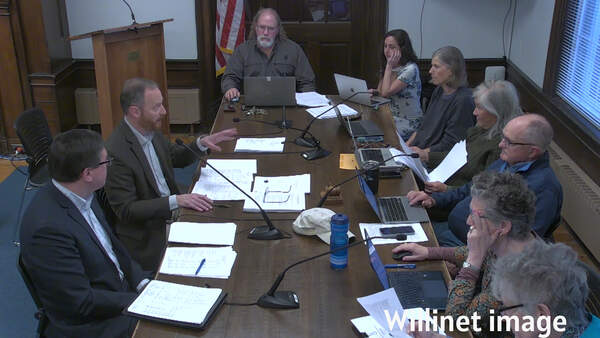
Chair Christina Conry read into the record a letter from Williamstown's Brian Drake, one of seven correspondents who sent public comments for Thursday's virtual meeting.
Drake called the commonwealth's initial guidance on fall learning plans "unacceptable."
"Williamstown is not a metropolitan or even suburban area," Drake wrote. "We are fortunate to live in a place with very few cases, and should be an advantage for this committee to take a leadership role in seeking to get our kids a better education and childhood.
"We, of course, need to be thoughtful to all those with underlying conditions and also to those who are afraid to come out of their homes. However, we need to be thoughtful to the population that would like to get back to living with little fear of a disease that, in all likelihood, would not impact us at all. It is simply unrealistic to live in a society where no one gets sick, yet that is the message we're sending.
"It is OK for people to get sick. We cannot prevent that, and I don't think any of us want to live in a permanent bubble."
Miller, who has shared a petition titled "No Social Distancing or Masks for Massachusetts Schools" on his Facebook page, referred to Drake's letter later in the meeting.
"There are plenty of unknowns, but one of the things we have observed right now is that there is a tremendous cost to what we're doing," Miller said, referring to school closures. "To me, as a mathematician, it's a cost-benefit analysis. What are the costs of having a lockdown versus not having a lockdown? What are the costs to doing the remote learning versus bringing students back? What would be the cost to having some of the students come in where you … keep the classrooms at a minimum?
"Unfortunately, there's no solution that will get us everything we want and still be perfectly safe. The expression I've been using is: ‘A ship is safe in harbor, but that's not the purpose of a ship.' At some point, life has risks, and we have to decide what level of risk is acceptable. What are the benefits of going forward and what are the costs?"
In other business on Thursday, the School Committee for nearly an hour discussed how it plans to move forward with the question of whether to make improvements to Mount Greylock's athletic fields, including a proposed synthetic turf field. The discussion followed an hour-long meeting of the committee's Finance Subcommittee, which decided to recommend that the full committee create an advisory group to collect the data that has been acquired by the district and answer any remaining questions in order to inform a decision to be made in the fall.
After assessing that at least four members of the seven-person committee favored that path, Conry referred the matter back to the Finance Committee to create a formal proposal for the advisory group, with names, that can be presented to the School Committee in the near future. Conry (cconry@mgrhs.org) and the Finance Subcommittee's Carolyn Greene (cgreene@mgrhs.org) are the contact people for anyone interested in volunteering for or consulting with the advisory group.
The School Committee Thursday did not discuss agenda items titled "Non Renewals'" and "Reduction in force" because the district does not need to look at making staff cuts at this time.
Superintendent Kimberley Grady Friday explained that the items were on Thursday's agenda because the committee would have needed to have a public conversation about the issue if the district needed to take those steps "by June 15th for non renewal or mid-August for RIFs."
Grady said that due to other cost savings identified by the administration and the availability of reserve funds at the School Committee's disposal, the Mount Greylock district does not need to follow the footsteps of neighboring districts in North Adams, Pittsfield and Hoosac Valley and send non-renewal notices to staff.
Grady this week sent an email to staff that addressed the fiscal crisis confronting public schools throughout the commonwealth due to the COVID-19 pandemic.
"I want to first let you know there will not be any non renewals issued on June 15th," she wrote. "The admin team and I are working hard to find other areas within the budget to cut before any current staffing levels would be reduced.
"As you all may know, the state budgets have not been set so we do not know the impact on the FY 21 budget at its entirety. We do know we have a few plans before we have to start getting extremely worried."
Tags: MGRSD,