'The Great Gatsby': Class Distinction by the Book
I wish that I were reviewing one of the half-dozen movies certain to be made when this pox upon our house is no more. But until that glorious return to normality has us resuming all the simple joys of life we take for granted, like going to the movies, I'll be retro-reviewing and thereby sharing with you the films that I've come to treasure over the years, most of which can probably be retrieved from one of the movie streaming services. It is my fondest hope that I've barely put a dent into this trove when they let the likes of me back into the Bijou.
…………………………………………………………………………………………………
I read a book a week for decades, and then I stopped.
For one, I began to fall asleep. Reason two, I'd read a book and say, "I could write this." And reason three, I'd be reading a book and realize with jealous reverence, "I could never write something this good." F. Scott Fitzgerald's "The Great Gatsby," adapted to the screen by Francis Ford Coppola and directed by Jack Clayton in 1974, fits the last category in spades.
There are movies like either of the first two Godfathers, or even the inimitable "Casablanca" (1942), that contain memorable lines we love to quote. But in Fitzgerald's brilliantly perceptive upbraiding of the Roaring '20s there are hauntingly beautiful passages that only he could have written. It's not just that they are poetry, but more so that the lilting missives of pure truth tap into that portion of literature's DNA that dissects and decodes the historical period from which they emanate.
Everyone in "The Great Gatsby" is of their time, proof positive and point of reference for anyone who cares to peer into the ebullience of the post WWI, Prohibition era of glitzy presumptiveness, and what Fitzgerald declaimed, through narrator Nick Carraway, as careless.
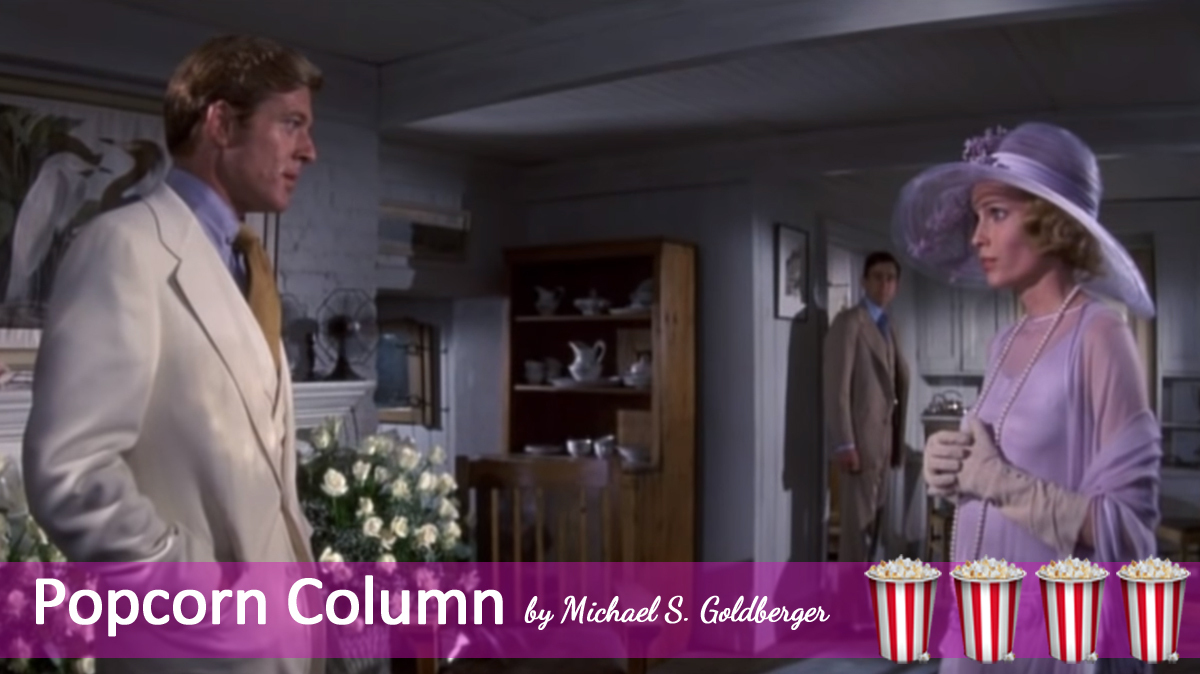
When the film, starring Robert Redford in the title role and Mia Farrow as Daisy Buchanan, the devastatingly rich symbol of dauntingly inaccessible social strata, was released, I bought in, hook, line and white pants. I still refer to some of my closer compatriots as Old Sport. You see, the world of affluence on Long Island where the mysterious Jay Gatsby has bought an estate to be right next door to his loving obsession, now married, brings out the desire to pretend.
It isn't enough to just intuitively show up at one the enigmatic Gatsby's spontaneous soirees where anyone who is anyone is in attendance and the host never makes an appearance. The idea is to be a part of whatever elegantly cryptic thing is at play in and around the display of blindly flagrant ostentation, to swap scandalous tidbits about their unseen host, and imbibe in a little golden calf worship.
When Sam Waterston's perfectly played Nick, narrator, bond trader and cousin of Daisy, takes up residence in a carriage house that just happens to abut the Gatsby and Buchanan manors, he becomes a confidante, and early on quizzically announces, "They say you killed a man."
"Just one?" asks Redford's impeccably coiffed protagonist, his smile a blast of sunshine.
Thus, we are in on the gambit and, through a skillfully woven exposition that hints at what Gatsby may or may not be, are given the opportunity to decide how we feel about him, and the truth be damned. Intrinsic to the process, our moral values are given a run for their money, twisted here and there, and beseeched to grant dispensation in the name of undying love.
But of course, in what might be termed the class-conscious variation on the Romeo & Juliet theme, the story's silent player, wreaking its havoc with the subtlety of fingernails on a blackboard, is the unholy trinity of ancestry, breeding and legacy wealth.
Gatsby knows this only too well, having informed his entire construction of self with the aim of penetrating the very fortress that has been built to keep out interlopers. And Daisy? "Her voice is full of money," says Gatsby.
This is the conjectural stuff deserving of exquisitely conducted college seminars. But if you need to boil it all down because you're in a hurry and don't want to get into the whole F. Scott and Zelda, gossipy ruminations, of which there are more than enough to go around, I like the quote by Mischa Auer's Carlo, the phony protégé sponger in "My Man Godfrey" (1936).
Imparting the screwball comedy take on class distinction, Carlo at one distressed moment cries out, "Oh, money, money, money! The Frankenstein monster that destroys souls!"
Or, to quote my rich sister Anne, "It's always about money, especially if they say it's not about money."
Nonetheless, most of us being equipped with the hopeless romantic gene as well as either the inclination to activate it or the determination to suppress it, the built-in dilemma of Gatsby's love for Daisy makes for great drama. And you in the back, frantically raising your hand, yes, maybe it's actually the idea of Daisy that Gatsby loves. But then, this is a film criticism and not that college seminar.
But I have to come clean. While Macy's doesn't tell Gimbel's, except in the case of "Miracle on 34th Street" (1947), I'll add to the exception by informing that many of my colleagues aren't as enthusiastic about the 1974 Gatsby as I am. However, I've mulled it and, after reasonable contemplation of the second-guessing kind, have decided that, quite simply, they are plumb wrong.
Granted, it's a tad long at nearly two and a half hours. A fast reader could knock out the 180-page paperback in the course of a lazy afternoon. But that's just it. Filled with Nick's beautifully fatalistic, word-for-word narration and the sympathetically enunciated reveries from Redford and Farrow's devotedly etched principals, it is practically the book, but on film. That director Clayton endowed the literature with breathtaking art direction and Nelson Riddle's Oscar-winning compilation of period-evoking music, but resisted the pretension to gild the lily, is why "The Great Gatsby" is great.
"The Great Gatsby," rated PG, is a Paramount Pictures release directed by Jack Clayton and stars Mia Farrow, Robert Redford and Sam Waterston. Running time: 144 minutes
Tags: movie review,