image description

State Offers Testing in Agawam, Springfield as COVID-19 Rate Inches Up

By Stephen DravisiBerkshires Staff
Print Story | Email Story
BOSTON — A reported outbreak of COVID-19 at Springfield's Baystate Health coincided Monday with the commonwealth's plans to provide free testing to asymptomatic residents in two Western Massachusetts communities.
 
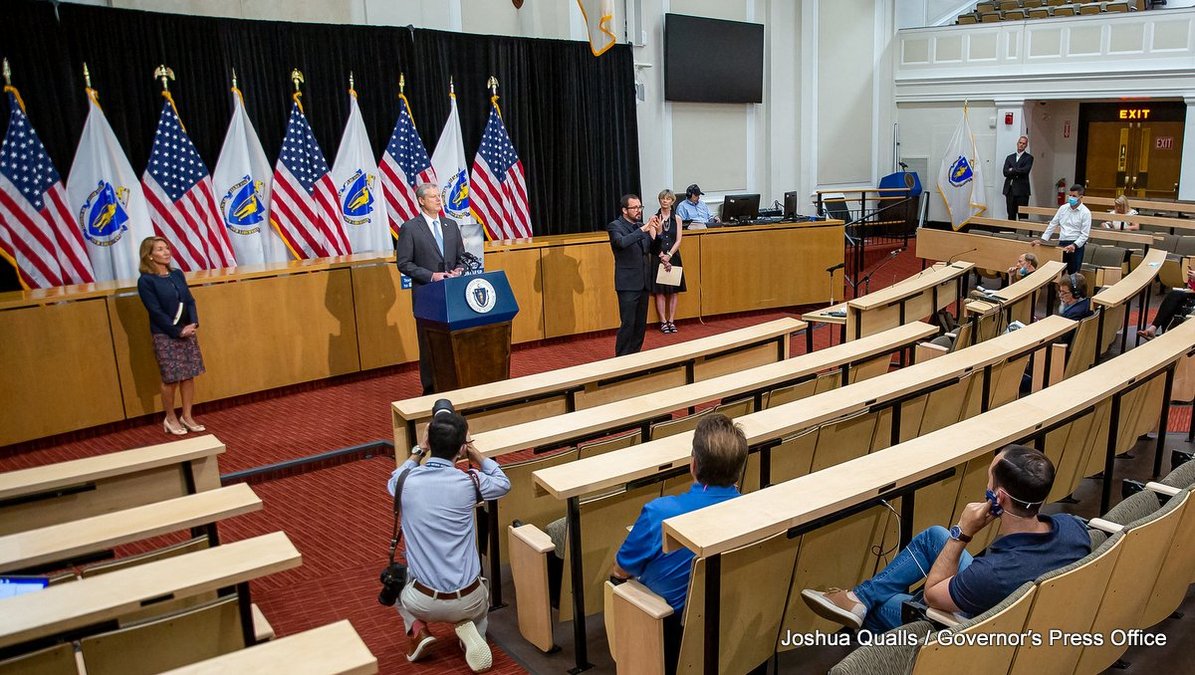
On Monday afternoon, Gov. Charlie Baker announced that Springfield and Agawam are among eight sites chosen for the next round of "Stop the Spread" testing, which aims to provide expanded testing in communities where postiive test rates are among the state average and testing volume has fallen off.
 
Monday morning, the CEO of Baystate Health reported that an outbreak of infections of the novel coronavirus has affected 23 employees and 13 patients of the Springfield institution, though Dr. Mark Keroack declined to identify which units of Baystate were affected, according to the Springfield Republican.
 
Baker addressed the Baystate Health outbreak during his daily press availability.
 
"There's recent information about an employee at Baystate [Health] who went to a hotspot state, came back and was lax with respect to wearing a mask," Baker said. "And there are now a number of people who work at Baystate and a couple of patients who were there, as well, who tested positive."
 
Keroack told the Republican in a story posted on its website, Masslive.com, that prior to the recent outbreak, there were no documented cases of COVID-19 transmissions between patients and employees at the hospital.
 
Baker used the Baystate incident and a widely reported cluster on Cape Cod linked to a house party to again emphasize the importance of remaining vigilant in the fight against the pandemic.
 
"We can also assume that there's simply a lot more mobility out there, some of it the result of the economic activity associated with opening up some of our commonwealth's businesses and employers, but some of it's also just people being out and about," Baker said. "It's warm out, and people, generally speaking, are in contact with other people more than they were in the months of April and May and even June.
 
"We should all remember where we were when we started this reopening program in May. We were seeing positive test rates north of 10 percent on much fewer tests. That's why we can't say enough about how important it is, and until we have a vaccine, that everybody continue to play their role. When we let our guard down, the virus will make gains."
 
Statewide, the positive test rate remains below 2 percent, though the seven-day average nudged up slightly on Sunday to 1.9 percent after hovering around 1.7 or 1.8 percent last week.
 
 
The positive test rate was even higher, 2.3 percent, in the eight communities chosen for the second round of the state's Stop the Spread testing program.
 
That initiative began on July 10 and is expected to run through mid-August in communities in eight communities eastern Massachusetts.
 
On Monday, Baker announced that it will expand to Agawam and Springfield as well as Worcester, Brockton, Methuen, Randolph, Revere and Taunton.
 
"These eight communities make up approximately 10 percent of the population but constitute 15 percent of the commonwealth's positive tests in the past week," Baker said.
 
Baker was asked Monday to react to a tweet from the president of the Massachusetts Medical Society, who pointed to a recent rise in positive test results in the commonwealth and suggested rolling back the administration's stages to reopen the economy.
 
"The data is early, but it looks like we are on the way back up," Dr. David Rosman wrote. "We should consider backing down a phase."
 
Baker indicated it is too soon to take that step.
 
"At this point in time, the most important thing we need to do is to continue to do the things that got us here in the first place," Baker said, referring to guidance on social distancing, face covering and hygiene. "When we look at the where clusters are that have been created so far, many of them are the result of people simply not doing the things we've been telling everybody to do, which has a lot less to do with the nature of what's open and what's not open.
 
"I think, certainly, the public health data is going to drive our decision making. But, so far, most of the data we've seen about where the clusters have come from have a lot more to do with people letting down their guard a little bit than anything else. The Chatham thing was a big outdoor party in someone's backyard. The Baystate thing was somebody not really abiding by the mask guidance and criteria that existed in the hospital.
 
"Most of the time, when people do the right things, we should be successful in containing this."

Tags: COVID-19,   


More Coronavirus Updates
Keep up to date on the latest COVID-19 news:


If you would like to contribute information on this article, contact us at info@iberkshires.com.

Puppets Teach Resilience at Lanesborough Elementary School

By Breanna SteeleiBerkshires Staff

The kids learned from puppets Ollie and a hermit crab.

LANESBOROUGH, Mass. — Vermont Family Network's Puppets in Education visited the elementary school recently to teach kids about being resilient.

Puppets in Education has been engaging with young students with interactive puppets for 45 years.  

The group partnered again with Bedard Brothers Chevrolet, which sponsored the visit. 

Classes filtered through the music class Thursday to learn about how to be resilient and kind, deal with change and anxiety, and more.

"This program is this beautiful blending of other programs we have, which is our anxiety program, our bullying prevention and friendship program, but is teaching children the power of yet and how to be able to feel empowered and strong when times are challenging and tough," said program manager Sarah Vogelsang-Card.

The kids got to engage with a "bounce back" song, move around, and listen to a hermit crab deal with the change of needing a new shell.

"A crab that is too small or too big for its shell, so trying to problem solve, having a plan A, B and C, because it's a really tough time," Vogelsang-Card said. "It's like moving, it's like divorce of parents, it's changing schools. It's things that children would be going through, even on a day to day basis, that are just things they need to be resilient, that they feel strong and they feel empowered to be able to make these choices for themselves."

The resiliency program is new and formatted little differently to each of the age groups.

"For the older kids. We age it up a bit, so we talk about harassment and bullying and even setting the scene with the beach is a little bit different kind of language, something that they feel like they can buy into," she said. "For the younger kids, it's a little bit more playful, and we don't touch about harassment. We just talk about making friends and being kind. So that's where we're learning as we're growing this program, is to find the different kinds of messaging that's appropriate for each development level."

This programming affirms themes that are already being discussed in the elementary school, said school psychologist Christy Viall. She thinks this is a fun way for the children to continue learning. 

"We have programs here at the school called community building, and that's really good. So they go through all of these strategies already," she said. "But having that repetition is really important, and finding it in a different way, like the puppets coming in and sharing it with them is a fun way that they can really connect to, I think, and it might, get in a little more deeply for them.

Vogelsang-Card said its another space for them to be safe and discuss what's going on in their life. Some children are afraid because maybe their parents are getting divorced, or they're being bullied, but with the puppets, they might open up and disclose what's bothering them because they feel safe, even in a larger crowd. 

"When we do sexual abuse awareness that program alone, over five years, we had 87 disclosures of abuse that were followed up and reported," she said. "And children feel safe with the puppets. It makes them feel valued, heard, and we hope that in our short time that we're together, that they at least leave knowing that they're not alone."

Bedard Brothers also gave the school five new puppets to use. Viall said the puppets are a great help for the students in her classroom, especially in the younger grades. 

"Every year, I've been giving the puppets to the students. And I also have a few of the puppets in my classroom, and the students use them in small groups to practice out the strategies with each other, which is really helpful," she said. "Sometimes the older students, like sixth graders, will put on a puppet show. They'll come up with a whole theme and a whole little situation, and they'll act it out with the strategies for the younger students. It's really cute, they've done it with kindergarteners, and the kids really like it."

Vogelsang-Card said there are 130 schools in Vermont that are on the waiting list for them to come in. Lanesborough Elementary has been the only Massachusetts school they have visited, thanks to Bedard Brothers. 

"These programs are so critical and life-changing for children in such a short amount of time, and we are the only program in the United States that does what we do, which is create this content in this enjoyable, fun, engaging way with oftentimes difficult subjects," she said. "Vermont is our home base, but we would love to be able to bring this to more schools, and we can't do this without the support of community, business funders or donors, and it really makes a difference for children."

The fourth-grade students were the first class to engage with the puppets and a lot of them really connected with the show.

"I learned to never give-up and if you have to move houses, be nervous, but it still helps," said William Larios.

"I learned to always add the word 'yet' at the end," said Sierra Kellogg, because even if she can't do something now, she will be able to at some point.

Samuel Casucci was struck by what one of the puppets talked about. "He said some people make fun of him if he dresses different, come from different place, brings home lunch, it doesn't matter," Samuel continued. "We're all kind of the same. We're all kind of different, like we have different hairstyles, different clothes. We're all the same because we're all human."

"I learned how to be more positive about myself and like, say, I can't do this yet, it's positive and helpful," said Liam Flaherty.

The students got to take home stickers at the end of the day with contact information of the organization.

View Full Story

More Williamstown Stories