Mount Greylock Elementary Schools Have Capacity for Full Classrooms
Update: At 9:15 on Monday evening, Interim Superintendent Robert Putnam sent an email to the district's families inviting them to view one of two presentations he will give on Tuesday, July 28, about the re-opening plans he will be submitting to the Department of Elementary and Secondary Education. Those presentations will be aired virtually at noon and 7:30 p.m. on Tuesday.
WILLIAMSTOWN, Mass. — The Mount Greylock Regional School District has room to welcome all its students back to its two elementary schools with six feet between desks, the district's interim superintendent said on Thursday.
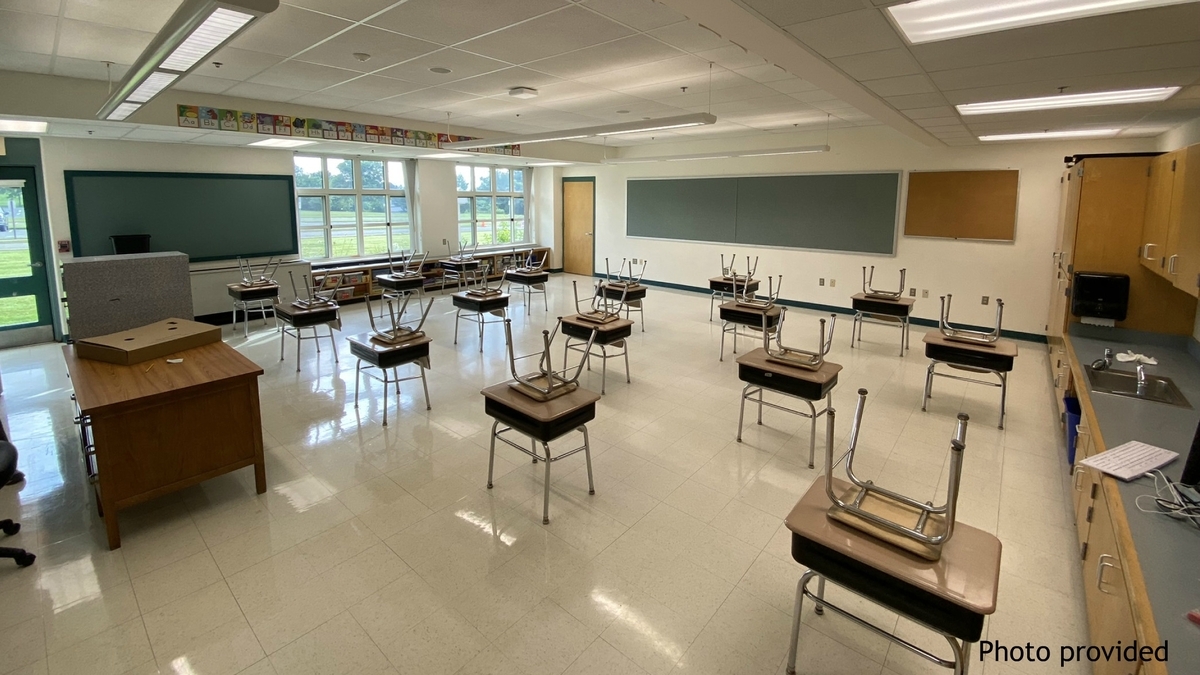
Addressing the School Committee's Education Subcommittee, Robert Putnam said the schools' classrooms have capacity for up to 16 student desks plus a teacher's desk while maintaining that social distancing standard.
Putnam expressed confidence about the ability of the elementary schools to absorb a full complement of students but indicated contingency planning still continues at the middle-high school.
"As you can see, there's a lot of room in these classrooms," Putnam said as the subcommittee reviewed photos of rooms set up to hold 16 students. "The administrative team has created maps to look at every option we've got. Both elementary schools — we can fit, with some modifications. In essence, there are some classes that are above the number we like.
"For example, the fourth grades in Lanesborough are 17 and 18 [pupils], so we'd have to deal with that. And the potential numbers in Williamstown, while the fifth-grade classes are at 17, all the other classes, fourth-grade down to pre-school, are all below 16. The sixth grade, there are three sixth-grade classes of 19, 20 and 20. … If we were going to put all students in school, we would most likely have to add a fourth sixth-grade classroom to maintain 6-foot distancing."
District staff this summer has been breaking down and reconfiguring classrooms to maximize the potential for social distancing.
Their efforts paid off at the two elementary schools, but results have been mixed at the middle-high school, Putnam and first-year Principal Jacob Schutz told the subcommittee.
"At Greylock, it's more doable for the middle school, based off of their schedule and the middle school model where they can move in a cohort," Schutz said. "But the movement of the high school students would severely restrict our ability to fit everyone in there.
"If you were just looking at square feet and how many desks fit in the rooms, we can fit about 16 seats in rooms, considering placing them 6 feet apart. But that doesn't take into consideration when students get up and walk down the aisle to use the bathroom or to leave or the sharpen a pencil.
"For the high school, it's looking like it would be very difficult to fit all students back into the building."
Schutz said he is waiting for the recommendation of the instructional working group to decide the implications of challenging high school infrastructure. The instructional group is one of a half-dozen task groups that include faculty, administrators, staff and community members.
"We're looking at what it would like remotely," Schutz said. "Like [Putnam] said, no matter what, there are going to be some people working remotely all the time. It doesn't look like fitting everyone in there is feasible, although physically possible. So we're looking at a variety of hybrid options. I really don't want to point any out yet because we have another meeting [Friday], and that group is looking to consolidate our analysis and thoughts to make one recommendation.
"I don't want to misrepresent or get any mixed messages out at this point."
The new principal at Williamstown Elementary School interrupted Thursday's discussion to note that the ability to squeeze all the children into the preK-6 school does not automatically signal that the district ought to go in that direction.
"Though it is physically possible for us to get all of the children into elementary schools, there are other considerations we need to make as far as the type of instruction that is being delivered for the students and the kind of staffing and scheduling that needs to be in place, especially at WES," Kristen Thompson said. "I think there needs to be a lot more consideration, especially when it comes to instruction and how we're delivering instruction.
"That may not be in a situation where we can have 100 percent of students back in class. Physically, can we do it? Absolutely. We've shown that we can. But should we do it is another question, especially when it comes to delivering instruction and the needs of students."
Thursday's Education Subcommittee was the latest opportunity for Putnam to give an interim report on the back-to-school plans being developed in the district in the face of the COVID-19 pandemic.
This Wednesday, Putnam is scheduled to share with the full School Committee what he is characterizing as a "feasibility study in regard to the requirement by the department of education to say whether we can get all students back in the building." Districts are required to submit those reports to the Department of Elementary and Secondary Education on Friday.
Two members of the community Thursday provided the subcommittee with differing perspectives on the risk-benefit analysis that school districts across the country are facing this summer.
Luana Maroja, an associate professor of biology at Williams College and parent in the district, argued that studies show transmission rates of the novel coronavirus are low among school-aged children and the outcomes of this spring's foray into remote learning models were disastrous for students in the commonwealth, particularly for under-achieving students and students from lower-income families.
Maroja said her top priority is the safety of students and teachers, and said that priority would be met by 3 feet of social distancing while allowing schools to provide proper, in-person instruction.
"I'm going to argue our risk is extremely low … because we live in an area that currently has incredibly low infection rates," Maorja said. "Massachusetts already is a place with low infection rates, and our county is particularly low. We are also very compliant in face mask using.
"We do have data from all over the world, and the data shows that schools are reopening with 1 meter distance, some of them 1 meter [about 3 feet] distance and no mask. Despite all of that, there hasn't been school outbreaks. It has been safe in Europe and Asia to open schools with 1 meter and no face mask."
Maroja cited high dropout rates in Boston that accompanied the closure of schools to in-person instruction in March and negative social impacts of children isolated in their homes. Maroja said there has been a "huge increase in depression rates and abuse in the household," and without in-person contact between students and school staff, the abuse is more likely to go undetected.
"I think a hybrid [instruction] system is way more dangerous than a system in which we physically distance students as much as possible with a minimum of 1 meter or 3 feet," Maroja said.
On the other hand, Williams psychology professor Amie Hane, another parent in the district, said that while she agreed with Maroja that in-person instruction is preferred, the jury is out on whether transmission rates are lower in the younger population.
"When it comes to transmission, we can't ignore that we finally have an epicenter that is testing a pediatric population, and that's Florida," Hane said. "New York did not. At that point for Wuhan [China], and for Italy and for New York City, children were sheltered in place and largely under-tested. We now have an epicenter where children are being tested, and children are pulling 30 percent on that test. That's children to the age of 18.
"The [Centers for Disease Control and Prevention] provides evidence that the rate of transmission … is on par with adult rates."
Toward the end of Thursday's meeting, in the chat section of the Zoom videoconference, Christina Conry, a member of the Education Subcommittee, posted a link to an article citing a South Korean study that found, "kids going to high school and middle school are likely to pass the virus amongst each other and then bring it home, even if they do not have any symptoms."
Tags: MGRSD, school reopening,
More Coronavirus Updates