'Being There': On the Square
I wish that I were reviewing one of the half-dozen movies certain to be made when this pox upon our house is no more. But until that glorious return to normality has us resuming all the simple joys of life we take for granted, like going to the movies, I'll be retro-reviewing and thereby sharing with you the films that I've come to treasure over the years, most of which can probably be retrieved from one of the movie streaming services. It is my fondest hope that I've barely put a dent into this trove when they let the likes of me back into the Bijou.
…………………………………………………………….............................................................
"It's for sure a white man's world in America. Look here: I raised that boy since he was the size of a piss-ant. And I'll say right now, he never learned to read and write. No, sir. Had no brains at all. Was stuffed with rice pudding between th' ears. Shortchanged by the Lord, and dumb as a jackass. Look at him now! Yes, sir, all you've gotta be is white in America, to get whatever you want. Gobbledygook!"
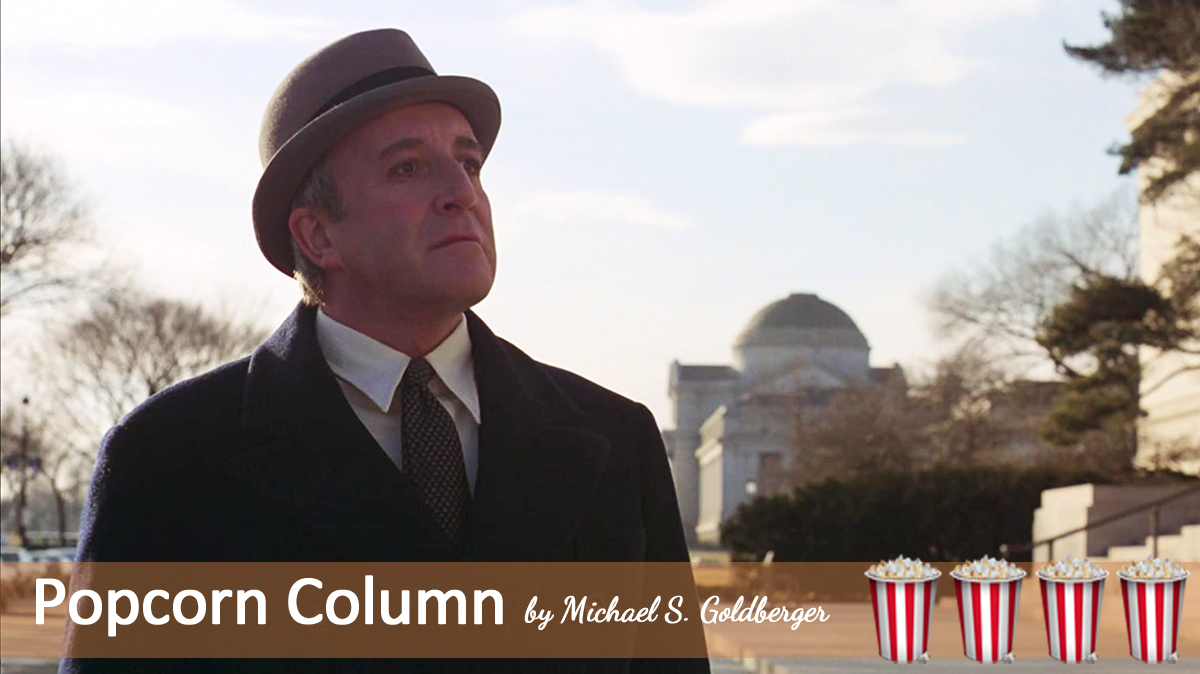
Thus spake Ruth Attaway's Louise, the maid who raised Peter Sellers' Chauncey Gardener, a simpleton (but is he really?), when she sees him on TV hobnobbing with the Washington elite and advising the president of the United States. Oh that we should be so lucky considering the power-hungry ineptness currently trampling our institutions.
It's left up to you to decide just what the mental acuity is of the middle-aged Chauncey, who has left for the first time the Washington manse where he was gardener for the recently deceased "Old Man." He might very well be the cognitive opposite of the fiendish evil now endangering our lives without the slightest bit of compunction.
Peter Sellers' brilliantly perceptive portrayal of Jerzy Kosinski's ingeniously imagined stranger in a strange land, purported to only know gardening and what he's seen on TV prior to being unleashed into Beltway society, provides a whimsical, metaphorical dissection of what's what.
More than one longstanding convention and just as many so-called pieces of traditional wisdom are satirically scorched in Kosinski's exquisite adaptation of his literary masterpiece, proffering that fates are decided by forces seemingly coincidental, often bizarre and perhaps a bit spiritual.
But what is most subject to severely polite, but all the same critical mockery is how, after journeying all the way from the primordial mud to the daily influence of the electronic media, our judgement doesn't seem to have improved at all. And while most of the reasons why humankind remains stunted in this area of potential evolutionary improvement is apt matter for discussion around the coffee table once you feel safe enough to invite the Lipschitzes over for cake and conversation (socially distant, of course), the film cleverly hints its opinion.
The total, insight-filled insanity of it all is that randomness combined with our subjective and often ludicrously motivated, feeble ability to make wise choices has hobbled us mere mortals from attaining what most of our numbers believe is a greater destiny. I mean, how else would you explain blunders in judgement like the Ford Pinto and Trump. Though, in all fairness there was no way for the average auto consumer to know that a design flaw would cause the Pinto's gas tank to explode on collision. But otherwise? C'mon.
The thought here, Goldberger interpreting Kosinski, is that we so can't stand the idea that there are no known answers to the greater quandaries of life, that we are willing quarry for any snake oil salesman promising a panacea. The sad thing is that, tragically intersecting with our underdeveloped sense of judgement is humanity's equally deficient growth in the morality department … resulting in entire industries built of people eager to profit from the Darwinian deficits of their fellow beings.
What we sense in Chauncey is an aura and impetus totally bereft of such crass dynamics. But whether he is just as advertised or the genius prophet essentially adopted and taken in by Melvyn Douglas' industrial giant, Ben Rand, trusted adviser to Jack Warden's president, his naivete, or what passes for it, invokes a refreshing purity.
Kosinski, via journeyman director Hal Ashby and an astutely tuned-in cast, criticizes a media-obsessed civilization with a perspicacity analogous to Dreiser and Fitzgerald's tsk, tsk of the Roaring Twenties, but with a little bit of a hopeful codicil.
Despite the raucous sarcasm inherent in Chauncey's rise to celebrity, which includes the infatuation engendered in Ben's wife, Eve, played by a delightful Shirley Maclaine, we get a warm feeling. Whether he is a force for good or not, which again I leave to you and the Lipschitzes, there is something oddly freeing in the thought that we might be bamboozled by a total innocent rather than a bona fide blackguard.
Inventive little segues running up seriocomic, eccentric alleys, such as Chauncey's ingenuous, casual acceptance of the angry instructions unleashed upon him during a run-in with a street tough, serve as dramatically savvy punctuation to the overall nuttiness.
And alas, all of it funnels into a philosophically adventurous thesis that on the surface is an update of "There's a sucker born every minute" — misattributed, by the way, to P.T. Barnum — but on deeper reflection delves into a much more dangerous posit. That being that truth itself isn't safe from a corrupting, specious application of the Theory of Relativity by evilly intentioned people. The insidious pretense is that spin, which should be added to Twain's listing of falsehoods along with white lie, damn lie and statistics, is a sort of honorary truth.
But whether Chauncey is an Alexis de Tocqueville tasting of a society never experienced beyond what he's inferred from TV, or a messenger from some profound illumination, those in search of a fancifully intelligent movie experience will agree that "Being There" is where it's at.
"Being There," rated PG, is a United Artists release directed by Hal Ashby, and stars Peter Sellers, Shirley Maclaine and Melvyn Douglas. Running time: 130 minutes
Tags: movie review,