September is Campus Fire Safety Month

Print Story | Email Story
STOW, Mass.— State Fire Marshal Peter Ostroskey reminds us that September is Campus Fire Safety Month. 
 
Massachusetts has a large population of college students that fire officials and college leaders want to be fire safe whether they live on-campus, in Greek housing, or in private off-campus housing. 
 
"Students come to Massachusetts to learn from around the country and the world, and not all of them have received the same great level of fire education in elementary and high school as our students do through the Student Awareness of Fire Education or S.A.F.E. Program," Ostroskey said.
 
With COVID-19 related issues, fewer students will be arriving this year, but fire officials want every student to be safe and live to graduate.
 
Make Fire Safety a Priority When Selecting Housing
 
The Department of Fire Services is joining forces with The Center for Campus Fire Safety, Boston Town and Gown Association, and the U.S. Fire Administration during the month of September to urge college students and their parents to make fire safety a priority when selecting housing, whether they live on- or off-campus.
 
Keeping College Students Safe in On- and Off-Campus Housing
 
"We need the help of both students and their parents to make sure smoke and carbon monoxide alarms are still working and exits are still clear three months from now," Ostroskey said. "If you're old enough to live on your own, you're old enough to take responsibility for the fire safety of everyone in the building." 
 
Smoke and carbon monoxide alarms may be working on move-in day, but disabled later by tenants, putting everyone at risk.
 
It Could Happen to You
 
In the last five years (2015-2019) there have been 3,019 fires in Massachusetts student dormitories, fraternities, and sororities, with two student deaths, five civilian injuries, five fire service injuries, and an estimated $1.4 million in damages. These tragic deaths occurred in substandard and illegal off-campus housing where there were no working smoke alarms, no working carbon monoxide (CO) alarms, and victims were trapped in rooms that had only one way out.
 
"Parents, talk to your adult children about fire safety, and look at their housing choices, especially if you are footing the bill," Ostroskey said. "Contact the local fire department about any safety issues the landlord won't address immediately, but don't leave your child in a home without working smoke alarms for a single night."
 
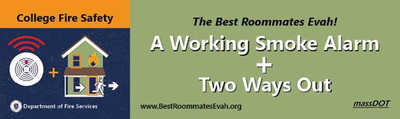
Best Roommates Evah! Smoke Alarms and Two Ways Out
 
In 2016, a group of fire chiefs, building officials, college safety officials and campus fire safety advocates met to share strategies for enforcing fire and building codes in off-campus housing. They launched a public awareness campaign about the importance of working smoke alarms and two ways out, called "Best Roommates Evah!" Go to www.BestRoommatesEvah.org for more information.
 
In a Fire Seconds Count
 
"In a fire, seconds count," says Ostroskey. "Working smoke alarms can alert students to a fire before it spreads, giving everyone enough time to get out, if they have two ways out and a practiced escaped plan."
 
"Remember," Ostroskey said. "Best Roommates Evah! Smoke Alarms and Two Ways Out."
 
For a quick list of resources and links to educational materials, please go to the Massachusetts Department of Fire Services website www.mass.gov/dfs and search on College Fire Safety.

Tags: college,   fire,   

If you would like to contribute information on this article, contact us at info@iberkshires.com.

BRTA Looks to Another Year of Fare Free

By Breanna SteeleiBerkshires Staff

PITTSFIELD, Mass. — The BRTA is expecting another year of fare free rides.

Berkshire Regional Transit Authority Administrator Kathleen Lambert told the advisory board recently that she expects to receive $1.3 million in state funding to remain fare free. She said RTAs may be given up to $40 million this year statewide, which is $5 million up from last year.

While the state budget is not formally approved yet, the effect will take place on July 1.

The news came at the same time the board approved the BRTA's budget of $13.6 million, which is an increase of 11 percent since last fiscal year.

Some of the increases were in the fixed route area which jumped from $9 million to $12 million. Lambert said this is due to the contractual agreement between the union where they have a five percent raise for all of the drivers and other union members, as well as a seven percent raise for paratransit fleet operators.

Lambert said much of the costs raised were fuel costs because of the ongoing war in Iran. The authority uses about 8,000 gallons of fuel a month and has planned for $5.75 per gallon.

The customer service desk, which currently staffs two employees, will be shut down, she said. The two employees were given notice months in advance and one showed interest in becoming a bus driver and will plan to interview for that. Lambert said two new drivers have started and that the new transit company Keolis, which is taking over for Transdev, will continue to hold recruiting events. The new manager is Mark Moujabber, taking over for Bobby Quintos. 

Lambert told the board she believed there are discrepancies in ridership data. Deputy Administrator Benjamin Hansen, who was in operations before his current role, said the authority has been seeing low ridership because of route cancellations, however, this past month, the numbers did not make sense as demand has stayed the same but ridership seemed exponentially low.

To get the figures, bus drivers must manually push a button on the farebox to record passengers, wheelchairs, and bikes, which might have errors. There are automatic passenger counters (APCs) installed, but they are not certified, so are only used as a rough comparison tool as they are not accurate.

Board member Stuart Lawrence asked if there has been any investigation on if this might be deliberate. Hansen said there is not as he does not know how they could watch for that to happen.

Lambert said she has been working with professor Paula Consolini at Williams College, who will have a group of samplers who will ride the bus and gather a week's worth of data.

In the last meeting, the board spoke about anonymous emails from drivers, and a letter iBerkshires received spoke of unhappy drivers who were considering quitting because of decisions being made without "input from frontline staff," frustration and falling morale, and the removal of the former general manager shortly after Lambert came in.  

Multiple employees had also signed on to a vote of no confidence letter in the BRTA administration spearheaded by Raymond Killeen who is a bus driver and represents Cheshire on the advisory board. Killeen said losing Quintos was hard, stating he was an excellent general manager and not having him there led to hardships on accomplishing many things.

"Once the removal was there, it was difficult to accomplish certain things, because we had lost the general manager. So, the letter was an attempt to get things moving a little bit quicker, so we could provide a better service for the residents of Berkshire County. I don't know if it accomplished that. We were able to do some things, though, but the concern amongst rank and file here is that we're not providing the best service we possibly could, and we're hoping that when the new management team comes in, that can be accomplished," Killeen said.

Killeen said he was unhappy with the progress to a revised driver schedule. The day after the meeting, Lambert and the team had a meeting to discuss and negotiate run schedules, Lambert said it was a very good and productive meeting.

View Full Story

More Berkshire County Stories