BRPC Supporting Measure to Create Comprehensive Health Districts
PITTSFIELD, Mass. — The Berkshire Regional Planning Commission has signed on in support of a bill that would create standards for boards of health, promote comprehensive health districts and establish appropriate funding.
The measure, HD.5306, was filed on Thursday morning by state Reps. Hannah Kane, R-Shrewsbury, and Denise Garlick, D-Needham, and has so far accrued 38 supporters, including state Reps. John Barrett III and Tricia Farley-Bouvier.
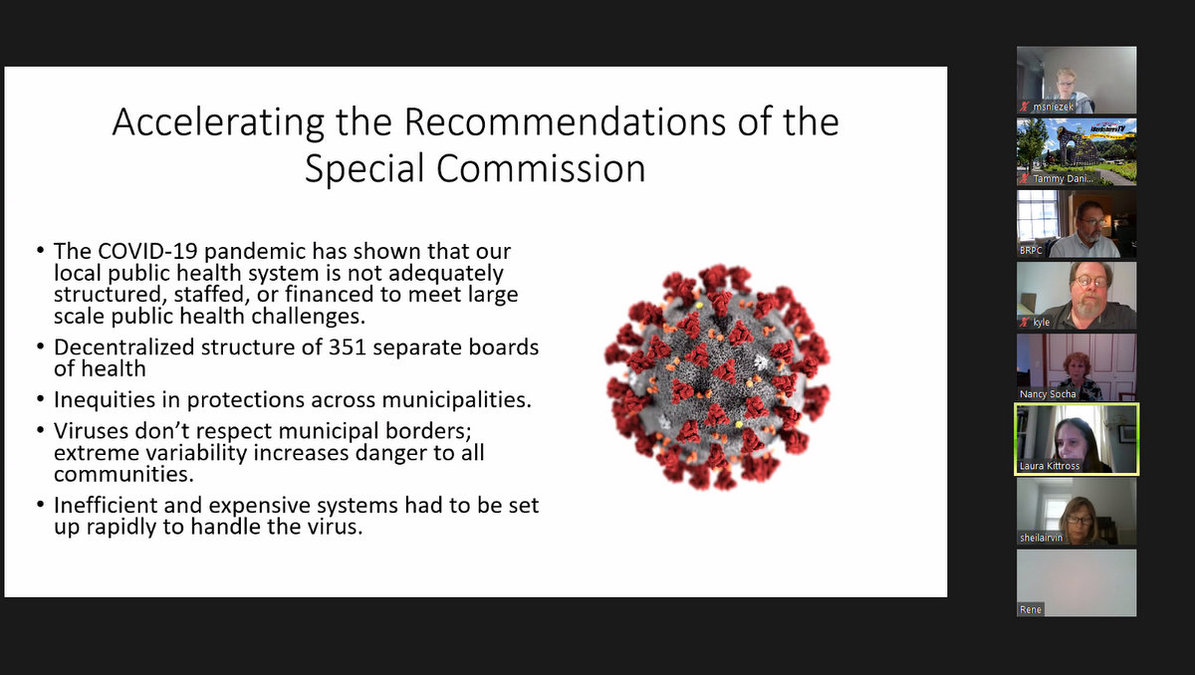
Laura Kittross, public health program manager for the BRPC, explained at Thursday's meeting of the Executive Committee that the bill if passed would accelerate the recommendations released last year after a two-year study of local and regional public health.
Massachusetts is unique in having a local board of health for each of the 351 communities in the commonwealth while other states use regional or county. California has about 60 regional boards for 40 million people; Massachusetts with 6.3 million people has about 11 percent of all the boards of health in the country.
The quality and resources for each board of health vary greatly, Kittross said, and can range from "an elected board member who has never done anything related to local public health before to people who have master's degrees and all the credentials you could want."
"It's really hard to know actually how well we are doing. Smaller municipalities in particular struggle with funds for their health department or to find somebody who's qualified who wants to work five hours a week or five hours a month, depending on the size of the town," she said. "So many of our local health departments are slow to meet their statutorily mandated services in Massachusetts, and few in Massachusetts are prepared to meet nationally recommended standards such as the Foundational Public Health Services."
The Blueprint for Public Health Excellence issued last year by the Special Commission on Local and Regional Public Health, and on which Kittross served as representative for the Western Massachusetts Public Health Association, recommended restructuring and funding the public health system, particularly in promoting shared services.
"By pooling resources, functions, and expertise, a consortium of cities and towns, especially those that are smaller or less prosperous, can improve compliance with their statutory and regulatory mandates and expand the protections and opportunities they offer residents," the report stated.
Some of the steps toward this was provided in the State Action for Public Health Excellence, or SAPHE, Act passed in April (and also sponsored by Kane and Garlick). Two existing health districts and eight new groups representing more than 40 municipalities were given grants to plan for sharing resources and expanding staff.
The BRPC was able to obtain $47,000 in grant monies for the Public Health Alliance to hire an administrative assistant and do some online permitting.
The newest bill, dubbed SAPHE 2.0, would being implementing the recommendations of the Special Commission by setting minimum standards for education and training, inspections, communicable disease investigation, reporting and permitting for boards of health either individually or through the creation of cross-jurisdictional entities.
It would also set unified standards for reporting to the Department of Public Health and supplement local funding using a formula based on populations, valuations, level of shared services and sociodemographic data.
Kittross said the commission's recommendations were expected to take five to 10 years to institute but the appearance of the novel coronavirus changed that.
"As we all know, about six months ago a little thing called COVID came along and really shone a bright light on the fact that our local public health system is not adequately structured, staffed or financed to meet a large-scale public health challenge," she said. "And a lot of inefficient and really expensive systems had to be set up in a big hurry in order to deal with COVID."
She pointed to the $60 million contact and tracing program rolled out through Partners in Health that would not have been needed if there were adequately funded and staffed public health nursing programs.
"As we were able to do here in Berkshire County, that could have been easily ramped up without that kind of expense and it's been a very bumpy rollout for $60 million," Kittross continued. "In addition, there was $20 million that was provided as emergency funding for local boards of health, but there was no infrastructure, there was no way a state could do contracts with 351 separate municipalities. ...
"So again, structure and infrastructure had to be built very quickly to get that money out. And BRPC played a big part in that."
Commissioner Rene Wood of Sheffield asked how the bill might affect the health alliance and BRPC. Kittross said it could make the agency more sustainable and a better resource for the Berkshires.
The legislation will not require shared services but the goal is to incentivize and encourage the expansion of shared services to meet the goals outlined in the recommendations with three levels of funding support — the highest going to comprehensive districts, although Kittross noted the text may change as the bill works its way through the Legislature.
"I would hope this would be an opportunity for the Berkshire Public Health Alliance and for the municipalities in Berkshire County to consider going to a comprehensive district model," she said. The alliance now has more of a cafeteria model through which communities chose which services to employ. "But it's all speculation at this point."
Chairman Kyle Hanlon asked if this should be brought before the full commission by Executive Director Thomas Matuszko said the Executive Commission could make the decision to join the coalition in support of the measure.
The commission voted in favor.
Editor's note: the incorrect figure was given for the state's contact tracing program and has been corrected.
Tags: BRPC, COVID-19, legislation, public health,
More Coronavirus Updates