image description
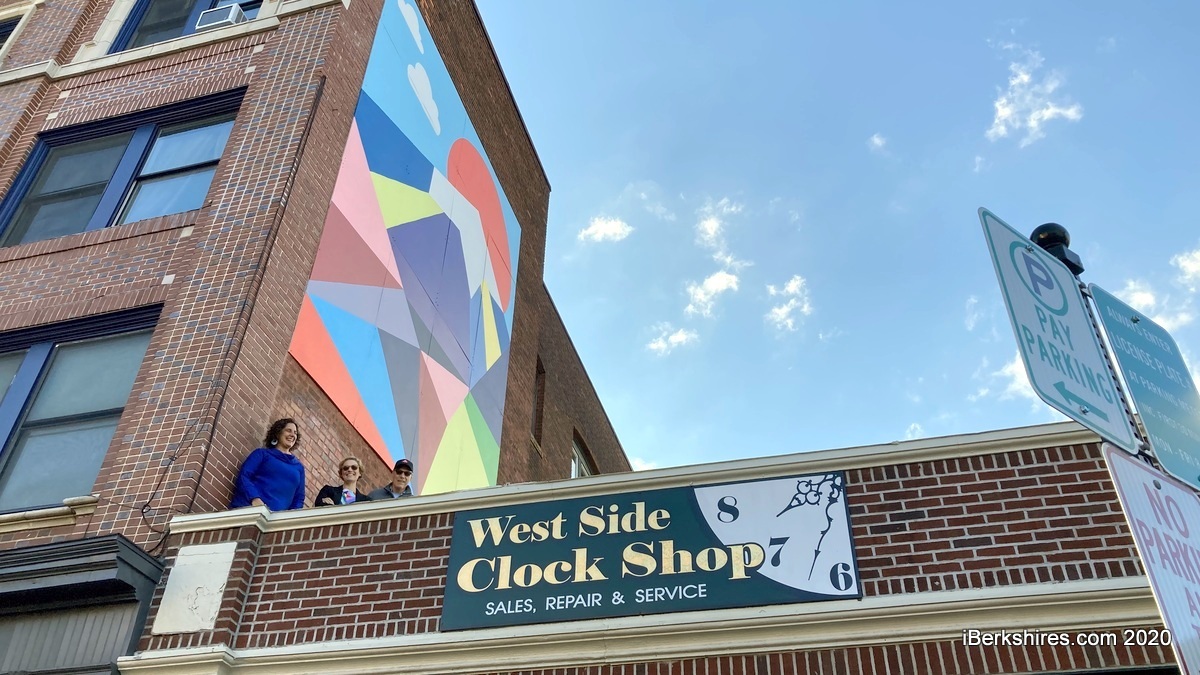
Pittsfield's newest mural,'The Sun Will Rise' was unveiled on Friday evening on North Street.

Artscape Unveils New Mural in Downtown Pittsfield
By Brittany PolitoiBerkshires Staff
Print Story | Email Story

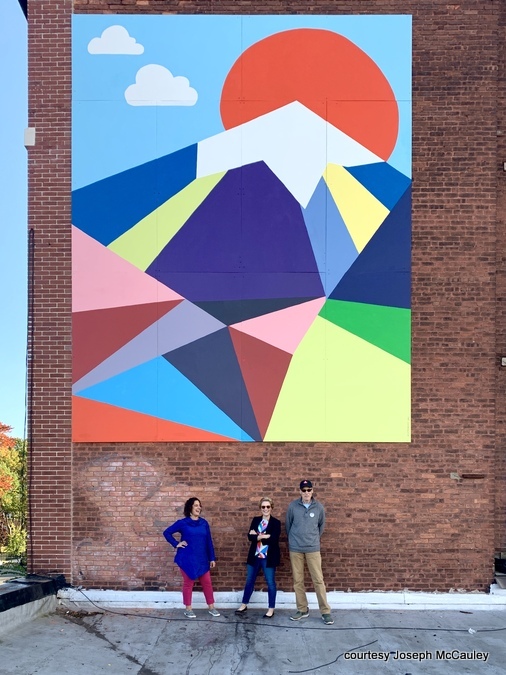
Stephanie Quetti, Jesse Tobin McCauley and Jay Tobin pose beneath their rising sun mural on North Street. 

PITTSFIELD, Mass. — North Street became more colorful late Friday afternoon when a collaborative mural titled "The Sun Will Rise" was unveiled.

Jesse Tobin McCauley, Jay Tobin, and Stephanie Quetti stood on the roof above West Side Clock Shop next to their work as Kathie Penna of Mill Town Capital and Abigail Powers of Artscape unmasked the mural for a cheering crowd.

"The Sun Will Rise" features an abstract, cubist image of a bright orange sun rising over a colorful mountaintop.

This mural can be seen at the corner of Linden and North Streets. The project was put on by Artscape, a volunteer committee that sponsors, plans, and oversees the annual juried exhibition of public art in the city, in partnership with Mill Town and the Pittsfield Cultural Council.

McCauley is a Pittsfield native painter and graphic designer who enjoys making mixed media paintings on paper, canvas, and panel. Her style features bursts of bold, bright, saturated color to evoke a feeling of happiness. Her photography lines the walls at The Lantern Bar and Grill and she has painted two murals on its property. She jokes that she has taken over the corner of Linden and North.

Quetti is a Berkshire Community College and Smith College alumni who has a master's degree in social work. She, too, enjoys bright colors that make viewers joyful when they look at them. She has painted three electrical boxes for Artscape's Paintbox Program and does youth paint projects with ROPE, an empowerment program for young women of color.

Tobin is a retired Pittsfield firefighter who has been part of the local mural scene for 30 years. He worked on both the police station mural on Allen Street and the Boys and Girls' Club mural on Melville Street. He was also an original member of Group W, an art collective that held large-scale exhibitions in a steel fabrication plant in Pittsfield.

Tobin is McCauley's uncle and they and another uncle, Bill Tobin, comprise the art group Tobin Trifecta.  They host art shows to showcase each of their individual works and in turn, spend quality time with one another.

This program was supported in part by a grant from the Pittsfield Cultural Council, supported by the Massachusetts Cultural Council, and Mill Town.


"This felt like a wonderful opportunity to support our valued local artists while reinforcing our commitment to invest in our downtown," Penna, operations manager for Mill Town, said.

Abigail Powers, chair of Artscape, spoke at the unveiling ceremony thanking the group's sponsors for making the mural possible.

"This project is possible thanks to the support of Pittsfield Cultural Council, thank you so much for your support," she said. "And, of course, this project would not be possible without the help of Mill Town. We're so thankful for the hard word they have done to make this space available and for their generous match of this project."

The early stages of this project started in April, around the beginning of quarantine. McCauley and Tobin took a long time to draft out the the initial concept and get it approved. When it came to painting the final design, it took about three days. This process happened at the Lichtenstein Arts Center.

The material the mural is painted on is called MBO board; which is basically plywood, and was done on 10 different panels that were then mounted to the wall together to make the mural.

McCauley was the first to suggest that the mural feature a sun so it could be symbolic for a sun shining through the depressing times of our present.

"I had an idea when I was doing the initial concept about the sun and just how everything is so kind of depressing and uncertain right now," she said. "But the only thing you can count on is that the sun will rise every day to a brand-new day and hopefully it will be a good one."

Quetti agreed with the sentiment.

"When you put something like that up with such a beautiful color combination and such a clean design anybody who looks at is just going to be so happy," she said.

The trio hopes they they will get to work on a mural together again in the future and provide more color and cheer to downtown.


Tags: murals,   
If you would like to contribute information on this article, contact us at info@iberkshires.com.

The Round Stone Barn is 200 as Hancock Shaker Village Celebrates

By Breanna SteeleiBerkshires.com

PITTSFIELD, Mass. – Hancock Shaker Village shared a bicentennial birthday, inviting the community to take part in the festivities.

On Sunday, Hancock Shaker Village celebrated the 200th birthday of their signature Round Stone Barn, the only circular barn ever built by the Shakers.

"The Round Stone Barn turned 200 this year," Hancock Shaker Village CEO Carrie Holland said. "It was erected in 1826, so we thought we would celebrate with the whole community. We'd do some cupcakes, and then we're lucky to work with Yo-Yo Ma's team to curate some special performances in the Round Stone Barn."

The community was invited to come to the village for free and take part in a wide range of activities including tours, live music from Ida Mae Specker Trio and Tanglewood, demonstrations, and more. 

The Round Stone Barn is widely recognized as an architectural icon and agricultural wonder. 

The Shakers operated a working dairy farm at Hancock until the 1950s, and the barn was originally a stable for its 52 milk cows, according to the museum's website. 

It has ground-level access on all three levels so, wagons could enter on the upper level to deposit hay into the central haymow on the main floor below, then the empty wagons would be driven around the circular barn floor and exit the same door it came in, eliminating the potentially dangerous activity of backing wagons out of a barn, the website said. 

The cows stabled on the main floor faced inward toward the haymow for ease of feeding and manure was shoveled through trapdoors to the cellar, where it was stored until needed as fertilizer in the gardens.

"Every time anyone comes into the timber frame, it's the very first thing that they see, and they always say, 'It's just like a photograph,' and it is," Director of Collections Kathleen Lynch said. "It's beautiful. People want to get married in front of it. We did our Christmas the festival of trees in here, and the mechanisms of it are so phenomenal."

Hundreds enjoyed music in the round barn and celebrated with free cupcakes and food trucks while listening on the history the village portrays.

"I think this is one of our most iconic buildings, and a lot of people have their own memories tied to it," Holland said. "We do baby animals here, and so there's personal history. ... But it's also a fantastic opportunity to share a bit about the Shakers, their design techniques and practices, their  sort of obsession with making operations efficient, because this is used as a dairy barn, and so they created these three layers to make their operations more efficient."

"So you can talk about their innovation. Of course, they're the longstanding legacy of agriculture here. So it provides us an opportunity to kind of share the Shaker history in this beautiful space, tied to folks who have their own personal memories here as well, and it's such an impressive, beautiful spot. I have such appreciation for what it took to build this 200 years ago, and whenever we can do fun things and throw good parties here, it's a great day.""

Holland helps build momentum for the unveiling of Hancock Shaker Village's new visitor center that is planned to take place next month.

The new facility will include updated galleries, community event spaces, collection storage, and research areas for the museum's collection of over 22,000 Shaker artifacts and ephemera. The renovated building aims to enhance the visitor experience through improved orientation, expanded program offerings, closer access to collection items, and views of the surrounding landscape. 

"Part of what we're also celebrating is past, present, future, and the future," Holland said. "We're very excited for expanded programming. We're opening our new visitor center, our Center for Shaker Studies, so that creates a whole new opportunity for our visitor experience, our galleries, our stewardship, and then that relates also to the programming that we can do in the historic village."

View Full Story

More Pittsfield Stories