Housing Proposed for Notre Dame Property in North Adams
NORTH ADAMS, Mass. — The administration has chosen a housing proposal for the Notre Dame complex on East Main Street out of two bids from well-known local developers.
The City Council will be asked on Tuesday to approve the sale of the church and unattached school for $10,000 to developer Moresi Commercial Development LLC. David Moresi is proposing to immediately secure both 19th-century structures and begin work on the school building by 2022.
In the second proposal, from the Barbara & Eric Rudd Art Foundation, the school would be used to address a shortage of economical studio space and preserve the church as an extension of the nearby Berkshire Art Museum. Rudd proffered a bid of $32,850.
Both developers have a track record in saving and restoring older buildings. Eric Rudd has taken over two vacant churches — the former Methodist and Unitarian-Universalist structures — for use as large-scale exhibition spaces. He also developed the Eclipse Mill into artists' studio/lofts, the Beaver Mill and the Flat-Iron Building. Moresi's ventures have been more in commercial and housing, including the Norad Mill, the Mulcare Building and the recently completed apartments and offices in the Wall-Streeter Mill.
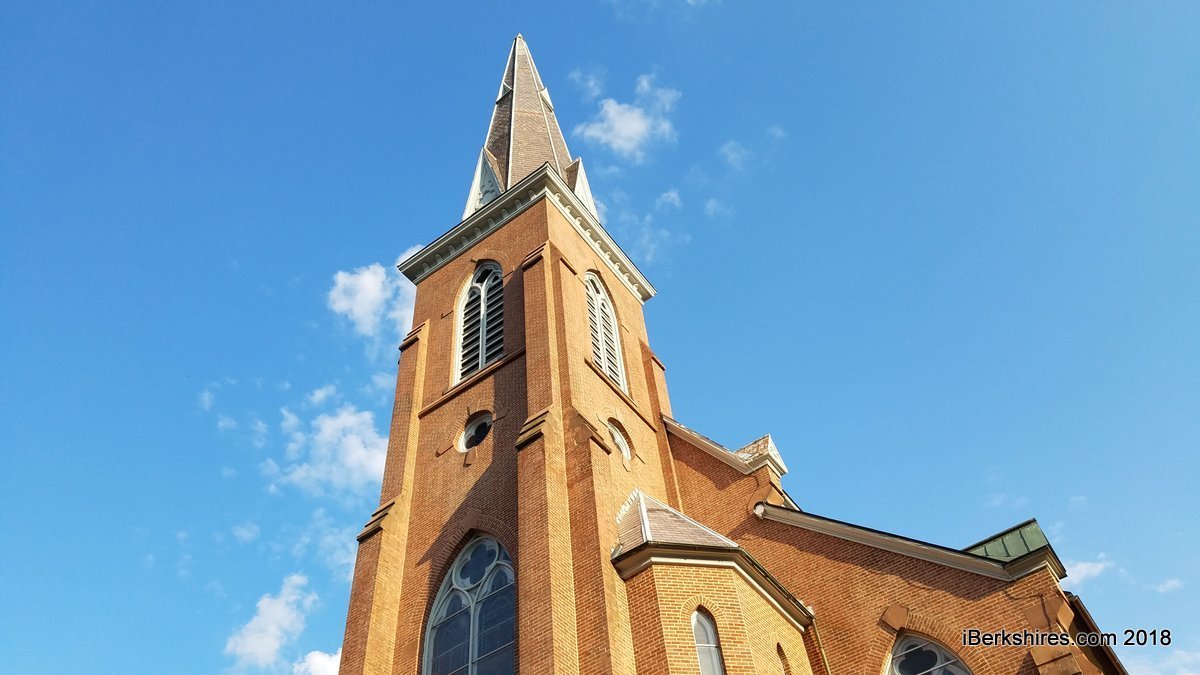
The 1889 Notre Dame du Sacré Coeur Church closed in 2005 and the then 130-year-old parish's sacred objects and relics ceremoniously moved to what had been St. Francis' Church, which was torn down several years ago. The long-closed school, which was leased by the city back in the 1960s and early '70s for its fifth and sixth grades, had more recently been home to the Church Outreach to Youth Center program.
The city has been trying to get rid of the church property for years. It was purchased in 2007 from the Roman Catholic Diocese of Springfield for a half-million dollars and interest from other entities: Massachusetts College of Liberal Arts was eyeing the rectory, the school would be redeveloped into housing by Arch Street Development LLC and the church would become the Contemporary Artists Center.
The CAC was out of the picture before the papers were signed and the only parcel to be sold off was the rectory to the MCLA Foundation. The housing deal fell through with the economic collapse. A bid in 2018 to redevelop the property into an $18.5 million hotel also failed to materialize. The property was recently put back out to bid.
Moresi's bid of $10,000 falls well below the assessed values for the church and school properties of $684,800 and $682,000, respectively, requiring the City Council's vote to approve.
In his bid, Moresi states that the development of the 1897 three-story school would commence with the completion of Johnson School into the "Residences at Amity Square." Moresi Commercial Investments bid $225,000 for the school last year with plans to put in 20 high-end, two-bedroom apartments; work is expected to begin on the project in the coming months.
"No doubt this will be the most challenging of all projects given the complexities of the buildings along with the deteriorated nature of the former school," Moresi wrote of the Notre Dame project in the bid. "Our firm is prepared for the challenge and has the proven track record to bring more market-rate housing to the downtown, which we firmly believe will help bring life back to what is a still struggling Main Street."
His proposal is to upgrade and modernize the school building for two-bedroom apartments while maintaining as much of its character as possible. Phase II would address the church, although there are no plans yet on how to do that.
"The desire of this developer is to incorporate a form of housing which makes the most of the impressive, unique spaces that exist in the building," he wrote. "One thing for sure, the steeple must be maintained to the best of repair as well as the building facade for all to enjoy. This developer is sincere to that commitment."
The main driver in the city taking possession of the church was to ensure the preservation of the steeple, which is a landmark sight arriving west on Route 2. A Massachusetts Historical Commission grant more than decade ago was contingent on maintaining the steeple.
Rudd's proposal also focused on preservation, stating that 100 percent of the foundation's income from the school would be used to preserve all historic buildings used by the Berkshire Art Museum.
"The purpose is to make good use of historic properties and preserve them for future generations," he wrote, adding that the foundation has been in talks with an out-of-town institution and the "acquisition of this property would enhance the proposed joint goals, which will also enhance the city's reputation as host to important cultural organizations."
Mayor Thomas Bernard, in his communication to the council, recommends Moresi's proposal based on reviews by a committee comprised of representatives from the Office of Community Development, auditor and inspection services.
Tags: church reuse, municipal property, RFP,