Pittsfield Aims to Make Lower-Income Neighborhoods Greener
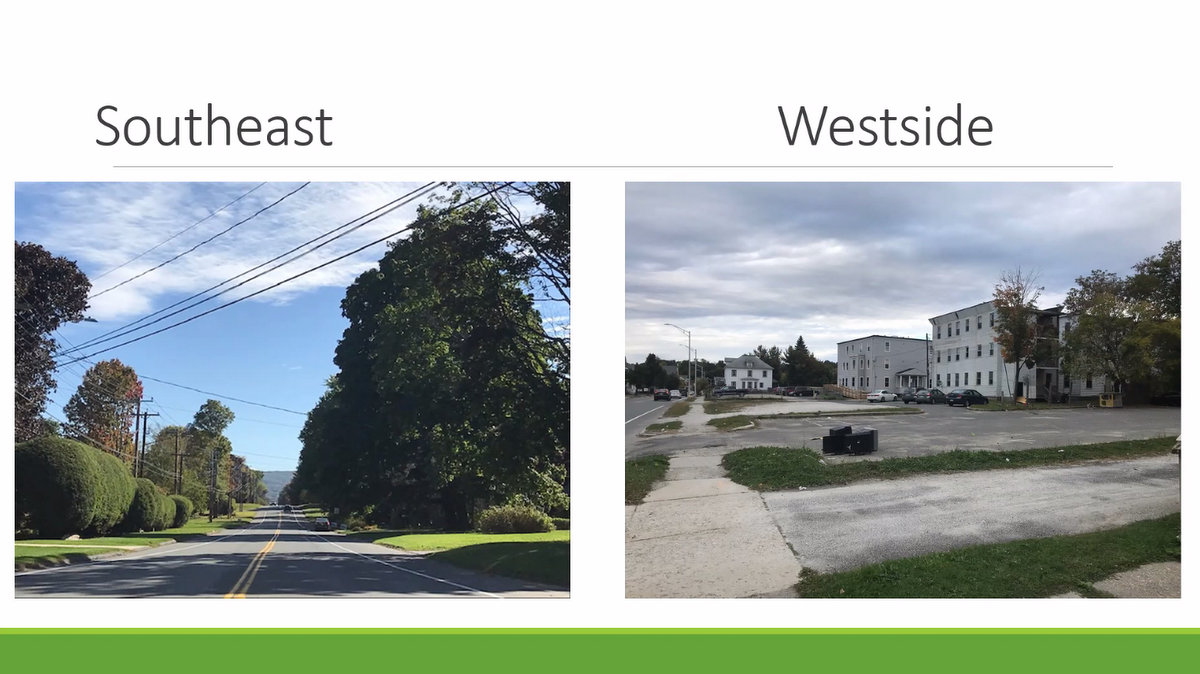
Higher income neighborhoods have more green space and shade trees than lower income areas. The 'Grey to Green' project will enhance two neighborhoods by improving green areas.
Studies have shown that low-income neighborhoods are more concrete or "gray" than higher-income neighborhoods, which can have a deleterious effect on the health of residents, Senior Planner Allison Egan told the Berkshire Regional Planning Commission on Thursday.
Having more green space in a neighborhood can contribute to longevity and encourages healthy outdoor recreation, she said.
"Pittsfield Grey to Green" will take place in the Morningside and West Side areas.
Funding for this project is through the Massachusetts Determination of Needs Fund, a pool of funding the state uses for public health and community-based causes.
"Grey to Green" is funded for five years and is estimated to cost about $185,000 a year. The project's primary partners are Central Berkshire Habitat for Humanity, 18 Degrees Family Services, and the city of Pittsfield.
The team is also working with community partners in the Morningside and West Side neighborhoods.
"When we were applying for these funds," Egan said. "The primary thing they wanted to see was that the initiative was addressing structural racism in some way."
The funding source was opened last fall, before the current racial justice movement taking place in the United States. Nonetheless, the project does align with things they are seeing in communities in relation to the racial justice movement, Egan said.
BRPC first reviewed existing plans, surveys, assessments, and other studies conducted in the two areas to get an idea of the residents' needs.
Planner Christine Ector compiled a draft of an environmental scan, compiling a mass amount of data from the last several decades that concern those neighborhoods. The data sources used were Berkshire Benchmarks, the state Public Health Information Tool, the Pittsfield Community Report, demographic and enrollment information from Pittsfield Public Schools, and Census data.
The working definition of structural racism that is being used for this project "is the normalization and legitimization of historical, cultural, institutional, and interpersonal dynamics that routinely advantage whiteness and produce chronic and cumulative adverse outcomes for people of color."
This project aims to address areas of structural and environmental racism and environmental justice as well as exploring the roots of environmental justice through communication, education, and advocacy.
BRPC wants to amplify the voices of Black people and people of color in Morningside and West Side, building initiatives around their needs as seen through their lived experience, not imposing solutions but listening with curiosity.
"We really want to know what the people who live in these neighborhoods, who grow up in these neighborhoods, envision for their future in the neighborhood," Egan said.
BRPC wants to incorporate residents of these neighborhoods into the plans, training them to do city audits and collaborating with them to establish the areas' needs.
Egan said one of the most important aspects of this initiative is that they are paying members of the community $25 an hour when they volunteer to help. It is felt that this rate will provide an incentive for residents to get involved and compensate them for the integral part they are playing in the process.
Before they created the initiative for the application, BRPC started looking at data to see if racial inequity is happening, where racial diversity is in the city, what the poverty level is, and the health status of different communities.
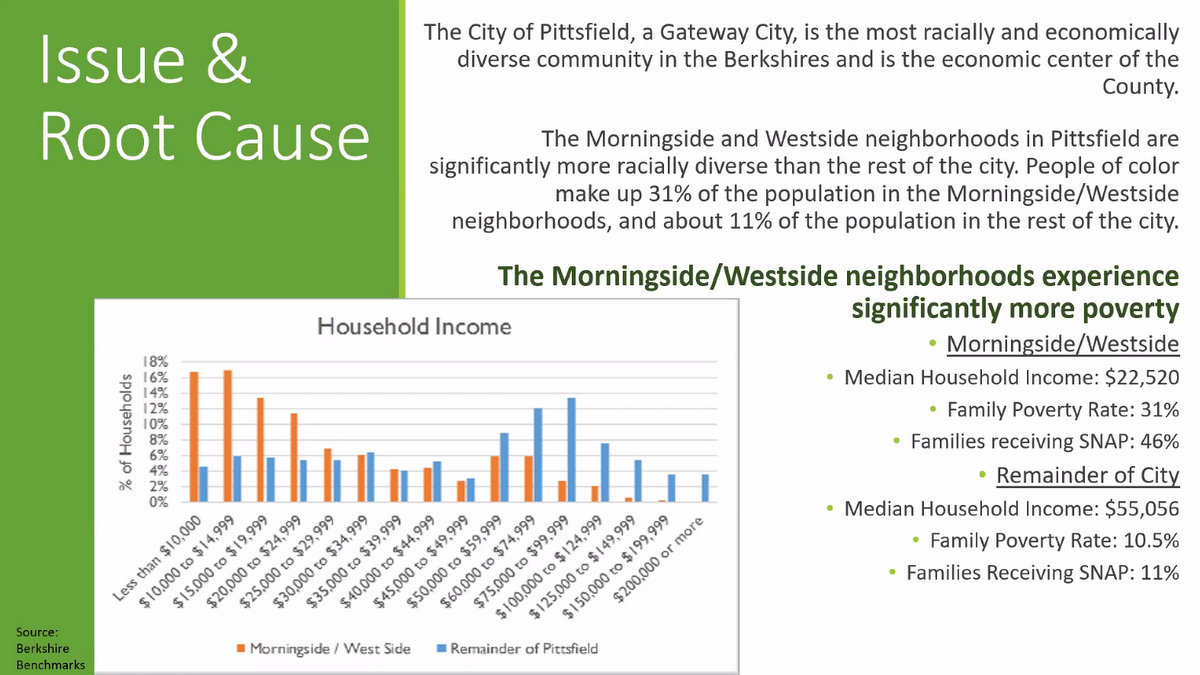
The data showed that Morningside and West Side areas have a median yearly income of about $22,500, while the remainder of the city's median incomes were more than double.
"Anyone can probably tell that driving from the Morningside or the West Side to the southeast of Pittsfield," Egan said.
About 31 percent of the population in the Morningside and West Side neighborhoods are people of color, while only about 11 percent of the population in the remainder of Pittsfield are people of color.
This is a significant income gap, Egan said.
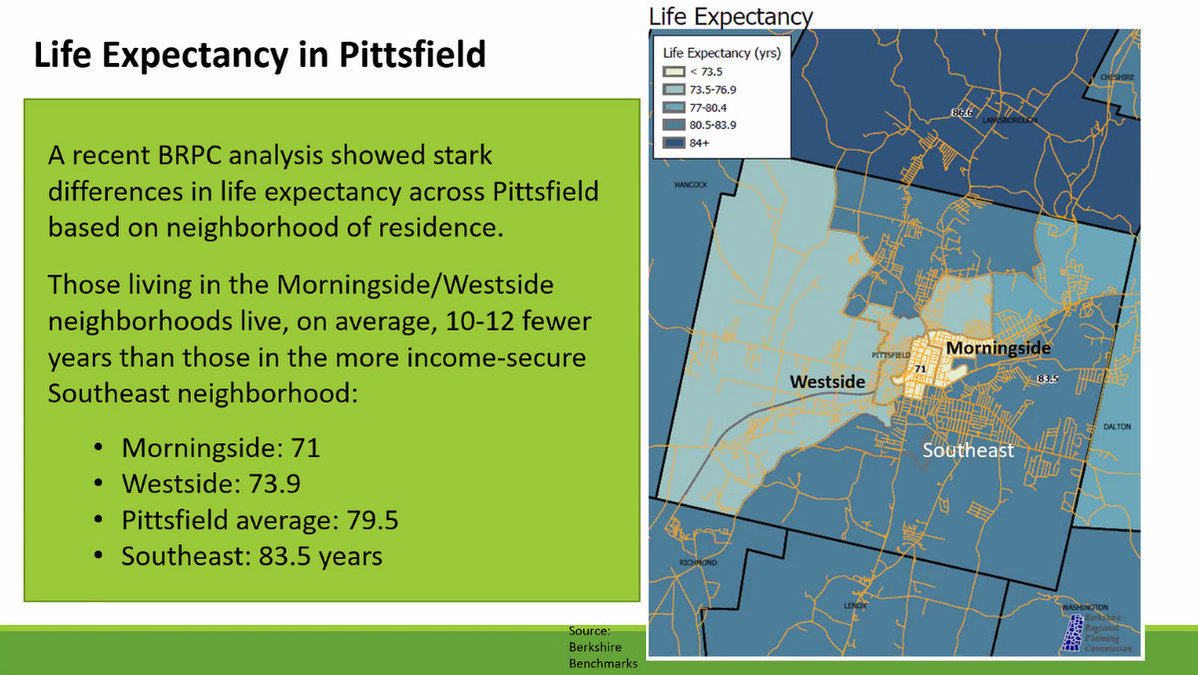
Recent BRPC analysis also showed stark differences in life expectancy across Pittsfield based on the neighborhood of residence. Those living in the Morningside/West Side neighborhoods live on average 10-12 fewer years than those in the more income-resourceful southeast neighborhood.
The life expectancy in Morningside and West Side is 71, while the southeast residents have an expectancy of 83 1/2.
"We know when we see data that is this drastic, it's not by coincidence," Egan said. "For public health, we don't look at individual behaviors for health, when we look at big population data, it's really about the population's health and we know that this isn't a coincidence and isn't based on individual behavior, there is something else underlying here."
BRPC overlaid Google satellite data to see where green spaces existed such as parks, lawns, and trees. They found that the West Side and Morningside are significantly more gray and the housing stock is more degraded.
Comparatively, the southeast and north Pittsfield house old hardwood trees, forests, large well-maintained parks, and tree-lined streets.
Because of this, they decided to focus on actual green space and look at how green space, or increased heat in neighborhoods due to lack thereof, can actually affect the health of people.
Climate change research has shown that people living in poverty and living in neighborhoods with greater heat exposure and less tree coverage are more susceptible to heat illness and mental health crises worsened by heat stress, Egan said.
In a study conducted by NPR, it was found that in neighborhoods and cities where there are more people living in poverty and more people of color there is significantly less green space and a higher heat index from lack of shade.
Egan explained that even a 5-degree temperature difference between neighborhoods can exacerbate COPD and mental illness. Just a 5-degree difference can cause medications used to manage things like mental health, heart conditions, and diabetes to be less effective.
Because of this, residents are more likely to have an episode or issue related to their condition, she said.
Before submitting the application for this project, BRPC explored Pittsfield and took pictures of different neighborhoods' infrastructure.
They found that medians in the southeast side of Pittsfield were well-kept, adorned with greenery, and pleasant to look at while the West and Morningside's medians were concrete and less maintained.
They also observed a general higher amount of maintained front yards and plantings in the higher-income neighborhood.
Egan said this is a result of investment in certain neighborhoods and disinvestment in others.
BRPC will work with the city of Pittsfield, environmental advocacy groups, neighborhood organizations, West and Morningside residents, and several service organizations to conduct planning that focuses on green development, promotes environmental justice, and establishes new standards for green investment and project prioritization in the most vulnerable neighborhoods.
The core of the project is to benefit of environmental stewardship and a sense of purpose for the people of the Morningside and West Side neighborhoods, Egan said.
This project is long term and will hopefully set up a structure to put people on a path for positive health outcomes.
"What really is striking to me is the aspect of the life expectancy," Executive Director Thomas Matuszko said. "At a relatively short distance there could be so much difference in life expectancy, and it's really related to the social conditions of the neighborhoods.
"Those are some of the things we can do something about as planners and other officials."
Tags: BRPC, green space,