Effective Monday, a Little More of State's Economy to Open Up
SALEM, Mass. — Massachusetts' reopening plan is going back to the future.
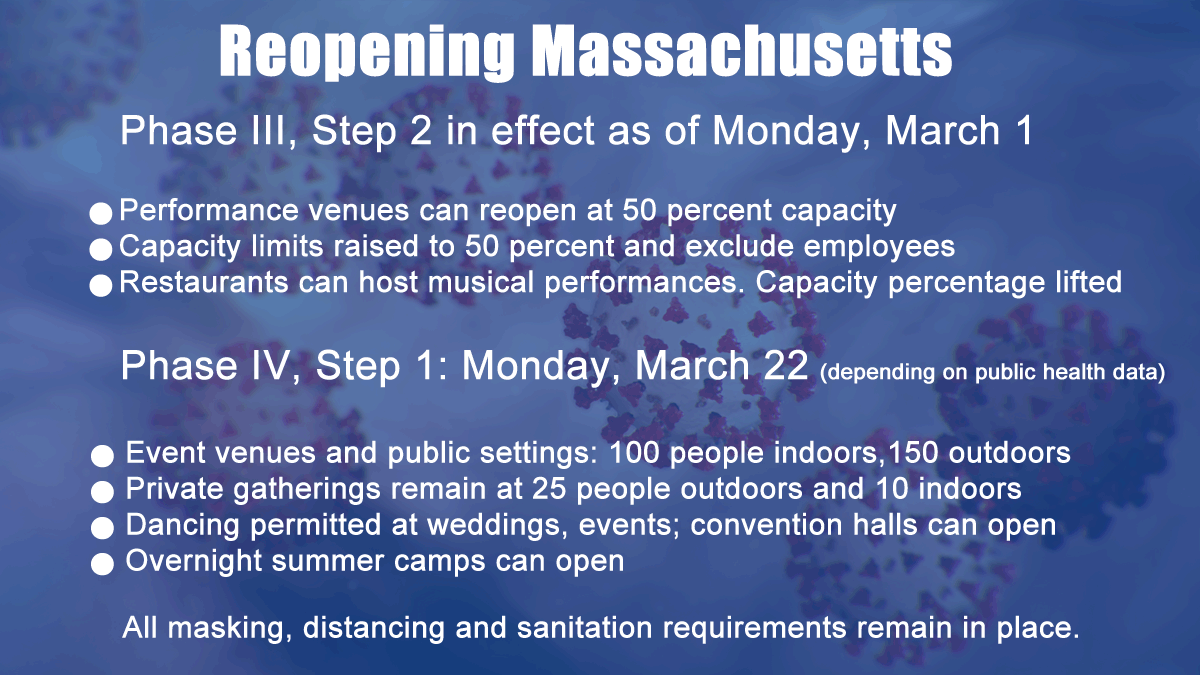
On Thursday, Gov. Charlie Baker announced that on Monday, March 1, the commonwealth will shift to Step 2 of Phase 3 of its COVID-19 reopening plan.
That means that indoor performance venues like theaters will be allowed to reopen with a 50 percent capacity limit, as will museums, fitness centers and libraries. Other restrictions also will be lifted, including a ban on restaurants hosting musical performances.
Actually, those restrictions will be RE-lifted. The commonwealth already was in Step 2 of Phase 3 until a post-Thanksgiving surge in COVID-19 cases forced state officials to move back to Phase 3's Step 1.
Furthermore, effective March 22, the commonwealth will move to Step 1 of Phase 4, which will enable outdoor and indoor stadiums to reopen with a 12 percent capacity limit. Phase 4, Step 1 also means an increase on gathering limits at event venues in public settings to 100 people indoors and 150 people outdoors. Gathering limits at private residences will remain the same: 10 people indoor and 25 people outdoor.
The March 22 move to Phase 4, Step 1, also will allow the use of dance floors at weddings and summer overnight camps.
Baker was asked whether there was a chance that the state slides back to the earlier steps of the reopening process, creating a hardship for people who make plans now for, say, a wedding in June or a trip to Fenway Park this summer.
"We were fairly careful when we started back in May [2020] with reopening," Baker said. "At that point in time, there were a bunch of people who said, ‘You're moving too fast,' and a bunch of people who said, ‘You're moving too slow.' We didn't see a significant increase in COVID cases during that time.
"When cases started to climb in the fall, we had to make adjustments based on that. … As our hospitalizations climbed and other issues associated with the health care system started to get severe, it was important for us to make decisions around stay-at-home advisories and capacity limits. We would not be making [Thursday's] announcement if we didn't think we'd seen, for almost two months now, positive trends combined with 1.1 million first-dose vaccinations."
Baker said there is always a risk that the state's COVID-19 numbers will go in the other direction, but the trends right now justify the moves to relax some of the restrictions on the economy.
Baker made Thursday's announcement at Ledger Restaurant and Bar, one of more than 12,000 businesses that have received more than $500 million in direct aid from the commonwealth to deal with the impact of the pandemic.
Baker and Housing and Economic Development Secretary Michael Kennealy announced another round of those grants, representing $49 million in awards to more than 1,100 businesses.
"All of these businesses meet the demographic and sector priorities, ensuring the hardest hit get the relief they need" Keneally said. "More than half [of Thursday's recipients] are restaurants, bars, independent retailers and salons. More than half are woman- and minority-owned businesses. That was a focused strategy from day one."
Lt. Gov. Karyn Polito, who joined Baker and Kennealy for Thursday's announcement, recognized the financial impact on small businesses of the state-mandated closures that began nearly a year ago.
"We know this has not been ideal," Polito said. "In fact, it has been very, very challenging for businesses across the commonwealth, including restaurants like here at Ledger.
"For nearly a year, businesses have had to come up with different strategies to continue to operate and be part of the communities where they are loved. It took a lot of investment, training and follow through every day … so your employees and customers felt safe and welcomed in your establishments."
It was noted that while the percentage capacity for restaurants will be raised starting Monday, the commonwealth still requires 6-foot distancing between tables, a six-person limit per table and a 90-minute time restriction per seating.
Baker said he hopes that continued positive trends in the commonwealth — like a test positivity rate under 2 percent, the likes of which the state hasn't seen since October — will help encourage Bay State residents to get back out and enjoy local eateries in a responsible fashion.
"As COVID cases go down, as vaccinations go up, you will find people more comfortable and more willing to go out and play a little bit," Baker said. "We want them to go outand play with their household. … But I do think for many of these places, [revenue loss] is not just a function of the rules, it's a function of the larger context and the environment."
Tags: COVID-19, reopening,
More Coronavirus Updates