Williamstown 2021: An Interim Kind of Year
WILLIAMSTOWN, Mass. — After ending 2020 with upheaval and uncertainty at the highest level of town leadership, the Village Beautiful began 2021 with more of the same.
And it enters 2022 without any real stability.
The year that is ending is arguably less tumultuous than the one preceding, and there was (finally) resolution on at least one issue that dominated one of the town's boards for more than a year.
But in other areas, the word of the year is "interim" as the town went through most of 2021 with a town manager and police chief were installed as caretakers while the Select Board makes a second try to find a permanent occupant for the corner office at town hall.
Here is a look at some of the stories we have been following this year.
Both former Town Manager Jason Hoch and Police Chief Kyle Johnson, seen her in happier times, both left within months of each other. The town has had interim leadership over the past year.
It did not take long for the other shoe to drop.
Two months after the town's longtime police chief resigned in a surprise December 2020 announcement, the town manager, who oversees all town employees — including the police chief — followed suit.
Jason Hoch announced his departure in late February, but he agreed to stick around through the end of the fiscal 2022 budget season and give his bosses on the Select Board plenty of time to develop a transition plan.
That plan started with the appointment of an interim town manager, and after having one of its two finalists essentially pull out during his interview, the board appointed Charles Blanchard.
Long-term, the board created a search advisory committee and employed the same national head-hunting firm that found Hoch six years earlier.
That screening process yielded two candidates, who were interviewed in November. But the Select Board decided not to offer either candidate the position and instead opted to reopen the search process in hopes of finding a permanent replacement for Hoch in spring 2022.
2. Pot proposal passes at last.
It took a couple of years and a couple of tries at consecutive annual town meetings, but the Planning Board finally was able to thread the needle on a proposal to update the town's 2017 cannabis production bylaw provisions.
For months, the board took testimony from residents arguing for sometimes conflicting interests: the need to provide economic opportunities for local farmers and the need to protect nearby homeowners from negative externalities of large-scale marijuana production.
An amendment on the floor — or, in the case of Williamstown's second straight outdoor town meeting, the bleachers — of the meeting may finally have tipped the scales. The amendment added language to the pot bylaw that specifically references another section of the town code, clarifying that cannabis production still would be subject to pre-existing development standards in the bylaw.
So amended, the cannabis bylaw passed with 82 percent of the vote, well more than the two-thirds majority it needed and failed to achieve at the 2021 annual town meeting.
3. Stubborn blaze finally succumbs.
For several days in May, the eyes of the commonwealth were on Williamstown as the state's largest wildfire in more than a decade drew fire personnel from around the region and air drops from the Massachusetts National Guard.
The community rallied to support the overworked firefighters with food and drinks as crews made repeated trips into the woods to contain the fire.
Eventually, the blaze that started on East Mountain burned itself out after spreading east and consuming about 800 acres and coming within a mile of homes in the Blackinton neighborhood of North Adams.
4. Financial fallout of a difficult year.
The town in 2022 will continue to pay, literally, for some of the changes that occurred in the 2020 calendar year.
Town officials likely were relieved when Police Chief Kyle Johnson, who became a lightning rod for criticism of the local police after a whistle-blower lawsuit became public, stepped aside. And many of Johnson's harshest critics in town likewise were glad to see Hoch leave in the spring.
But after their departures it came to light that their respective separation agreements included long-term payouts — in Johnson's case through June 30, 2023.
A third departure this year, that of the police sergeant whose lawsuit ignited a firestorm in August 2020, likely included additional fiscal costs, but town officials have not disclosed the price tag.
The fact that the severance payouts to Hoch and Johnson were not included in the budget Hoch prepared for FY22 caused consternation among members of the town's Finance Committee.
Meanwhile, some residents questioned the cost of two town initiatives intended to address the issues raised in the lawsuit filed by former Sgt. Scott McGowan: a townwide survey to look at policing needs and an independent investigation of the allegations raised in the lawsuit.
5. A return to normal-ish.

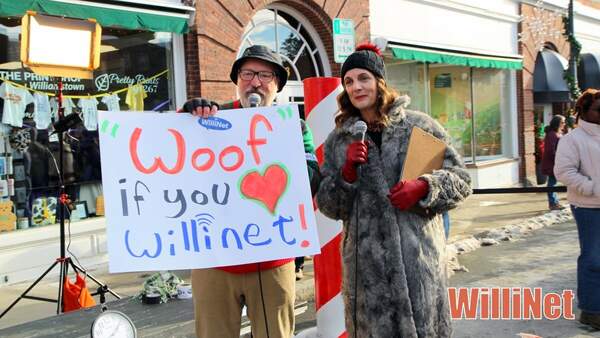
This year saw the return of community events including the popular Reindog Parade, part of the Holiday Walk.
The latter came back with an all outdoor season that won raves from town health officials but ultimately ran into trouble with its backstage workforce that drew negative attention in the national media. On Nov. 1, the WTF board announced that its artistic director had resigned and former director Jenny Gersten would be returning to take the helm for the 2022 season.
As the year went on and the benefits of the vaccine rollout were realized, life returned to normal more and more with the return of parades on Independence Day and for the Holiday Walk in early December.
Even the public school system, one of the first things to close due to COVID-19 in March 2020, was back to operating at full capacity, albeit with face-coverings, in early September.
Widespread testing in those schools did turn up some cases, particularly at the elementary school, but officials were confident those numbers would go down as more children were fully vaccinated after the grade school cohort became eligible in the fall.
As the year ended, though, there were reminders that while people are tired of the pandemic, the pandemic is not done with us. The commonwealth in late December advised that face-coverings be worn indoors regardless of vaccination status, and the high schools started to see athletic events canceled as Springfield's public schools hit the pause button on their sports programs.
6. End of blight, dawn of a new era.
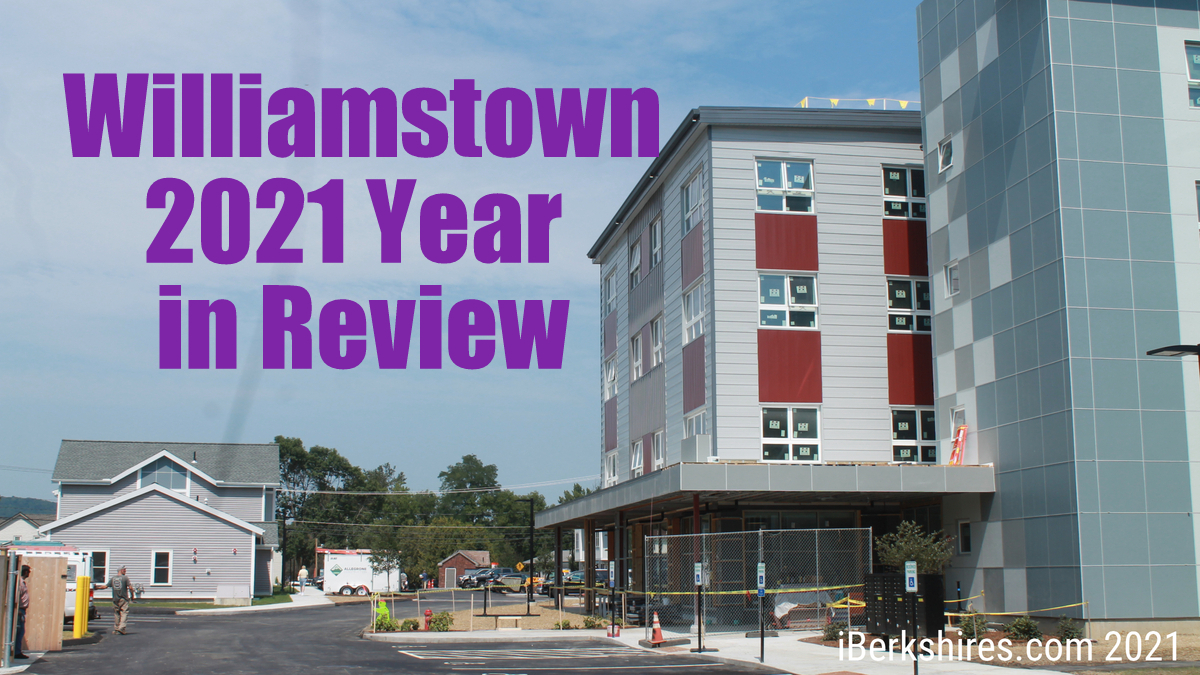
One of the town's most prominent eyesores got new life and new blood in 2021 as construction came to an end and new families started moving in to the former mill complex at 330 Cole Ave.
The new affordable housing complex, developed and managed by Pittsfield's Berkshire Housing, includes 42 units of permanent, subsidized housing.
It was another active year on the affordable housing front in town. In addition to the large complex at the north end of Cole Avenue, a single family home welcomed its first residents at the corner of Cole and Maple. The home, built on land acquired by the town's Affordable Housing Trust, was constructed by Northern Berkshire Habitat for Humanity, which immediately began building a second home next door.
Days after the Cole Avenue apartments opened, community members gathered to mark the 10-year anniversary of Tropical Storm Irene, which forced the closure of the Spruces Mobile Home Park and exacerbated an existing need for afford able housing in town.
The trust continued its efforts to address housing instability caused by the pandemic by creating an emergency mortgage assistance program to complement its emergency rental assistance program. Both are income-qualified programs that are aimed at residents who have suffered financial setbacks due to COVID-19.
And a second town panel took its own action to address the need for lower-cost housing in town. The Planning Board — freed of the seemingly endless debates about cannabis production — started a conversation about how the town's housing bylaw can be amended to create more opportunities to add to the town's market rate housing stock.
7. Can you hear me now?
An issue that has been dragging on longer than cannabis — though not quite as long as what to do about 330 Cole Ave. — came to an end when the Zoning Board of Appeals this year approved a special permit to build a new wireless communications tower in South Williamstown.
It took three continuations of the public hearing and several modifications requested by the ZBA to get the permit request across the finish line. And it was not the first ti me that a developer has tried to build a cell tower to serve that area of town. In 2012, the ZBA denied a special permit for a tower on the nearby campus of Mount Greylock Regional School.
With the permit in hand, the new applicant, Evolution Site Services of Pittsfield, in October built the tower whose initial tenant will be AT&T.
8. Voices of the historically disenfranchised lifted up, frustrated.
A few years after town meeting overwhelmingly decided to rename October's Columbus Day holiday in honor of indigenous peoples, a group of residents decided to use Indigenous Peoples Day 2021 to make a statement about Williamstown's colonial heritage.
The local artists sought and received permission from the town to erect a screen to temporarily obscure the 1753 House at Field Park, which recognizes the honors the memory of the town's 18th century European settlers but, for many, provides a painful reminder of the people who were forcibly removed from the land to make room for towns like Williamstown.
The plight of Black, indigenous and people of color has been very much on the minds of Williamstown residents since the national conversation focused on that issue in May 2020 and the aforementioned police lawsuit that came out a couple months later.
The town's Diversity, Inclusion and Racial Equity Advisory Committee continues its effort to center the concerns of the historically disenfranchised, but a couple of events in 2021 showed how much work needs to be done: five persons of color on the DIRE Committee (the town's first ever majority POC panel) chose not to continue after their first year with a couple specifically citing frustrations with their ability to be heard in town government, and members of the WPD were suspended after they illegally accessed the commonwealth's Criminal Justice Information System to look up residents who had been vocal on police issues.
Still, there was reason for optimism. Interim Police Chief Michael Ziemba was widely — though not universally — praised for his transparency about the CJIS violations, and he has engaged community members in a conversation about policing under the framework of a Department of Justice program. The town's public schools, meanwhile, continue to make it a priority to ensure that all children and families feel a sense of belonging in the Mount Greylock Regional School District.
9. Historic but adaptable.
One of the town's oldest landmarks is getting a fresh start and, perhaps, a new look, the town learned in 2021.
The Store at Five Corners, which dates back to the 18th century but has been closed since the summer of 2020, is on track for a revival in 2022 thanks to the efforts of a group of volunteers who formed a non-profit aiming to acquire the property and rent the business to a proprietor committed to maintaining it as a country store and community resource.
It is a good bet they will keep the name even though the namesake junction of Routes 7 and 43 may have its corners rounded off in the near future. The Massachusetts Department of Transportation has a plan to convert the intersection to a rotary in an effort to slow down vehicles and increase safety for the accident-prone location.
In 2021, MassDOT collected survey data about the idea, and just 17 out of 100 respondents indicated they were not in favor of the change.
10. From public house to Prendergast.
Speaking of highway interchanges, the junction of Routes 7 and 2 likely will have a new feature in a few years.
The Williams College Board of Trustees this year voted to move forward with plans to design a new Williams College Museum of Art on the site that formerly was home to the Williams Inn (since moved to the bottom of Spring Street).
In December, the WCMA's colleague, Clark Art Institute Director Olivier Meslay, called the new location a "game-changer" because of the increased visibility it will bring to the college's museum, home to the world's largest collection of the work of Maurice and Charles Prendergast.
Tags: year in review,