Police Advisory Board Hears From Community About Estrella's Death
PITTSFIELD, Mass. — The panel that spent last year questioning its purpose, feeling starved of community input, and losing a majority of its members is suddenly in the spotlight.
The killing of Miguel Estrella in late March by Pittsfield Police officers was the topic Tuesday with the Police Advisory and Review Board, meeting for the first time since the incident.
The board heard from six community members who asked questions about the workings of the Police Department that it expects to address at its next meeting.
"The PARB would like to express our sympathy for Miguel's family and friends," Chair Ellen Maxon said. "This has to be a very emotional and hard time for all connected to him and also for the whole Pittsfield community, thank you for deciding to attend and to share your thoughts with us."
She also noted that this is the most input the board has received from the community since it was founded.
Estrella's death remains under investigation but the incident has incited a larger conversation about mental health resources and police use of force. The 22-year-old was shot by police who said he was in a state of distress while wielding a knife on March 25.
NAACP member Kamaar Taliaferro, who has previously spoken on Estrella’s death, asked about the board's recommendations for the department in light of the incident, the number and nature of complaints that the board has received in its tenure, and the department's resources for less-lethal ammunition or restraint equipment.
He also had questions about the department's budget, which was $11,516,231 last year.
"I think that I would just like to recognize that this body was formed after another shooting of a resident in Pittsfield, Daniel Gillis, and there were members who are on this board who had said, 'we are preventative, we are not reactionary,'" Taliaferro said.
"So in the interim, it's been, what five years now? What concrete steps has this body taken, has the Pittsfield Police Department taken, in order for us to not have to react to the killing of our neighbors?"
Vice Chair Michael Feldberg said the board's governing ordinance has limited it to be reactive and to advise, but not to set and approve policies.
"It's also important to say that we review cases after they have been adjudicated after they've been resolved and one of the things that I think the public deserves to know about our role in this shooting that we're all concerned about is that we will only get to review the internal affairs investigation that the department does," he explained.
"Everything else, and I'm assuming at some point there will be a report and we will get to review it but it will be after the chief has reached the determination about whether or not the officer performed according to the standards and regulations in the department.
"Beyond that, if the district attorney wants to do anything about the case, it's outside our field of jurisdiction so we have a limited role here."
Maxon also reported that the board receives maybe six to eight complaints a year.
He also made a general observation about the board's recent struggles with its purpose.
"Looking over the minutes from 2020 and 2021 I see a consistent question was asked by members of this board, what is the goal? And how do you serve a function that's useful for people in our community?" Taliaferro said.
"I will leave that up to y'all to answer."
Pittsfield resident Dana Rasso spoke on how the city needs to invest money into the community.
"If we want a strong and successful community here in Pittsfield, we have to fund programs that create stability, our education system, our health care services, employment programs, and substance abuse treatment programs, and the solutions are all around us," she said.
"I'm not saying look too a far-off land that has implemented these solutions, I'm saying we can look to the Pioneer Valley where there have been these solutions implemented, these programs implemented."
She said investment in mental health programs should be separate from the Police Department and not dispatched with officers.
Rasso also called for the names of the officers involved in Estrella's death to be released and argued that ShotSpotter, which the department uses to respond to gunshots, is a waste of money and does not save people's lives.
Resident John Loomis brought up training that the department had done through the National Alliance on Mental Illness saying he was surprised the training was paid for through fundraising and that it was voluntary.
New PARB member Thomas Grady, a lieutenant colonel in the sheriff's office, said the training was based on the "Memphis Model" in which trained officers are spread throughout shifts to assure people in crisis are routed to mental health facilities and not jail.
NAMI saw the co-responder model as having a lot of value, he said, and the goal was to have crisis intervention training and have partnerships and relationships to be able to move toward that model, he said.
"The fundraising was developed because the smaller communities just do not have the ability to backfill the positions to allow the officers to attend a 40-hour training, so that was the reason behind the fundraising," Grady continued. "The Pittsfield Police Department never asked for backfill and overtime, they support this program very strongly by sending officers to each and every session and they were the ones that ended up developing the first-call responder model force in the county."
Michael Hitchcock, of the nonprofit Roots and Dreams and Mustard Seeds, pointed to the importance of having representation on the board.
"One thing that is important for you to know is that, try as you may, you are not representative of the community, there are now thousands of Latinos throughout the county, and many live and work in Pittsfield. There are people who are very impoverished and this board is more toward the middle-class side than the impoverished side," he said.
"So there's a little bit of a communication problem because your board is meant to be a conduit for community voices but community voices are less likely to be able to talk to people who don't speak their language, who don't look like them and who have much more affluence than they do ... your board is somewhat inaccessible to the kind of people that are most affected by policing."
Resident Alexander Blumin disagreed with many of the sentiments that were stated in the public comment portion.
"I believe this board represents representation perfectly fine, OK, you should not forget that besides democratic liberals that are also conservative people who live in Pittsfield, with a right to have different opinions," he said. "And according to our opinion, this board representation is absolutely fine and we should not have a special representative for different groups of people."
Blumin added that he supports ShotSpotter and the use of bodycams for police. He believes the police do need to have guns but should be "very careful" with them and try to avoid using them.
"In general, Police Department officers work good and from time to time, yes, something terrible can happen like what happened with Miguel Estrella but hopefully it will be fully investigated," Blumin said.
"But in general, they do need to have guns, we're not in Portland, we're not in the Pioneer Valley, we're here in Pittsfield, Massachusetts, with a lot of drug abusers, a lot of drug dealers, so police must have guns, however, they should be very careful using those guns, they should try to avoid using those guns."
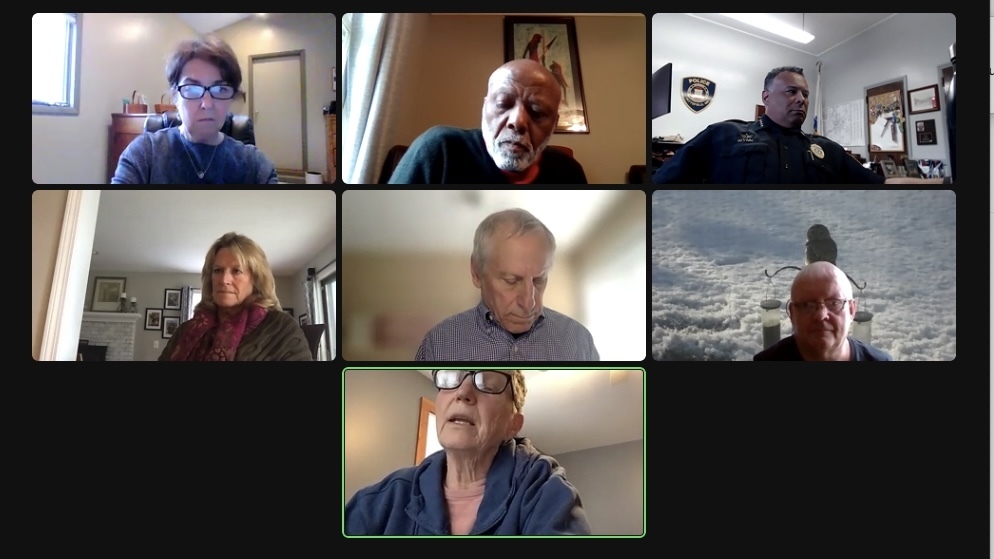
During this meeting, PARB welcomed three new members: NAACP President Dennis Powell, retired Pittsfield Public School employee Marie Richardson, and Grady.
The board is supposed to have 11 members and now has six, which is an improvement from the three members it had previously.
PARB's next meeting is on May 17 at 5 p.m
Tags: police advisory,