'Mary Ann Unger: To Shape a Moon from Bone' at WCMA
 |
WILLIAMSTOWN, Mass. — The Williams College Museum of Art (WCMA) announced "Mary Ann Unger: To Shape a Moon from Bone," a project consisting of a retrospective survey on view from July 15 through December 22, 2022, as well as a publication.
Organized by Horace D. Ballard, former Curator of American Art at WCMA and currently the Theodore E. Stebbins, Jr. Associate Curator of American Art at Harvard Art Museums, the exhibition and catalog offer the first curatorial assessment of the entirety of Unger's practice and highlight key works as culminating examples of her material experimentation.
According to a press release, rising to prominence in the downtown New York art scene in the 1980s and 1990s, Mary Ann Unger (1945–1998) was skilled in graphic composition, watercolor, large-scale conceptual sculpture, and environmentally-responsive, site-specific interventions. An unabashed feminist, Unger was acknowledged as a pioneer of neo-expressionist sculptural form.
"To Shape a Moon from Bone" reexamines the formal and cultural intricacies of Unger's oeuvre, as well as the critical environmental themes suffusing her monumental installations. The exhibition repositions Unger within and against the male dominated New York sculpture scene in the last decades of the twentieth century.
"To Shape a Moon from Bone" is Unger's first solo museum presentation in more than twenty years since the McDonough Museum of Art at Youngstown State University (Ohio) presented a fifteen-year retrospective in 2000.
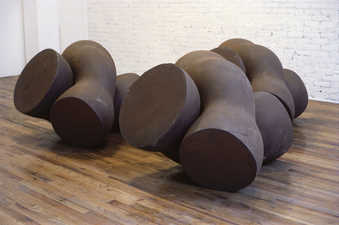
The artist's monumental homage to prehistoric migration, Across the Bering Strait (1992–94), will be on view in concert with previously unseen works on paper and other sculptural works from the Mary Ann Unger Estate, as well as special loans from the Whitney Museum of American Art and Munson Williams Proctor Arts Institute.
Works by Unger's daughter Eve Biddle, artist and co-founder of the Wassaic Project, bring two generations of a family of artists—which includes Unger's husband, noted photographer Geoffrey Biddle—into conversation around memory and material evidence.
Tags: WCMA,