Berkshire County at Level 1 as Most of State Experiences Drought Conditions
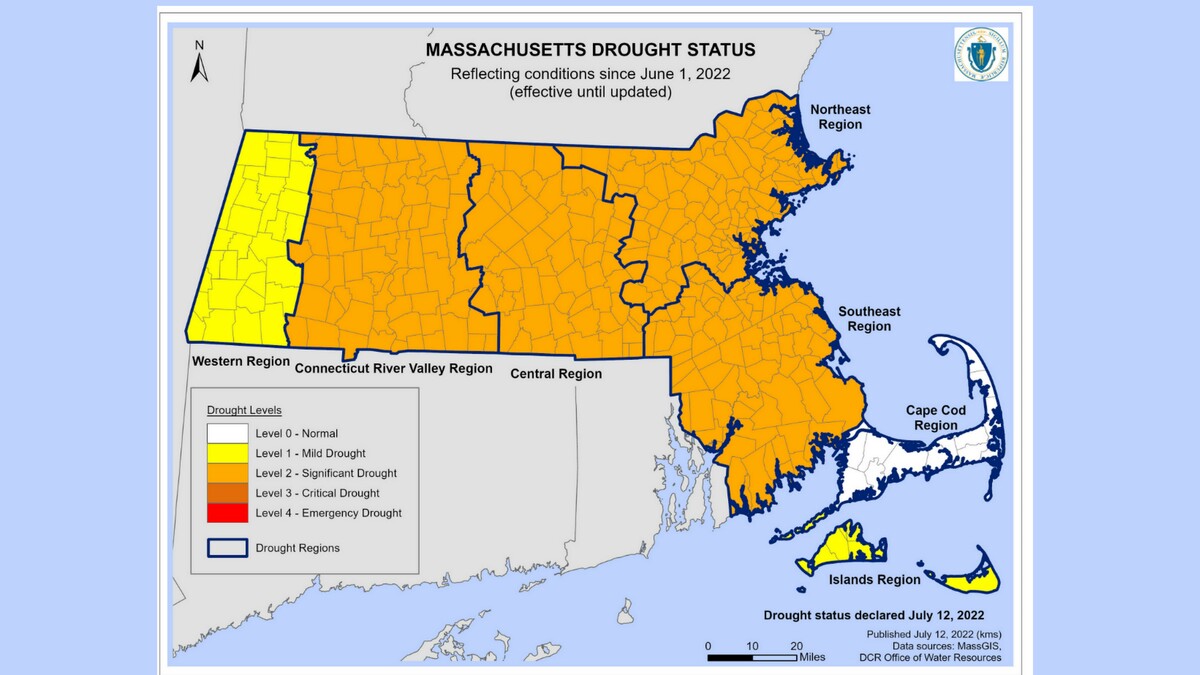
BOSTON — The state has declared Berkshire County to be in a Level-1 Mild Drought, as 90 percent of Massachusetts is experiencing drought conditions.
Energy and Environmental Affairs Secretary Beth Card on Wednesday declared a Level 2-Signficant Drought in the Northeast, Southeast, Connecticut River Valley, and Central Regions of the state. Additionally, the Islands Region will remain at Level 1-Mild Drought along with the Western Region, which was elevated from normal conditions last month.
A Level 1-Mild Drought warrants detailed monitoring of drought conditions, close coordination among state and federal agencies, and technical outreach and assistance to the affected municipalities, according to state officials.
The Cape Cod Region will remain at normal conditions. As outlined in the Massachusetts Drought Management Plan, a Level 2-Significant Drought warrants the convening of an inter-agency Mission Group, which has already been convened, to more closely coordinate on drought assessments, impacts and response within the government.
"As the state continues to experience dry conditions, and with little rainfall expected in the immediate forecast, it is important that we all implement water conservation practices to reduce stress on our local water supply systems and our natural habitats," said Energy and Environmental Affairs Secretary Beth Card. "The Baker-Polito administration will continue to work closely with its municipal partners and local water suppliers as we further monitor ongoing drought conditions and address its impacts, particularly on the agricultural sector."
Massachusetts Emergency Management Agency acting Director Dawn Brantley said residents should exercise caution when using charcoal grills, backyard fire pits, and other open flame outdoor activities to prevent outdoor fires.
"Residents can also assist during the drought by minimizing water usage and following any local water restrictions for their area," she said.
Since the start of June, hydrological conditions have continued to decline across the state and in particular in the northern half of the commonwealth. Significantly, the drought has been both spreading and intensifying, with indices dropping more rapidly due to lack of precipitation over the past several months.
Fire danger in the northern half of the state is steadily on the rise, with noticeable drought stress on foliage in shrubs and grasses. It is expected that low dew point and higher evapotranspiration may continue to impact the drought in the coming weeks as the state will experience the hottest time of the year. Furthermore, streamflow has been severely impacted across the commonwealth, with dry stream beds and ponding visible in many locations. Ongoing drought conditions are also impacting growers, including local farms, with some farmers irrigating more heavily due to the lack of precipitation.
The Massachusetts Water Resources Authority water supply system is not currently experiencing drought conditions, as defined within its individual plan. However, private wells, local streams, wetlands, vernal pools, and other water-dependent habitats located within MWRA-serviced areas will be impacted by drought conditions while water quality in ponds can deteriorate due to lowering of levels and stagnation.
Those in Level 1 and 2 are advised to minimize water use and limit outdoor watering to one day a week with handheld hoses and watering cans before 9 a.m. and after 5 p.m. Toilets, faucets and shower make up more than 60 percent of indoor water use.
Communities can adopt the state's nonessential outdoor water use restrictions for drought such as limiting washing of outdoor surfaces and vehicles, filling swimming pools and hot tubs, and establish water-use reduction targets.
The Drought Management Task Force will meet again on Monday, Aug. 8, at 1 p.m. For further information on water conservation and what residents can do, please visit EEA's drought page and water conservation page. To get the most up-to-date information on the drought indices, go to the state's drought dashboard page.
Tags: bad weather, drought,