'I Am Water' Billboard Exhibit Speaks to Environmental Issue
PITTSFIELD, Mass. — H20-themed billboards across the city — and one in North Adams — aim to start a conversation about water issues.
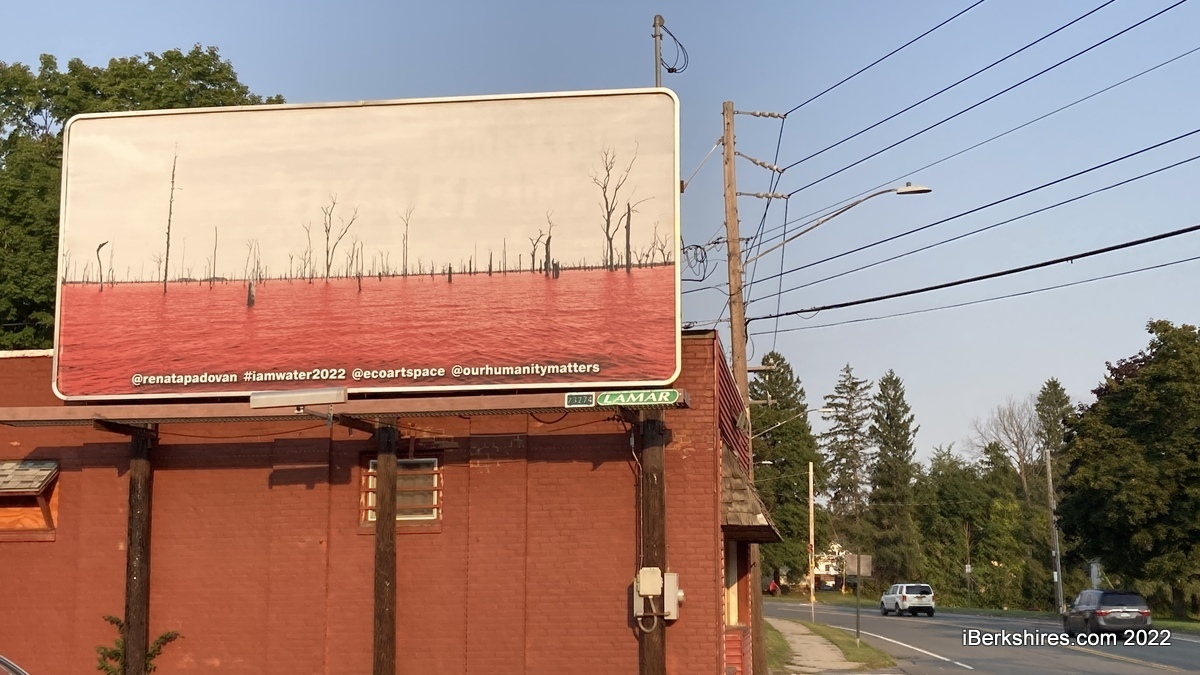
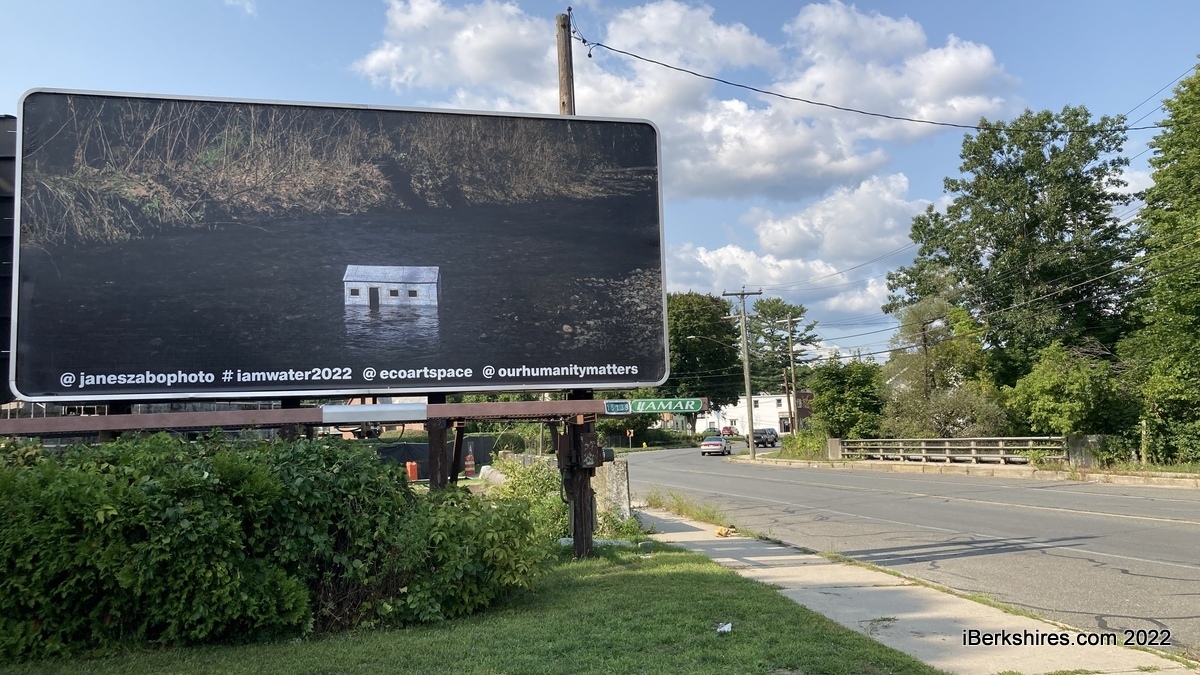
As a part of the "I Am Water" exhibition by ecoartspace and Our Humanity Matters, five billboards featuring artwork that speaks to the power of water will be featured in Berkshire County and one over the state border in New Lebanon, N.Y.
The works address water conservation, quality, flooding, and scarcity.
It is an appropriate time for the narrative, as the state and county has been in a drought this summer and, last month, the city of Pittsfield implemented mandatory water restrictions.
"'I Am Water' is the scientific reality that we are water," said Patricia Watts, founder of ecoartspace, a platform for artists addressing environmental issues.
"We're composed primarily of water and when we look at water bodies, lakes, rivers, streams, or oceans, we're really looking at ourselves because we can't live without it. If it's contaminated or not drinkable, not potable, then you know, our time is limited here."
One of the artists, Lyn Horton, resides in North County. Her digital photograph that features an up-close look at natural waters will soon be featured on a billboard next to Charland Jewelers at the intersection of Dalton Avenue and Cheshire Road.
"What I'm interested in when I take photographs of nature, in nature, I want to find something that is within the frame that has some sort of abstract content," she explained.
Horton's love for drawing informed her skills in photography.
"I learned from the photographs that the relationship I was applying in my process of drawing was similar and so when I photograph things, I'm actually constructing the photograph only in the frame," she explained.
"So, I'm attracted to what works within the frame, which means that I am I'm sort of imposing on my choice of what's in the frame in regards to what I have made in drawings."
The photograph is a part of her water journal and was taken near Worthington in Hampshire County, which is not far from the Berkshire County line.
She raised the money for her board through a GoFundMe campaign after being selected as a finalist.
Over 20 years ago, Watts conceived the idea for her art space and then partnered with New York City curator Amy Lipton --who passed away in 2020-- to create ecoartspace. It has been a platform for artists addressing environmental issues since 1999.
"We wanted to do a space but what happened was we were early. We were earlier in the conversation about how artists could address these issues and so we ended up basically educating a lot of institutions about the artists and curating shows for them," Watts explained.
"So we decided that it would just be a platform and not a physical space because if we wanted to focus on the shows and building a building and all that can be un ecological so we just focused on doing the shows and curating and educating."
The exhibition will include a total of 17 billboards in New York City and the Western Mass region and the artists were selected out of more than 450 initial submissions.
Watts and Tanja Andrejasic Wechsler, founder of Our Humanity Matters, selected the first round of 40 artists and then invited the ecoartspace members to vote on their top ten.
Through fundraising and application fees, the organization had about $5,000 to put toward the billboards. After starting the process of placing boards, they were offered a few bonus public service announcement boards and less expensive interim boards.
They then invited the remaining artists out of the 40 to individually fundraise for their billboards, bringing the budget to $10,000.
"Western Mass was welcoming and made it easy for us," Watts said about the decision to bring the billboards to the Berkshires, citing high costs in other areas of the country.
She added that Lamar Outdoor Advertising was very generous in providing the PSA billboards and was pleased to see that they use a more eco-friendly, thin wrap for the board.
"I think that the real idea here is to co-opt the kind of capitalist model of advertising and use it as a way to mirror back to society what's really happening in the world outside of what you can buy and consume and extract from the planet," she said.
"That these resources are finite and advertising gets this into the subconscious. We want these images to be in their subconscious rather than products."
Last year, the two organizations held the I Am Water exhibit in collaboration with a third organization, SaveArtSpace. It consisted of 10 billboards in the boroughs of New York City.
The paid boards will be up for a month and the PSA boards will remain until another advertiser buys an ad on the board.
Horton became involved with the art space some time ago and became more involved during the COVID-19 pandemic through meetings over Zoom.
"My participation in this group is as an activist," she explained.
"I do my work and publish it on my website and let people know about it and so as long as people know about it and I'm bringing awareness to the drawings that I make, I'm bringing awareness to trees, water, whatever I'm doing, that's my activism."
The six works on the billboards in Berkshire County and Columbia County include:
- E.J. McAdams, "DROUGHT," 2022 at 368 State St., North Adams
- Lyn Horton, "Water Journal 14," 2022, at 6 Cheshire Road
- Renata Padovan, "The Dam That Killed the Forest," 2022 at 220 West Housatonic St.
- Perri Lynch Howard, "Lights Flight," 2022 at 17 Elm St.
- Jane Szabo, March 2, "Coal Creek, March," 2019 at 185 Wahconah St.
- Rebecca Riley, "Flood Atlas, Page 10," 2019 in New Lebanon, N.Y.
Tags: art exhibit, billboard,