PHS Alumni Write Training Book on Terrorists in the Prison System
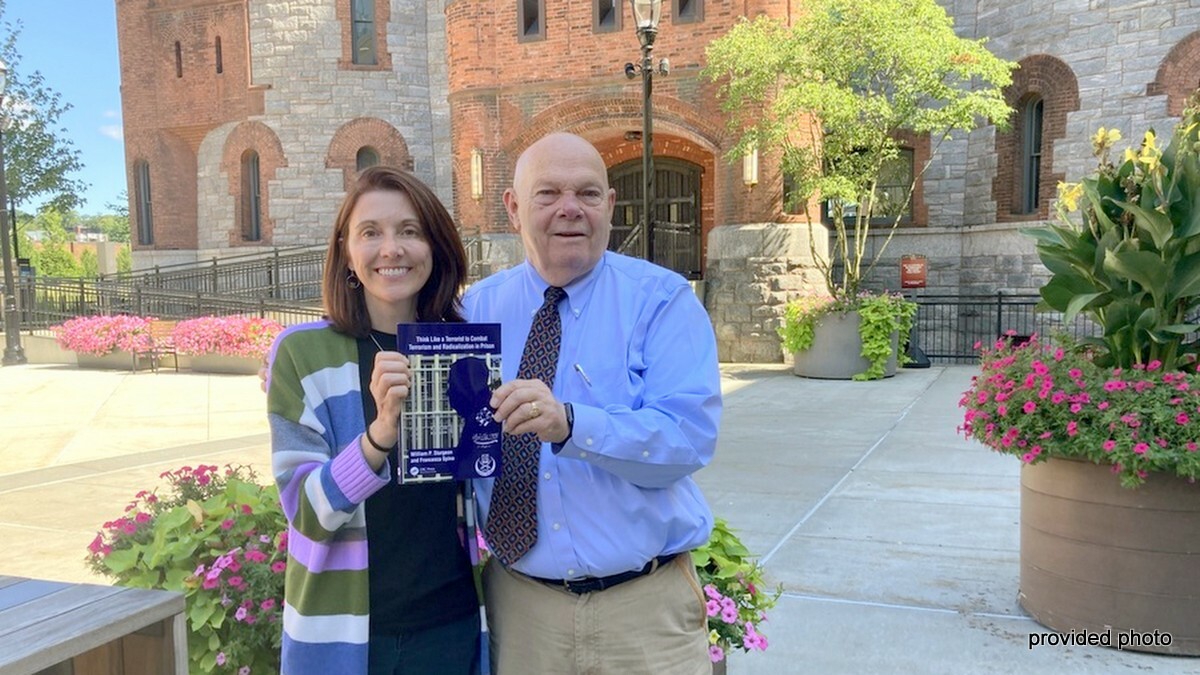
PITTSFIELD, Mass. — Two Pittsfield High School graduates separated by 30 years collaborated on a book urging a change in the way the prison system functions to address terrorism and radicalization.
Criminal justice consultant and local radio host Bill Sturgeon and scholar Francesca Spina combined their experience to research and present best practices in their training guide "Think Like a Terrorist to Combat Terrorism and Radicalization in Prison."
The duo made a good team working intergenerationally and across specialties, they said.
Researchers and practitioners are often separated so Spina said she was very excited when Sturgeon reached out to her to collaborate on the book. She is a professor in the field of criminal justice and co-authored another book on the state's criminal justice system.
The book provides guidelines and training for hardening facilities to prepare for a new type of criminal that will eventually enter correctional facilities.
"The terrorist extremist is a different type of offender because they have a cause. They're not just criminals, they commit criminal acts, which ends them up in the correctional facilities, but they're committing these acts as part of their belief system," Sturgeon said.
One of the things Sturgeon noticed in his nearly 50 years of experience in the criminal justice field is the outside world is a precursor to what is to come in the correctional world — but facilities are underprepared when it arrives.
"First was HIV/AIDS. It was all over, you know, the civilian world and then it came into the correctional world. And there wasn't any protocols planning for it. It was just there. So we were playing catch up," Sturgeon said.
He also saw this in the 1990s when youthful offenders began to be adjudicated as adults and sent to penitentiaries that weren't based on dealing with juveniles so they also had to adapt to that.
Another example was the increase in street gangs that eventually became into prison gangs but no one "translated it to be prepared to go into the correctional environment," Sturgeon said.
Most convicted terrorists are housed at a super maximum-security prison, or supermax, in Florence, Ariz., but at some point will enter the prison system and its unclear how it will react. However, Spina said most radicals will come through a county jail, which is why the book heavily focuses on jails.
""It's so complicated and I think they don't focus on the prison system. It's like we only see what's in the media. You know, when we see the Boston bomber, for example, you don't think about how do we manage these folks when they're actually in the prison system and the problem of the radicalization within the political system and it just spreading everything," Spina said.
Sturgeon recalled a quote from a British team member that resonated with him during his first counterterrorism job.
"To defeat a terrorist, you have to think like a terrorist," Sturgeon quoted him saying.
They both noted that there have not been a lot of successful deradicalization programs because the subjects are often raised from a young age to have this belief system or hatred.
One thing that the book calls for is staff training to strengthen first-line supervisors and staff because they're the ones who interface with prisoners on a daily basis.
This training is especially important because some terrorists are being trained on how to act out in prison, Sturgeon said. For example, an Al Qaeda Training Manual that was located during a raid in Manchester, England, that described how inmates should behave in prison.
"[There] is a whole section on how to behave in prison. So they're trained on how to act, and how to act out ... so they're trained to deal with prisons, but we're not trained to deal with them," he said.
The first thing that Sturgeon and Spina's training teaches is to acknowledge and respect why the subjects committed their crimes.
"They have an ideology. Don't be disrespectful of their ideology because you have to take them as they are," Sturgeon said. "We have been painted to be the 'great Satan,' the great evil. So, if we start to treat them with respect hopefully, you're breaking down a barrier."
A part of the correctional system that people often forget is "care and custody," Sturgeon said. So staff needs to treat the prisoners with respect to act as role models in an effort to transform the image that they have been taught.
"I’m a big believer in people's rights and human dignity. You may be in prison, you did something your punishment is being in prison. There's no more punishment than losing in my opinion and losing your freedom," Sturgeon said.
"So to treat people with respect, that is always been one of my standards, even when they weren't always respectful to me. But for us to demonstrate who we are as a nation as a people, to me is an important part of deradicalization than a formal program."
Although it is important to treat the inmate's ideology with respect it is also important to be prepared and expect the unexpected because they have been taught to act out when arrested, Sturgeon said.
The changes that they are also proposing is vetting visitors, religious practitioners and mail that comes into the prison.
"I think that the proposals that are the changes that we're proposing can be very effective. ... I also wanted to mention vetting the mail that comes in but just making sure that the staff are trained to recognize religious material that could come in could be radicalization material," Spina said.
"Just being able to recognize that either if it comes into visitors, or if it comes in through just the mail itself, and just that the inmates don't disseminate that material. Don't get in the place, but so they can't disseminate it to others."
Although vetting is an important part of the process they also want to make it so that inmates have access to their religious material.
In the book, they propose a diverse panel of individuals who represent various religions and others on the outside to determine what religious materials and articles will be permitted within a correctional facility.
They also call for a separate and distinct classification and housing and then a step-down program if there is a documented and verified attempt for the deradicalized.
"So the goal, again, is respect. But fair, firm and consistent behavior on the staffs part. Fair, Firm and Consistent. So when I come to work, they see me, they know this is my tolerance level," Sturgeon said.
Professionalism even if a staff member does not share in the inmates' beliefs is key, Spina said.
"I think that a lot of correctional staff, they've become more professional over the years, whether it be dealing with gang members, or no matter who you're dealing with," Spina said.
"I think it's just important to professionally deal with these types of inmates whether or not the guards or others agree with their beliefs, and just treating them with dignity and humanity, and things of that nature."
This change would have to start from the individual agencies.
More information on the authors or their book here.
Tags: books,