Berkshires Applauded for Climate-Tech Ecosystem
PITTSFIELD, Mass. — The Berkshires are seen as important partners in the statewide goal for a climate-tech corridor.
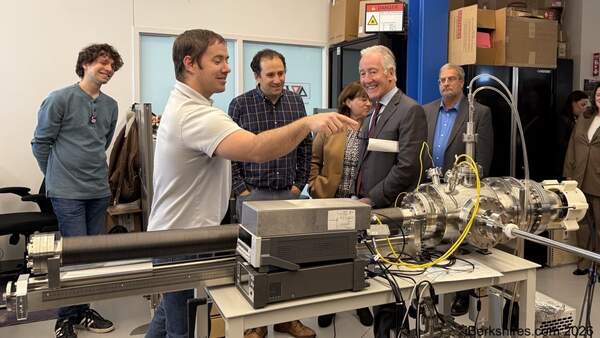
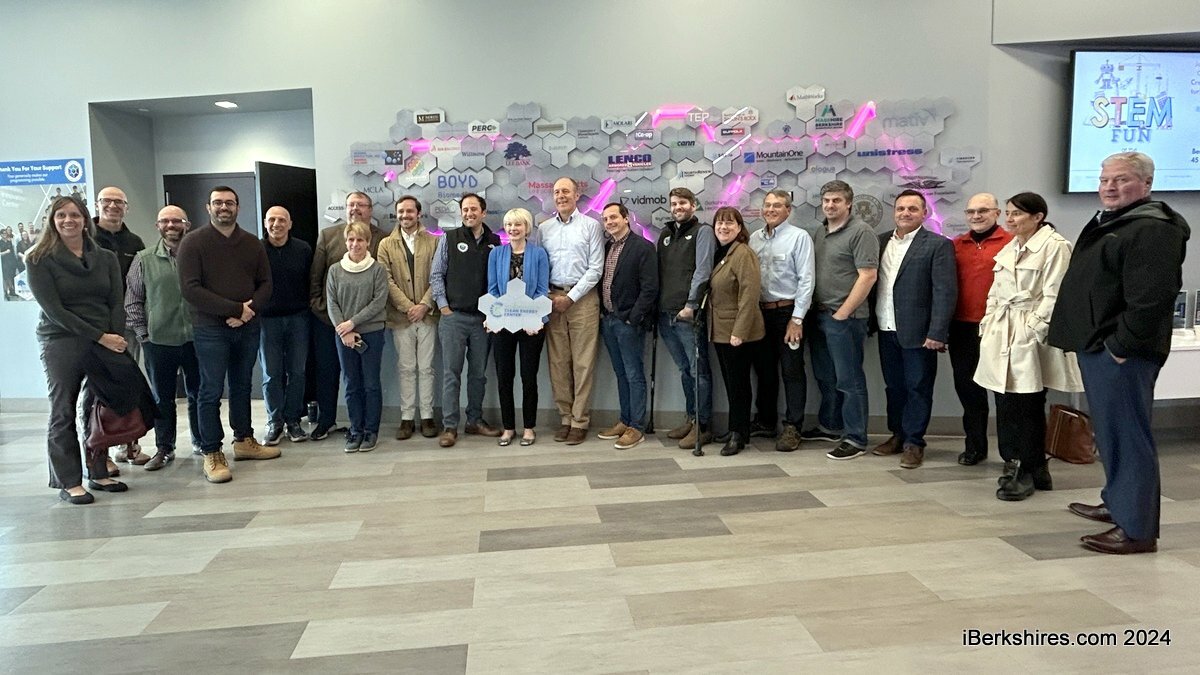
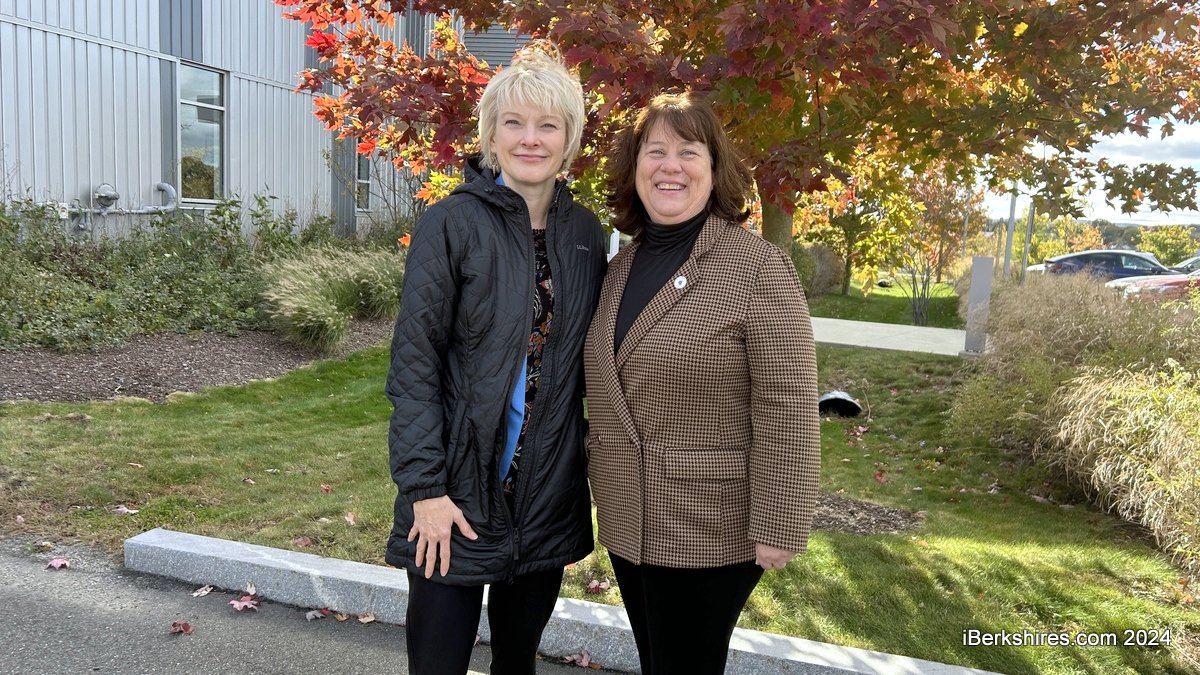
On Wednesday, Massachusetts Clean Energy Center CEO Emily Reichert visited the Berkshire Innovation Center to hear from industry stakeholders. After a roundtable with local startups, economic development officials, and other representatives, she was given a tour of the park.
MassCEC is committed to building a climate-tech corridor that touches all corners of the commonwealth, from the Berkshires to Barnstable.
"I have to say, actually, climate tech is already here. I think just sitting around the table, there are about six startups who happen to be here today that are doing climate tech-related innovations so that's pretty incredible. We're building on something in this region and I think that if I was to summarize what we're doing here today, it is really the beginning of the work that we are doing as an administration to build a climate corridor across the state," Reichert said.
"A climate corridor that recognizes that each region uniquely can contribute to being part of a greater climate tech economy and they can do that through having young companies but also larger companies, investors, talented students, and employees that can be part of building these companies, academic institutions who are helping to produce the graduates."
She added that there is a willingness and interest to do more to help create that future "And I definitely feel that here visiting the Berkshires."
MassCEC funds climate solution innovation to meet the state's emission reduction goals while growing the state's clean energy economy.
The BIC is positioned on the former General Electric headquarters, offering new life to the site after the company left decades ago — also leaving behind PCB pollution.
"What better place to have this rebirth around clean energy than the William Stanley Business Park," said Ben Sosne, executive director of the BIC.
"Which, thanks to the work of the city and the state, is now prime for this redevelopment."
The business park's largest parcel Site 9 underwent an $11 million makeover to be development-ready, and nearly five acres were purchased by Mill Town Capital for a commercial building upwards of 20,000 square feet.
"It's exciting to think about how industrial spaces of yesterday can be reutilized for the innovations of tomorrow and so when I think about the opportunities here, I really think about what are the next generation of companies that could build here in Berkshires," Reichert said.
"And from what I understand, the community has really worked hard to move these former sites to a place where they are now ready to support that growth so it seems like an exciting opportunity to me."
She recognized that each region has something unique to offer and commended the existing ecosystem in Berkshire County. Sitting at the roundtable in the BIC, she felt how strongly the community wants to be a part of the climate-tech future.
"When I think about the Berkshires, I think about first and foremost companies that you already have here who are choosing to start the company in the Berkshires because they're part of an ecosystem that is forming here around the Berkshire Innovation Center," Reichert said.
"That is a really important point, is that you need that ecosystem. You need the connective tissue, the fabric."
She pointed to the nearby remnants of General Electric and how they translate to today.
"It translates to the talent that exists here, the expertise that exists here and so I'd say that's another key piece of the puzzle is that you have this manufacturing history, people that have been involved in these companies, this know-how for developing products at scale and so that's actually a very exciting thing that I think the Berkshires has to offer," she said.
Reichert has sensed a climate-tech cluster around agriculture, as it is a large source of carbon emissions and has impacts on the waterways. During the roundtable, she heard about several different companies working in that area and thinks it can be built upon.
She explained that the MassCEC helps to build a developing and testing network for young companies to market their technologies and expand.
"I believe that there will be a number of assets in the Berkshires that we will be able to point people to, wherever they're coming from across the state," she said.
The CEO identified the Mass Leads Act as the catalyst for creating the climate corridor. The bill includes a 10-year investment in climate tech to compete in the emerging clean energy sector.
"Whenever that bill is passed, we will be ready because we have an economic development plan for climate tech for the state that is ready to go and is currently in final review," she reported.
Over the summer, the BIC announced they were named a Phase II: Create winner by the U.S. Department of Energy for the Manufacture of Advanced Key Energy Infrastructure Technologies (MAKE IT) Strategies Track.
The BIC is one of seven applicants across the country, and the only one in Massachusetts, to receive a Phase II award. The Phase II award of $100,000 will support the BIC's project, the Berkshire Clean Tech Initiative (BCTI), to create a roadmap for growing clean tech manufacturing in the Berkshires and supporting start-ups in the clean tech industry.
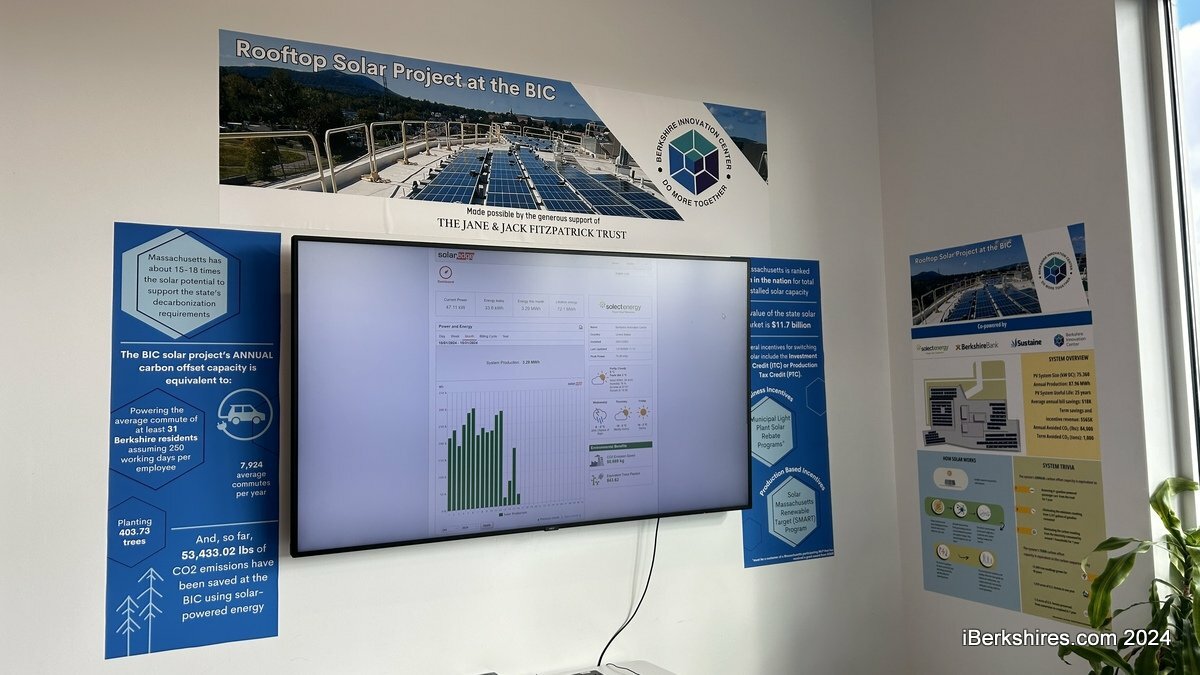
This year, the center installed solar panels on its roof that will cover about half of its usage for the year. The panels are co-powered by Select Energy, Berkshire Bank, and Sustaine.
Sosne also hopes that the move will inspire others in the community and BIC's network to follow suit.
Tags: BIC, clean energy, climate technology,