North Adams Council Pauses Tax Rate Decision
.jpg)
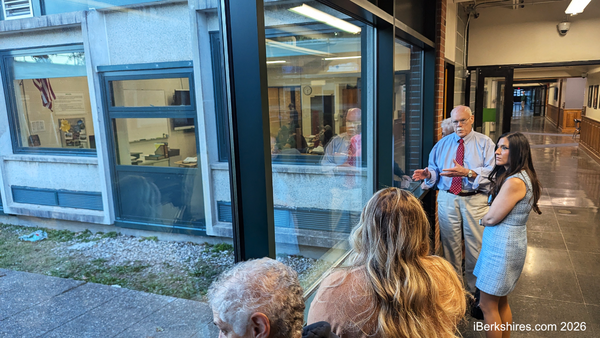
Assessor Jessica Lincourt goes over valuations at Wednesday's tax classification hearing.
Mayor Jennifer Macksey had recommended a 1.75 shift differential to the commercial side as a way to relieve pressure on homeowners.
The councilors, however, described the jump from last year's 1.68 to the max shift as "whiplash," especially after spending years trying to gradually shift toward residential to find some equity between the rates.
The council briefly considered setting it as 1.72 as a compromise — and so as not to publish it as a legal notice again — but ended in referring it to Finance Committee.
"I'm very, very cautious and aware of keeping North Adams an affordable community to the residents while also wanting to be welcoming to both businesses who operate here currently, and those we hope to attract," said Macksey.
The mayor and her team said the recommendation to depend more on the commercial side was based on rising heating prices and inflation that's hurting residents.
A split tax rate with a commercial shift of 1.75 would set the fiscal 2023 residential tax rate at $17.46 per $1,000 valuation, a drop of $1.07 from last year, or 6 percent. But the owner of an average single-family home assessed at $194,714, up $30,000, would see their tax bill rise by $300.
The commercial and industrial rate would have been $38.35 per $1,000 valuation, a drop of 91 cents, or 2 percent.
Councilors Keith Bona and Wayne Wilkinson objected that jumping the commercial rate would hurt businesses. The city's commercial rates are high in comparison to other Massachusetts communities while its residential bills are among the lowest.
Bona said the costs for businesses are pretty much the same throughout the state. But a higher tax rate in North Adams may deter new businesses from opening and affect those small businesses already in operation.
"It's just not to me a business-friendly message to keep having that separation," he said. "We've been trying to pinch it a little."
Councilor Bryan Sapienza pointed out the city has been trying to grow more commercial outlets.
"It's very tough to own a business in the city and with a higher tax burden, I think that's going to discourage more and more businesses and we need our businesses," he said. "We need the businesses to thrive in this area."
The mayor's financial team thought that this would be a good time to raise the business side because the commercial values had not risen in the same way that personal property ($3 million) and residential had ($82 million).
"Given the unrest right now in the world, gas prices — residents are really struggling," said Assessor Jessica Lincourt. "We just kind of looked at the 1.75 as the next best option."
Councilor Marie T. Harpin said she was supportive of business but thought the residential side needed some relief.
"The shift has always been more favorable to the commercial industrial side," said Harpin, participating remotely. "This year, I would really advocate even more because the residential side valuations went up so substantially, and commercial and the industrials went down."
She said she had heard from residents about tax rates but not from businesses. "I'm really not sure how much the business community was concerned on this," she said
Bona noted that the commercial side's lowered valuation by $2 million was because of abatements, reductions in value and properties coming off the tax rolls. That would leave operating businesses to pick up the slack, he said.
"I think when a lot of people think commercial, they think of these big huge corporations and conglomerates, but it's not the case," said Councilor Ashley Shade. "It's all the mom-and-pop stores, too, all the local businesses. People who live in this community who are now paying extra as well. And I think we have to find a balance together as a community."
There was some discussion on whether to amend the order to a 1.72 shift (for a residential rate of $17.64 and commercial rate of $37.37) but the motion failed 5-4 as councilors preferred a more expanded debate.
A frustrated mayor said she was willing to work with the council but also wanted to keep the needs of residents in the forefront — and keep in mind the need to start sending out bills.
"I'm willing to work with you but I'm a little upset," she said.
The council voted to refer the matter to the Finance Committee to meet on Nov. 22 at 6 p.m. prior to the full council meeting.
Tags: fiscal 2023, tax classification,