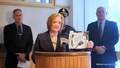
Emergency Planning Committee Notes Staffing Challenges
PITTSFIELD, Mass. — The Berkshire County sheriff's office is working with the state in an attempt to resolve some of the staffing shortages for emergency personnel exacerbated by lack of funding.
At the most recent Central Berkshire Regional Emergency Planning Committee, Lt. Col. Thomas Grady, assistant deputy superintendent at the sheriff, noted that there are five public safety answering points in the county along with the sheriff's 911 countywide dispatch center.
Dalton, Great Barrington, North Adams, Pittsfield and Williamstown operate their own call centers.
"Everybody else is competing for the same group of people and it becomes that same thing as EMS, it's a round robin, it's a challenge with financing and funding," he said.
The management of 911 dispatch center's budget is confusing because it is part of a state agency, as opposed to a municipality. That makes it challenging to get and transfer money, and how the State 911 department can support it with their formulas, Grady said.
These staffing challenges were one of the areas for improvement noted at the hazardous material exercise that took place on Oct. 22 in Richmond.
"We just don't have people during the day. It's a sign of the times and so those are the types of things that we've got to plan for it. We've got to look at, you know, where can we get people," Planning Committee Chair Michael Britton said.
Public safety agencies were able perform operational coordination with some challenges including staffing shortages, training, and lack of resources.
The after-action plan noted the strengths as being able to develop and implement the initial incident command system, expand the Incident Command System as the emergency grew in size and complexity, and good coordination between local responders.
During the training, commanders for the fire, police, emergency medical services, and the department of public works expressed the need for continued ICS training.
"The region has a lack of 'large scale' incidents which would allow for 'on the job' training," the after-action report says.
Mmber Ray Bolden mentioned that there should be a central location where training date, times, and locations can be posted to make it easier for people to find training and maintain their certifications.
It was also noted in the after-action plan that initial road closures were delayed due to lack of resources.
"It appears that local public safety agencies are reluctant to request and deploy resources out of their domain," the report said.
"Many tasks that could be filled quickly, i.e. road closures, were delayed by dependence upon other public safety agencies, Mass State Police, Pittsfield Police Department, etc. There were some comments on requesting Massachusetts Department of Transportation to provide additional sign boards and barricades."
Although Richmond officials were able to provide sufficient warning and information to the public in an emergency using a public alert system, social media, and informal communications capability, they were met with major challenges, the after-action report said.
The community has a CodeRed system but only a few of the department heads are "authorized" to use it, "not leaving many other agency personnel to quickly relay information to the public," the report said.
Another area of improvement noted was the use of social media to share incident updates, traffic concerns, and road closures.
It was recommended that agencies develop a policy that would prompt the on-duty dispatcher to request the incident commander's permission to inform local media outlets of the incident.
Grady noted that although social media is a good tool to spread information they should not be solely reliant on it because it tends to be unreliable during certain emergencies since the internet tends to go out during major weather-related emergencies.
"Should we start looking at reinstalling learning sirens in communities to be able to notify people, when they hear a siren going off, that there's something going on?" Grady said "And there's more to just that, then the siren, but the technology is great, while it works, but in all of the major catastrophic incidents that we've had, it's always identified that the communication systems fail."
Grady also announced that he has deferred his retirement to continue to liaison with public commissions, including the CBREPC, public safety, the regional Homeland Security council, and other groups.
He has stepped away from the day-to-day operations and running the 911 Center. Capt. Jason Breault will now be in charge of running the center. Grady has moved to a temporary office down at the old jail on Second Street.
In other news:
The committee voted to move forward in the application for the Hazardous Materials Emergency Preparedness (HMEP) grant which is due Dec. 30.
Grady informed the committee that there is a free training class on the Western Region Homeland Security Advisory Council website for advanced medical life support. There will be a couple of sessions over in Easthampton and it is open to any EMS groups in Western Massachusetts.
Massachusetts has adopted the National Fire Protection Association 3000 standard for a consistent standard on how to respond to active-shooter incidents.
"What that brings with it is the Rescue Task Force model now. So what the Rescue Task Force says is that the response to active shooter and hospital event incidents is no longer just a law enforcement response," Grady said.
"We're going to create hot, warm and cold zones. We're going to be able to bring fire and EMS in to extricate victims of these types of incidents and the way we're going to do that is we're going to train with them and we're going to equip them."
Numerous EMS and fire agencies in the county have already applied for ballistic vests, helmets, and protective equipment.
Tags: emergency preparedness,