Williamstown Planning Board Talks 'Cottage Court' Bylaw
WILLIAMSTOWN, Mass. — Though its work is not completed for the proposals it hopes to bring to this spring's annual town meeting, the Planning Board recently started talking about an idea it wants to work on for the 2023-24 cycle.
Ken Kuttner and Roger Lawrence at the board's January meeting gave their colleagues a presentation on the concept of cottage courts and suggested a bylaw could be crafted to allow that style of housing in town.
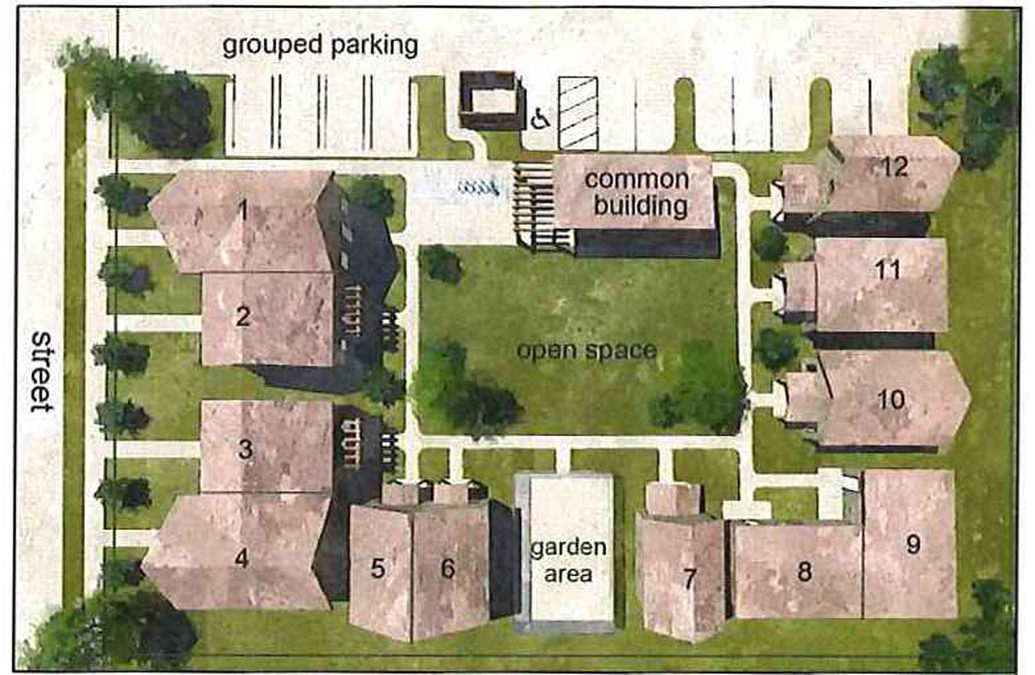
Cottage courts are relatively small clusters of homes, typically 500 to 800 square feet, grouped together on a single residential lot.
"They're not 'tiny houses,' " Kuttner said. "Typically, they're single family but sometimes duplexes. … One of the distinguishing features is they have a common area, sometimes a community building. You can get densities of maybe 10 to 15 dwelling units per acre, which is pretty good."
The concept of cottage courts, also known as "pocket neighborhoods," has been explored elsewhere in the commonwealth as a potential solution to local shortages of affordable housing. Kuttner talked about successes with the model around the country and noted that the concept was utilized in California in the early 20th century.
Kuttner said while not necessarily "affordable housing," in the sense of income-restricted homes, the market-rate cottage court homes might be a more affordable alternative.
"In theory, they should be [attainable] thanks to small lots, small structures and economies of scale from building multiple units at the same time," Kuttner said.
"Suppose we allowed manufactured homes and cottage courts. You could imagine synergies between the two. That would be something where you could achieve some real cost savings."
One of the warrant articles the board has been working on to send to May's annual town meeting would allow manufactured homes, by right, on single-unit lots in the town's residential districts.
Lawrence pointed out that the cottage court housing, if allowed, could be developed in a cooperative ownership structure.
"If folks who wanted to live in small homes wanted to pool their resources, they could gain an efficiency of scale," Lawrence said.
Town Planner Andrew Groff advised the board that the cooperative ownership structure is allowed by right already in the commonwealth and not a local zoning consideration that would need to be addressed in the town's bylaw.
The cottage court concept would require a zoning change, primarily to address the density restrictions in the bylaw.
Kuttner showed the board a sample ordinance from Langley, Wash., that allows, "one dwelling unit per two 2,904 square feet of lot area (15 units per acre)." The Washington city's ordinance also caps the unit size in the pocket neighborhood, requires minimum common areas and mandates that parking be screened.
The board agreed that he and Lawrence should begin drafting a proposed bylaw for Williamstown that the board could take up at some point in the next few months and begin developing for the 2024 annual town meeting.
As for this year's town meeting, the board in January worked on hammering out the language for an FAQ document to inform residents about the proposals the panel does plan to bring as warrant articles. It also talked about other modes of outreach the board can employ in advance of the May meeting.
Tags: housing, Planning Board,