Pittsfield Panel Supports GE Funds for Optics Company
PITTSFIELD, Mass. — Electro Magnetic Applications Inc. may get a quarter-million-dollar boost from the city for the development of a characterization testing chamber.
On Monday, the Community and Economic Development subcommittee supported a $250,000 allocation of GE economic development funds for the tech company.
"We all know how important workforce development is and we know how much of an impact advanced manufacturing has on our regional economy so when we have a company looking to work with high school students and college students and give them the training that they need to go into jobs within our community and to keep our kids here, I think that's great," Ward 5 Councilor Patrick Kavey said.
"I'm happier doing that and I actually prefer seeing small local advanced manufacturers instead of a large company because I don't think it's smart to put all of our eggs in one basket. We saw what happened with GE, they were our largest employer by a lot and when they left, it crippled our economy for decades so seeing a company like yours grow from eight employees to 60 employees and so on, I think that's kind of the sustainable growth that we need to see here."
By expanding its space environment and radiation effects lab at the Berkshire Innovation Center, EMA plans to double its workforce by adding eight full-time jobs with minimum salaries of $65,000.
It also plans to invest $3 million into the project and have it completed by 2026.
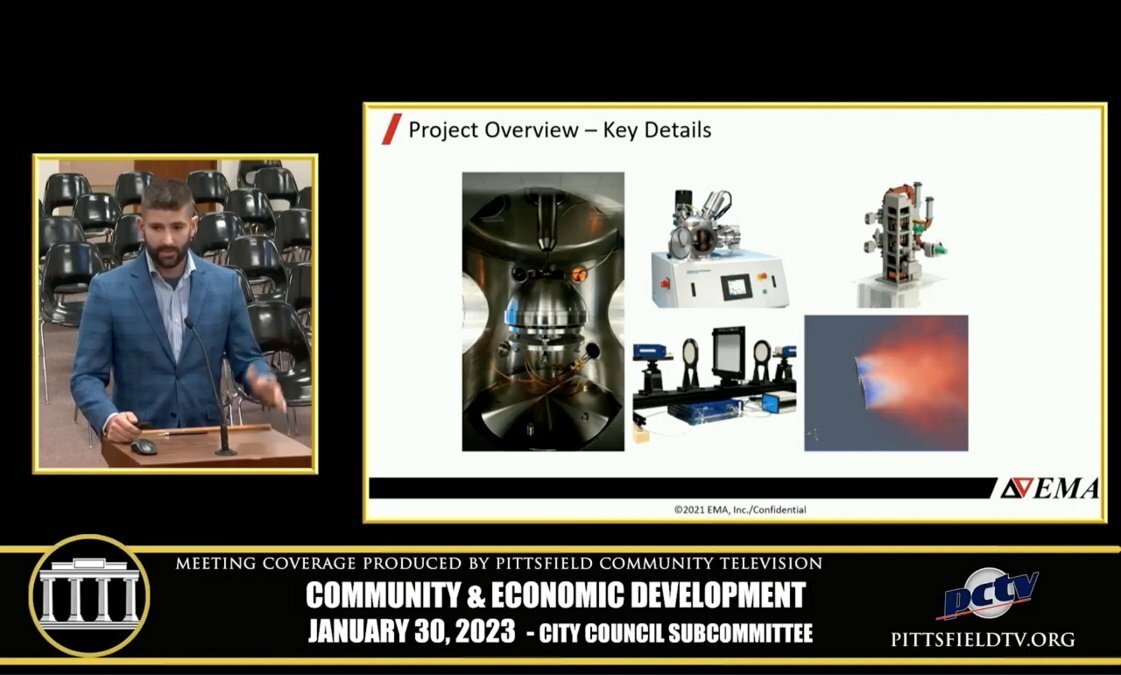
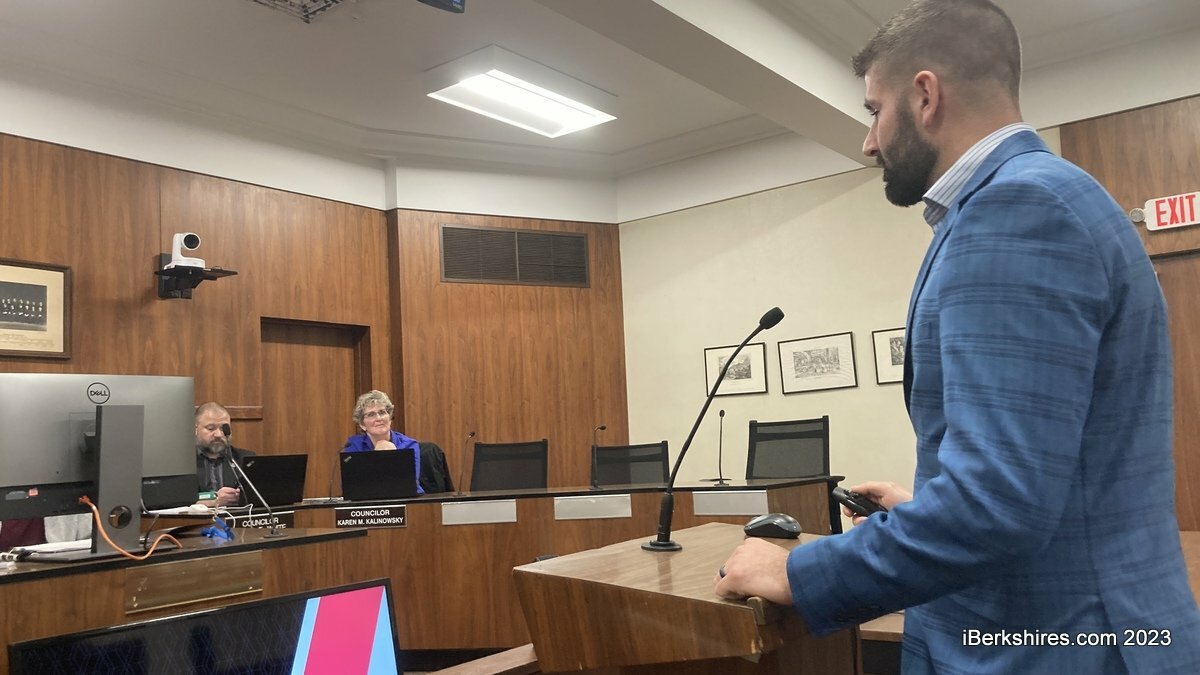
"We shoot radiation at things and try to predict where and when these things are going to happen and whether it is bad or not," principal scientist Justin McKennon said while giving an overview of EMA's technology to the panel.
"And that's really important for space applications but with what we're trying to do now, it's going to be kind of a merging of consumer electronics and health care and space and a lot of the other areas that we're really interested in."
EMA's facility at the BIC is the only third-party commercial space radiation effects facility in the world. This new proposal will establish partnerships with Berkshire Community College, the University of Massachusetts at Amherst, and other institutions, allowing students to specialize in emerging optics technology.
McKennon explained that meta lenses, or flat lenses that use metasurfaces to focus light, are the "bleeding edge of optics technology" but are bulky and require extremely pricy manufacturing facilities of upwards of $20 billion.
UMass, along with other companies that are part of this project, has figured out a way to make these lenses through nanolithography that can be built through a $10 million facility.
"We have a ridiculously high concentration of these companies in the state already today doing this stuff and they all want to participate in augmented reality, virtual reality, and all of these advanced sensing technologies here," McKennon explained.
"And it's really scary to think that if we don't establish a center of excellence in the United States and ability to handle this, it will go to Europe and to China. So there's a lot of demand from the (U.S. Department of Defense) and a lot of big companies out here to solve this problem and we think that we have a way and we believe we have a way to do that out here."
In order to do this, companies need to have access to manufacturing capabilities, to try designs and to learn how to make the devices. They also need to have demonstration capabilities and training to build new expertise.
The point of EMA's project is materials characterization, which is how a material's structure and properties are probed and measured.
The economic development funds would help purchase two systems for this effort: a sputtering and deposition system and a focused beam and coating characterization system.
Augmented reality is predicted to be a $340 billion market by 2028. There are more than 40 companies in the state that work in advanced optics and photonics but for the most part, they are subject matter experts and not commercial resellers.
In 2019, EMA was first brought in front of the City Council when $140,000 in economic development funds was approved to support the SERE lab at the BIC.
The company also received a five-year tax increment financing agreement from the city.
Mayor Linda Tyer submitted a communication in support of the allocation. She indicated that the company has the financial and technical ability to complete the project based on a financial review of the its past three years.
Records revealed that they have been profitable over that period with gross revenues approaching $7 million in 2021.
Councilor at Large Karen Kalinowsky was the lone vote in opposition. While she supports what EMA is doing, she is hesitant about using the resource for a company seeing that much revenue and was contacted by constituents who did not agree with it.
"We have businesses that are going under her in the city that aren't even making close to what you're bringing in," she said. "And so I'm just personally having a difficult time saying 'yes.'"
McKennon asserted that EMA is a small business in every sense, with not a dollar of profits leaving the company.
"We don't keep hundreds of thousands of dollars in our checking account here so it's a major hurdle into how long it takes for us to do this and as I mentioned, the reason that we're getting into this now is the time essence of this," he added.
"So if UMass is going to continue on this path, they'll find another partner and we want that partner to be us out here because they're doing this work and this research."
Councilor at Large Earl Persip III responded to Kalinowsky's assertion that there are limited GE economic development funds and the city needs to be selective with its use.
"We talked about this fund and giving money to local businesses. This is a local business. This is a local business," he said.
"They started, yes they made a profit, hooray. There's other parts of EMA, the part in Pittsfield is growing and if the city cannot invest $250,000 out of the Pittsfield economic development funds for eight jobs, we are doing something wrong because guess what, they will go somewhere else."
The current balance of the fund is about $1.3 million and was created over 10 years ago with a balance of $10 million. The city is hoping to have the refreshed with $8 million in the near future.
Persip said he got similar communications from constituents in opposition but that this is everything that the city wants in a proposal and EMA is the right kind of company to use these monies.
"We can't ask for a better partner for these funds," he added.
Councilor at Large Peter White also pointed out that the company's existing employees moved to the Berkshires for work and spend their money here, contributing to the economy.
Tags: BIC, GE fund, technology,