
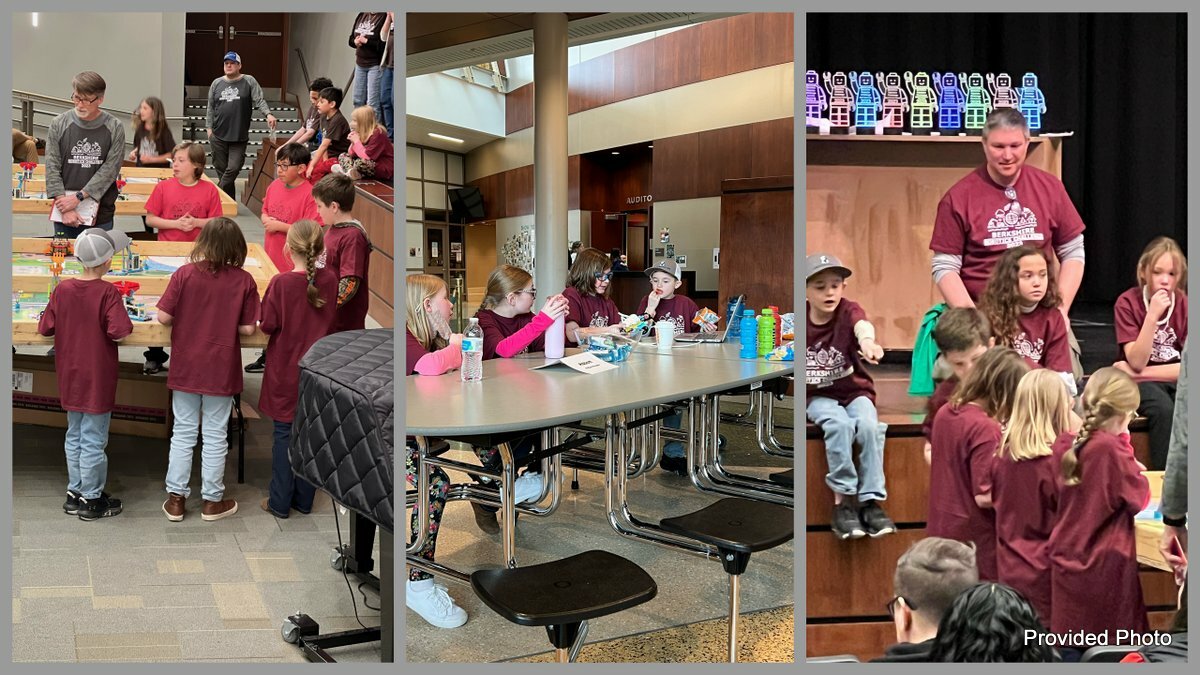
image description
Abbott Memorial fielded two robotics teams this year, the first time the school's entered the challenge in at least six years.
image description

Abbott Memorial School Participates in Berkshire Robotics Challenge

By Jack GuerinoiBerkshires Staff
Print Story | Email Story
FLORIDA, Mass. — Twenty Abbott Memorial School students participated in the Berkshire Robotics Challenge marking the school's return to the competition.
 
Students from Grades 3 through 7participated in the competition on Saturday, March 18, at Taconic High School.
 
"For the students, it is pure application-based learning. The anticipation of participating in a competition increases the stakes for the students — there's something more meaningful than an abstract grade on the line," said voach Tim Herrmann. "For some students, the challenge is learning that failure is the best teacher; programming errors and flaws in building design can be frustrating, but the students learn to persevere and keep trying."
 
Herrmann, who has a passion for applied science and technology, spearheaded the school's re-entry and said the last time Abbott attended the Berkshire Robotics Challenge was more than six years ago. 
 
He said students have met twice a week since December to train and learn about the various "missions" of the challenge, and then design and build a robot to accomplish a few missions.
 
"After building the robot, students then begin learning to program the robot to move and interact with the different elements on the competition board," he said. 
 
Herrmann said students base their designs on a few simple models that can be found on the Lego Education website.
 
"Usually, the building part is easy. The programming is the hardest challenge that the students face because the performance of the robot requires precise movement and consistent positioning at the start," he said. "One of the biggest lessons early on is the propagation of error; small degrees of error add up rather quickly."
 
Herrmann said, as a coach, part of his job is to know when to step away and let students work through problems on their own.
 
"One of the core tenets of the program is that the students are encouraged to do the heavy lifting of thinking through problems, coming up with solutions, and testing those solutions," he said. "That's a big task for students who think that the answers to every question can be found through a Google search."
 
The actual Berkshire Robotics Challenge is a stand-alone event that follows the structure of the First Lego League Challenge. Teams register for the competition in early autumn.
 
At the competition, teams present their robots for inspection, where judges look at the design and build of the robot, as well as the programming. Each team participates in four rounds of running missions on the challenge board trying to score as many points as possible. 
 
This year, the top eight teams then competed in elimination rounds until there was one team that scored the most points. 
 
Herrmann said in addition to the "game," as the mission challenge is known, teams are judged on team spirit, sportsmanship, and completion of an optional project based on the theme of the competition. This year's theme was SuperPowered.
 
Herrmann said Abbott Memorial School fielded two teams at the competition this year: A-B0T Power, composed of 3rd and 4th-graders, and A-B0T United, composed of students in Grades 5 through 7.
 
"A-B0T Power performed admirably under some difficult circumstances with last-minute changes to programming and came away from the competition with a treasure trove of experience to build on for next year," he said. "A-B0T United came in 9th place, one spot out of making it to the final 8."
 
Herrmann said he is looking forward to future competitions.
 
"Coaching the robotics club has been one of the highlights of my career in education," he said.  "Next year I'm hoping to break down our 20-student group from two teams to four, to give more students a chance to be more involved in the competition."

Tags: robotics,   
If you would like to contribute information on this article, contact us at info@iberkshires.com.

McCann Making Progress Toward MCAS Targets

By Jack GuerinoiBerkshires Staff

NORTH ADAMS, Mass. — McCann Tech Principal Justin Kratz told the Northern Berkshire Vocational Regional School District School Committee last week that because the school is making substantial progress toward its 2026 MCAS targets, there will be no Massachusetts Department of Elementary and Secondary Education (DESE) intervention.

"So long story short, we are not on DESE's radar for MCAS performance," he said. "At the end of the day, that is what is what we are after."

Kratz said McCann scored "a ton" of points, showing growth in most categories. He said they earned 75 percent of total possible points for all students and 83 percent of all possible points for lowest-performing students.

Kratz noted that DESE tends to change targets and formulas every year. But he drew attention to the year 2025, when a passing MCAS score was no longer a graduation requirement. In 2025, McCann received 33 percent of the possible points and 7 percent for the lowest-performing students. This equaled a score of 20 percent.

"That was the year where everything went off the cliff," he said. "We didn't do very well. This year was 79 percent, and that is knocking it out of the park. ... If we followed up with another 20, we would have been in rough water."

Kratz added this drop was typical across the state, saying he assumed students just took the test less seriously. He wanted to demonstrate how the scores and targets are "reshuffled" and gave a closer look at English scores over the years.

In 2024, the school had a target of 499.3 (average scaled score). The school scored 500.4. In 2025, McCann's new target was 502.5, but McCann scored 485.6. McCann's 2026 target was 487.7, and they scored 486.8.

Kratz said McCann is not scoring as high as they were in 2024, but they are getting more points. He said sometimes the scores needed to be taken with a "grain of salt."

He underlined that although MCAS is important in a vocational education, it only represents half of what a student does in a given school year. 

"There is no MCAS for 50 percent of their time here, which is their trade area," Kratz said. "They [DESE] don't assess that ... so this one little pocket is important, but it doesn't show the entire picture of a student."

Kratz moved from what he called the "good" section of his presentation to the "awesome." He said McCann was recognized as one of 55 schools that drastically improved chronic absenteeism by at least 5 percentage points. He said the school received a letter from DESE congratulating them that included a survey that asked how the school did it.

"It was a nice letter, but we kind of laughed and asked, 'What did we do?' " he said. "I say that sort of tongue-in-cheek because we didn't do any sort of targeted attendance improvement initiative."

He said the more he thought about it, the more he attributed the change to standardized grading and improving the school environment physically and culturally.  

"We didn't do all that wanting to improve attendance. We did it because we wanted to create more equity, and ... I think that is a byproduct of that," Kratz said. "Kids are more likely to want to go to school if that 62 they got on a test does not bury them for the rest of the year. They know they can dig their way out of it. And they are more likely to go to school if the building is a little brighter when they walk in in the morning."

Also, the importance of attendance is baked into the vocational school experience.

View Full Story

More North Adams Stories