North Adams School Building Committee Gets First Look at School Concepts
 |
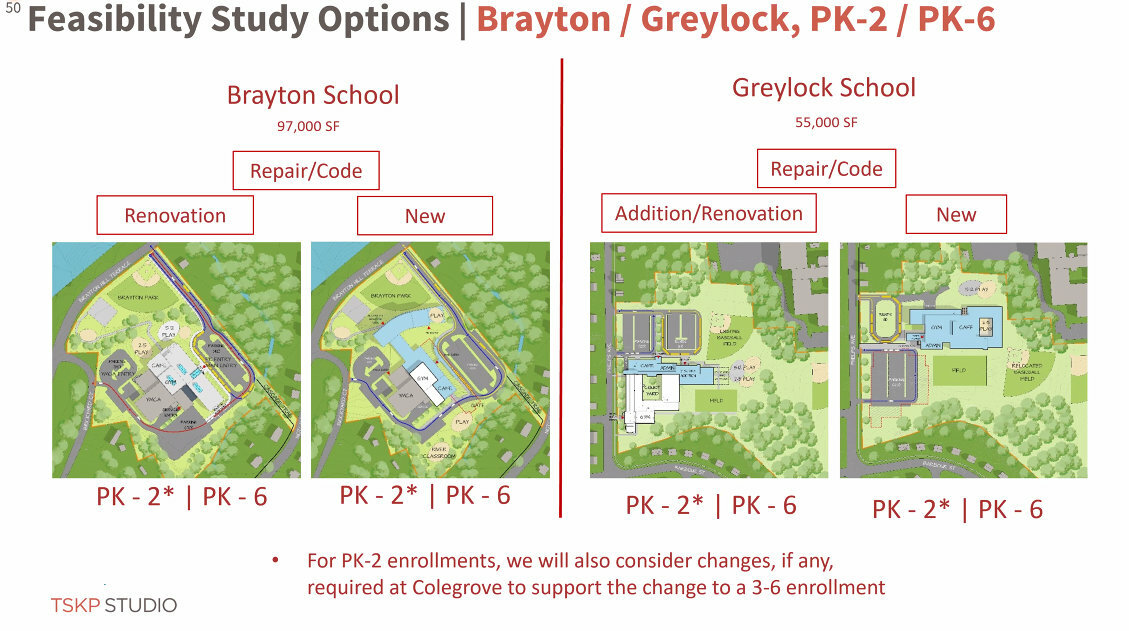
NORTH ADAMS, Mass. — Nearly a dozen options for Brayton and Greylock elementary schools were presented to the School Building Committee on Tuesday.
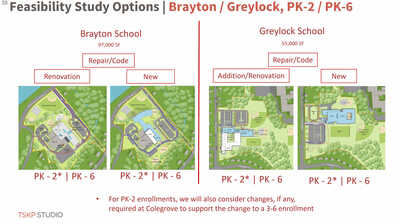
The preliminary concepts covered new buildings, renovations and additions at both sites as well as different configurations of grades.
These are not plans but rather possibilities for the committee consider as it determines its preferred choice for the city's elementary pupils. The city is currently in the feasibility stage of the Brayton/Greylock School Project with the Massachusetts School Building Authority.
The options presented by Jesse Saylor of TSKP Studio focused on light, space, access, use of site and safe drop-off and pickup.
"We're not coming forward today to help advise you as to where the benefits are so much as we're showing how these options can support your educational program, which I think is exciting," he said. "It's quite an improvement. So hopefully some of that will come through as well."
Each building would have to change in size by about 20,000 square feet, whether they are used for prekindergarten through 6 or split into lower and upper grades. Greylock at 55,000 square feet would have to add square footage and Brayton at 97,000 would have to reduce. This is based on enrollment projections and the square footage standards of the MSBA.
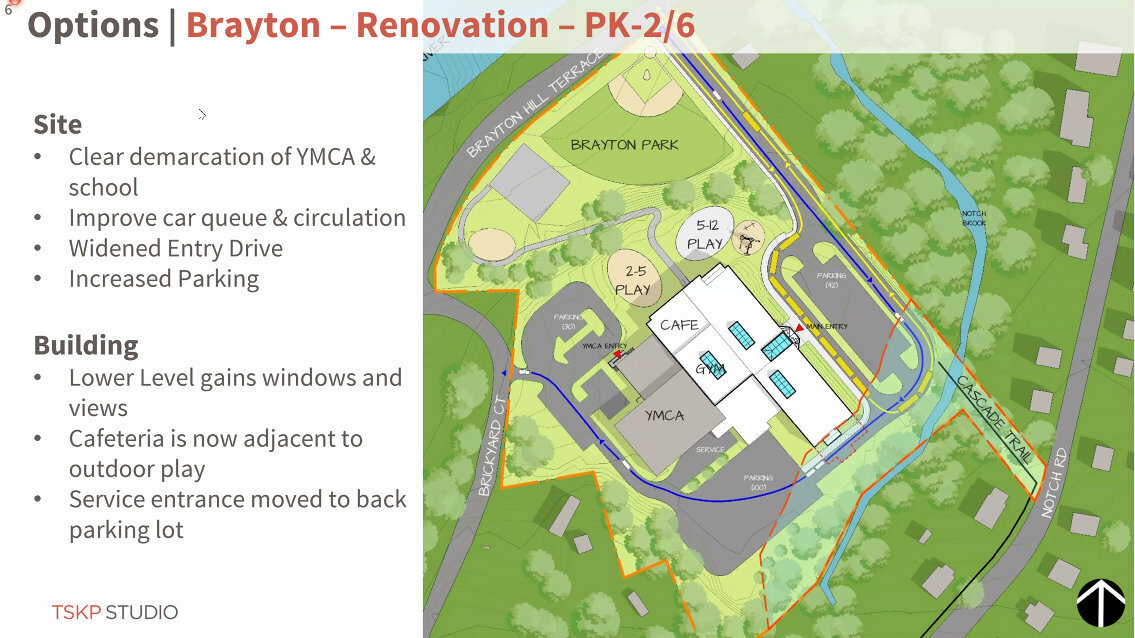
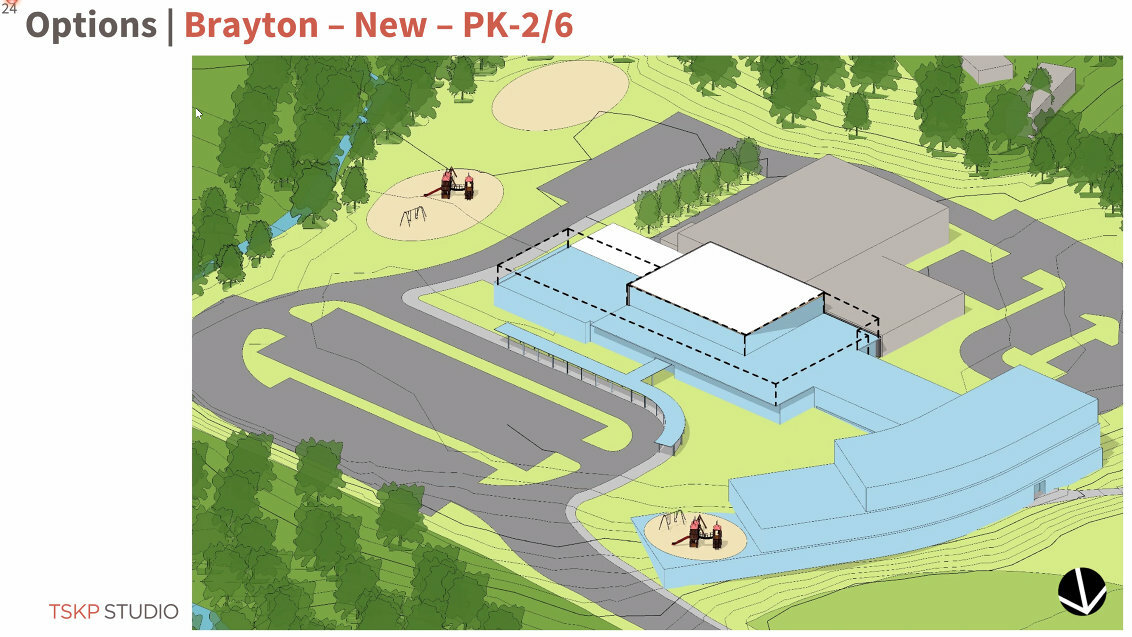
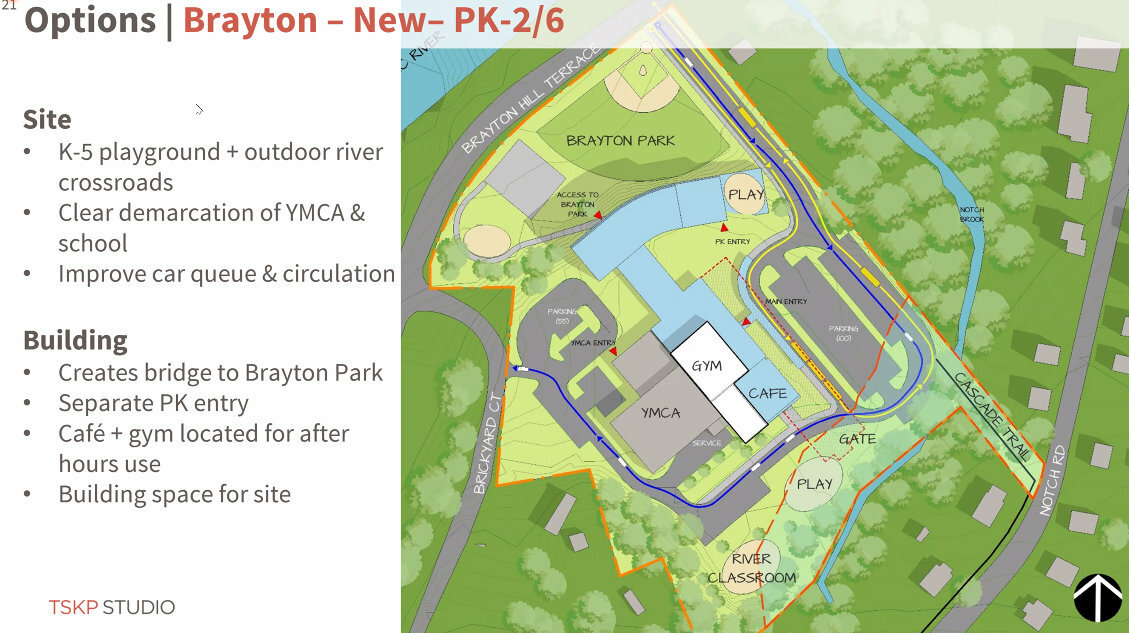
The concepts for Brayton would trim the building in the back and relocate vehicle traffic there to relieve the traffic crunch at the entrance and remove access along the front between the school parking lot and the YMCA parking lot. This would accommodate up to 10 buses should the committee chose it as a single school.
"Brayton, of course, shares the site with the YMCA, which creates somewhat ambiguous security-type concerns about its parking and drop-off, which is shared with the YMCA," Saylor said. "The traffic report that was created as part of the study notes that the primary concern for this site is student safety during drop-off and pickups."
The renovation idea would move the play area to the front, closer to the park and by the cafeteria, with the grade brought up to the cafeteria steps. It would also include larger windows on the basement level to better utilize that space and skylights to bring more light into the interior of the building.
A new Brayton would continue with the traffic going around the back but with a new wing built into Brayton Hill that would connect with the park on the bottom level. The size of the school would be dependent on the grade configuration. There could be some play area in the back and Saylor said this area with the Cascade Trail and Notch Brook could make for an outdoors classroom.
The school would continue to share the gym with the YMCA.
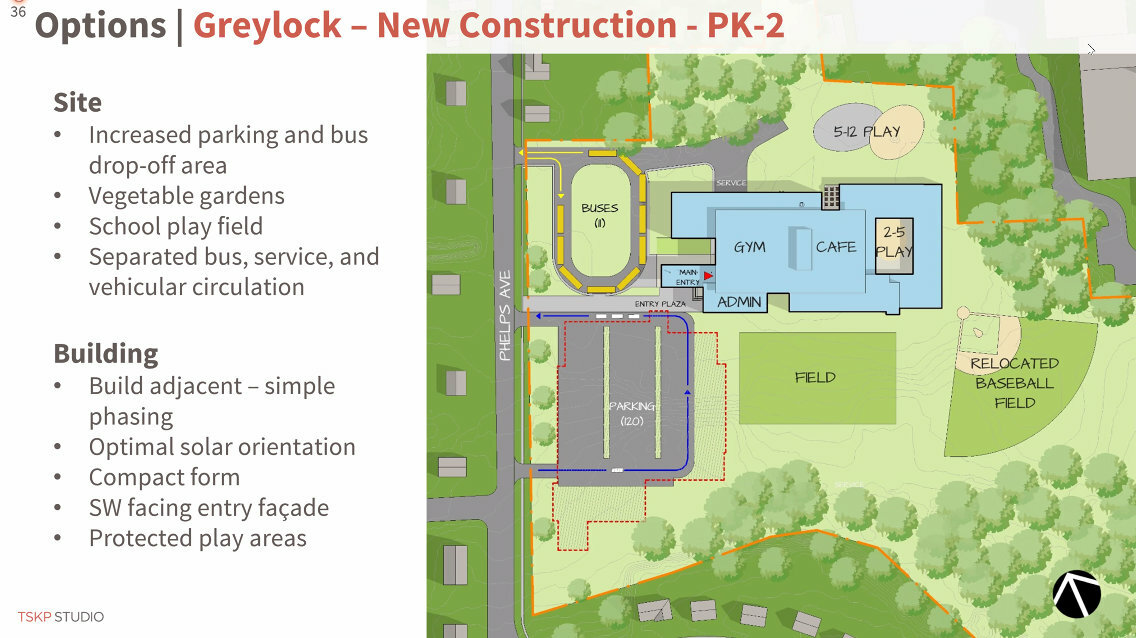
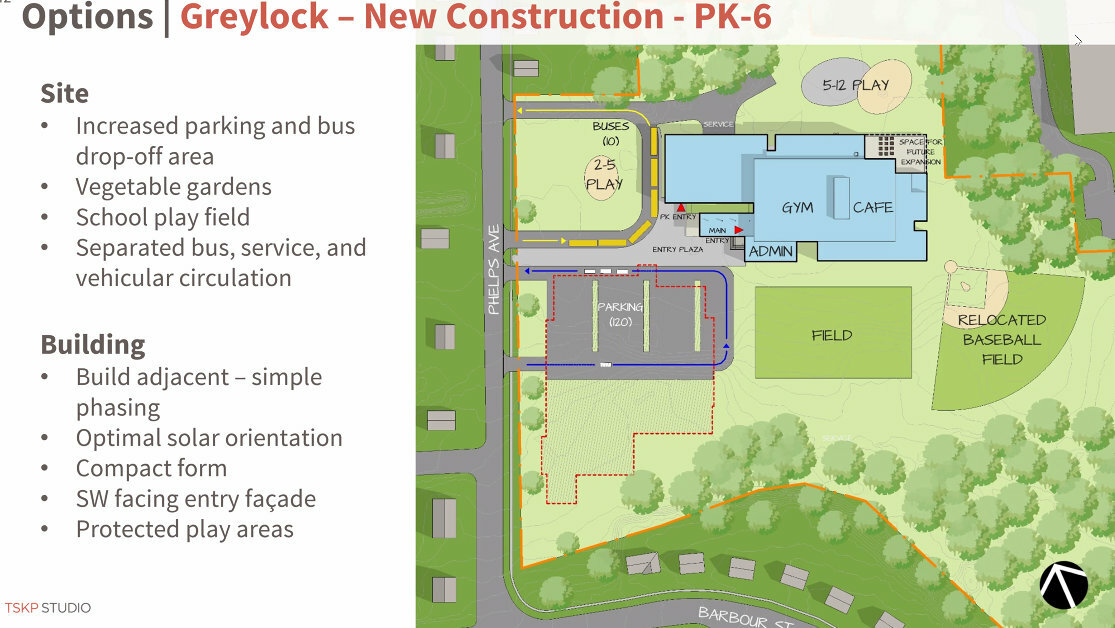
Where the 5-acre Brayton site is somewhat limited by its topography, the YMCA and a brook, Greylock's is much larger at 12 acres with another five adjacent to it. It's also flatter and would allow for new construction while the current school remains in place.
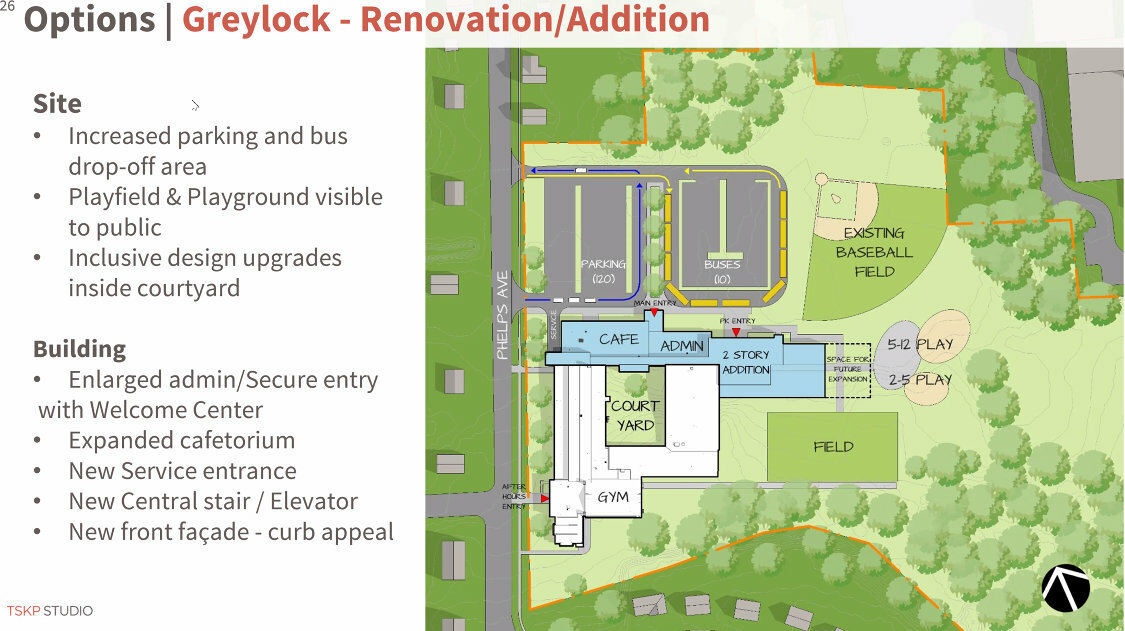
The traffic flow seems to work well, so only minor adjustments would be needed in a renovation.
"We're proposing a two-story addition, which is in blue in the site plan there, and stretches across the north face of the building," Saylor said. "We think this is a good approach because it really provides a new space for the building and makes the entry allows us to remake the entry in a way that will be welcoming and open to the community."
The plan would put preK into the new addition and shift the administration to the front of the entrance, creating a separate entrance on one side to the addition and another to the school proper.
A new building would be oriented on the site to take the best advantage of light with an interior configured a couple different ways to accommodate a full preK-6 or a split grade. It would also keep Greylock's beloved courtyard design.
All the concepts would include full accessibility to all floors, breakout spaces in corridors for gatherings, identifiable and secure entrances, community-use spaces that can be secured from the rest of the school, and lots and lots of light.
Committee member Benjamin Lamb said he liked the new Greylock option because "it really encapsulate everything" but was also taken by the idea that Brayton have a river classroom.
"I know that's like a minor piece of it, but I do feel like that's leveraging an amazing asset," he said.
Committee member Richard Alcombright also liked the idea of the environmental piece at Brayton but questioned the fate of the Little League field at Greylock, saying residents would have a lot of questions if they saw these plans.
"We were planning to relocate it but have it still be on site," said Saylor. "So we were constructing it just adjacent to where it's currently located."
Mayor Jennifer Macksey also noted that Greylock School is situated closer to homes than Brayton and — after seeing some entrance designs — said that should be kept in mind.
"I think we need to be really sensitive that that is really is a part of a neighborhood," she said. "We need to make sure that when we design that building that it kind of blends into the neighborhood."
Committee members reiterated that these were conceptual plans and Saylor said further details would be pinned down as the committee closed in on its preferred option. This will occur during the schematic phase later this summer.
In other business, Matthew Sturz of Colliers International, the owner's project manager, said the feasibility project is on track in terms of budgeting and noted dates that were coming up for presenting plans to the MSBA.
Superintendent Barbara Malkas said she is looking for feedback on the draft educational plan to be submitted to MSBA.
"We're still very much a work in progress, but I was hoping that if any of the committee members had any specific information that they wanted us to think about or include," she said. "Or if they feel that this is comprehensive in terms of an education plan that represents what the district is hoping for with our new building project."
Tags: brayton/greylock project,