Williamstown Town Meeting Says Yes to Clickers, No to Manufactured Homes
WILLIAMSTOWN, Mass. – Town meeting Tuesday rejected a bylaw amendment that would have removed barriers to manufactured housing, endorsed the use of electronic voting devices at the meeting and chose to take no action on a bylaw change that would have required dogs to be leashed in public areas.
In a four-hour, 20-minute session at Mount Greylock Regional School, meeting members also passed the majority of the town's municipal financing articles without discussion and approved the Mount Greylock Regional School District budget after concerns were raised about the district's move to delay filling an administrative position focused on diversity, equity, inclusion and belonging in the preK-12 district.
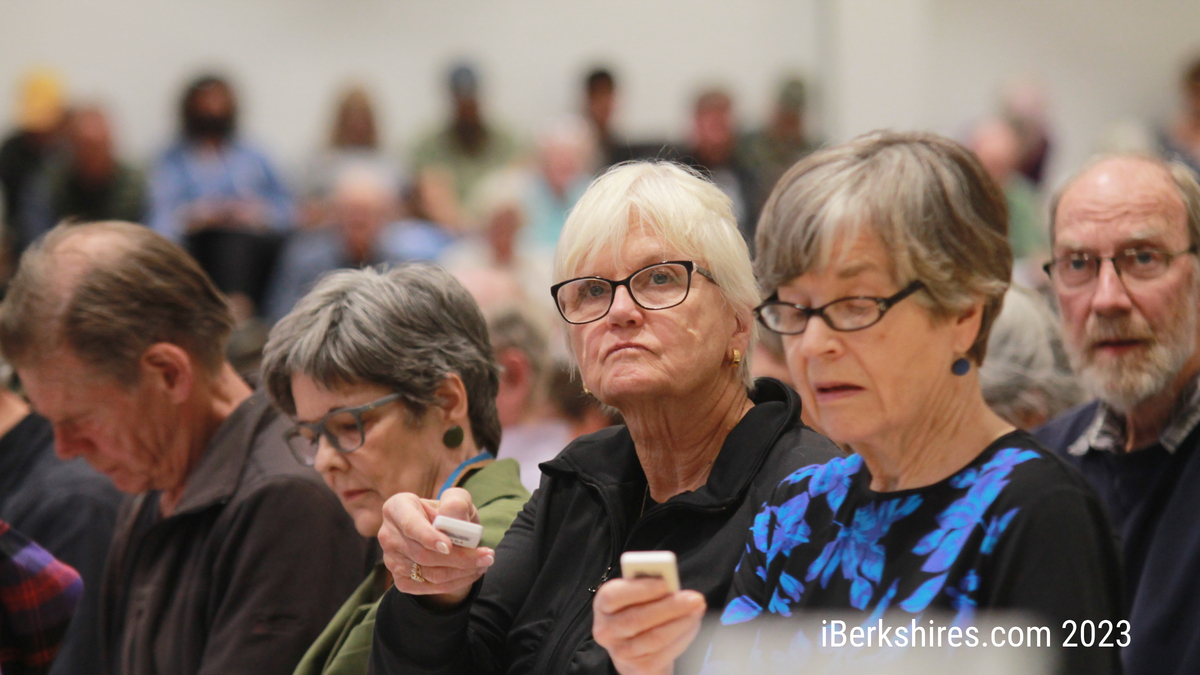
No item on the 42-article warrant generated more comment than Article 27, which sought the meeting's input on whether the Select Board should purchase electronic voting devices at a cost of $27,000.
Some residents raised objections to the "clickers," arguing that the device's lithium batteries are costly to replace, costly to dispose of and bad for the environment. Others maintained that the devices would "fundamentally change the fabric of town meeting" by allowing members to cast their votes anonymously.
"The whole point of town meeting is to see where our neighbors stand on issues," John Kalapos said. "If we move all our votes to a secret ballot, I wonder why we have a town meeting. Why can't I just vote for things on my own time?"
Others countered that anonymity is needed in order to allow town meeting members to vote their conscience on highly contentious issues.
"I have seen, in this town, people being retaliated against for speaking their mind," Steven Miller said. "It's unfortunate but true that a lot of people are not comfortable speaking their minds."
"People in town are worried about being able to vote their conscience for fear of retribution," Andi Bryant said. "That's more important than 25 cents for a battery."
Despite the extended debate on a pair of motions — first to take Article 27 "out of order" as the 15th vote of the night and then on Article 27 itself — the meeting decisively went in favor of the clickers.
The motion to consider Article 27 earlier than planned passed on a voice vote. Article 27 itself passed, 226-114.
The first issue that saw a close vote tracked by clickers — instead of a standing vote with individuals holding aloft colored index cards as in years past — came on Article 21, one of several zoning bylaw changes advanced by the Planning Board.
The manufactured home bylaw amendment would have allowed the placement of manufactured homes or mobile homes on any residential lot where a "stick-built" home currently is allowed.
A majority of the meeting favored the proposal, but not the two-thirds majority needed for passage.
Planning Board Chair Stephanie Boyd, who recently was elected to serve instead on the Select Board, told the meeting that manufactured homes can cost half as much per square foot as stick-built homes. The potential of allowing less costly housing options was the main impetus for the Planning Board developing the bylaw amendment proposal.
Boyd also noted that 20 states allow manufactured housing in all residential zones, and 18 states allow local control but "encourage fair treatment" of manufactured housing.
"At the moment, Massachusetts is considered to offer weak support [to the housing option], so we need to make appropriate regulations at the local level."
Paul Harsch, a longtime real estate agent in town, told the meeting members that mobile homes, unlike stick-built homes, do not appreciate in value and, in fact, depreciate over time.
"They don't build equity for the owner," Harsch said. "They end up demolished, like automobiles."
Alex Carlisle echoed that point, saying that instead of helping make housing more accessible to potential residents of less means, the manufactured homes instead would be, "a terrible disservice to the people we're trying to serve."
Boyd argued against the assertion that manufactured homes lose value by citing statistics from the federal government that say the opposite, but Harsch dismissed the government figures as inapplicable in New England.
The vote on Article 21 was 216 in favor and 114 against; 221 affirmative votes would have been needed to cross the two-thirds threshold.
All of the other zoning bylaw amendments developed by the Planning Board over the last 12 months passed, including two born of proposals the meeting referred to committee last June: a change to the dimensional requirements in the General Residence district to reduce the frontage requirement for building lots and the allowance of up to four-unit homes in the General Residence district by right.
As previously announced, the owners of Sweetwood Independent Living Community asked the meeting to take no action and refer to committee a pair of bylaw amendments it placed on the warrant in an effort to make the Cold Spring Road facility more economically viable.
Likewise, the authors of an article placed by citizen's petition to institute ranked-choice voting in local elections was withdrawn with hopes of bringing back a better proposal next spring.
Another citizen's petition article, as anticipated, sparked a lengthy discussion that got underway about 3 1/2 hours into the meeting.
Article 32 sought to amend the town's current dog bylaw to remove language allowing dogs to be in public spaces if controlled by voice command and instead require all dogs to be leashed in public areas, specifically singling out the new multimodal trail from Syndicate Road to the Spruces Park.
"I came with [the article] because person after person has come to me who are afraid of walking the 'rail trail,' walking in the Spruces or even on Spring Street — people who were jumped on by dogs that people claim are friendly dogs," Randal Fippinger said. "There are other perspectives on dogs other than, 'Everyone thinks dogs are great.' "
Roger Lawrence told the meeting that while he empathizes with residents who are afraid of dogs, his dog is "highly trained."
"It is a lot of work," Lawrence said of the training process. "Many people are afraid of dogs. That's something every dog owner should take very, very seriously. We should validate and honor their fears. The question is how do we do that."
Lawrence proposed an amendment to Fippinger's warrant article language that would have preserved the current bylaw language allowing dogs to be either leashed or under voice control except on the majority of the new bike/pedestrian trail, where Lawrence suggested the town should require dogs to be on a leash of no more than 6 feet.
Lawrence's effort to amend the warrant article failed on a voice vote. A motion to table Article 32 itself passed by a vote of 166-58, easily clearing a needed two-thirds threshold.
In addition to winning passage of its budget, the Mount Greylock Regional School Committee was a winner on two other fronts on Tuesday. The town approved a committee request to establish a stabilization account for the district and voted in favor of two separate articles related to the field and eight-lane track project at the middle-high school.
The meeting passed by overwhelming voice votes Article 18, which approves the district's plan to borrow up to $800,000 to fund the project, and Article 35, a grant of Community Preservation Act funds in the amount of $100,000 to support the field and track.
Article 18, the request for approval to borrow money, needs to pass at next month's town meeting in Lanesborough, the other partner in the two-town school district.
Tuesday's meeting attracted 380 of the Williamstown's 5,068 registered voters, a 7.5 percent participation rate.
Tags: town meeting 2023,