North Adams Mayor 'Terrified' of Potential for More Storm Damage
 |
| Jim Labonte of Fuller Street addresses the North Adams City Council on Tuesday night. |
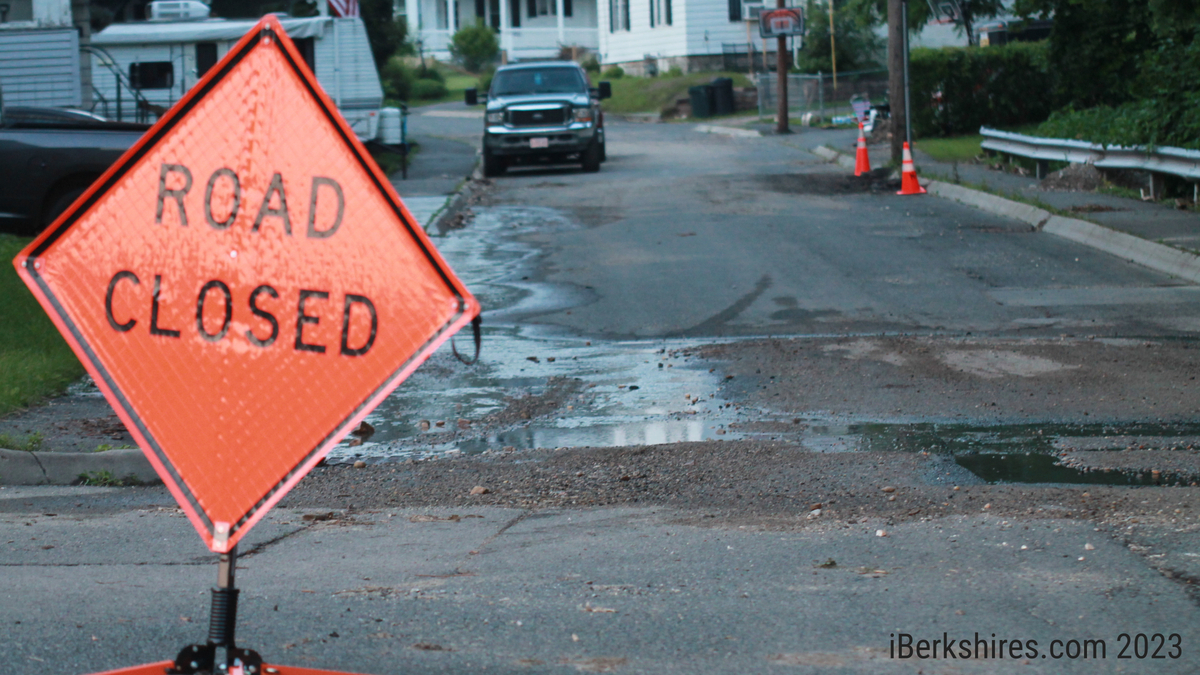
NORTH ADAMS, Mass. — Residents who have been hit with storm damage twice in the last five weeks told the City Council Tuesday that drainage problems in their neighborhood need a long-term solution.
"Five weeks ago, I was left with a 2 foot ditch against my foundation," Frederick Street resident Leigh Uqdah told the council. "DPW helped me, fortunately. But this last storm washed it away.
"If another storm comes and it's not fixed, it could potentially cause my house to tip over. The city of North Adams needs to prioritize how we manage severe storms and runoff."
Uqdah spoke from the floor of Tuesday's meeting along with Frederick Street neighbors Jim Labonte and Matt Cook.
Cook said that in the year he has owned his home, he has gone through two floods, both this summer and most recently Sunday into Monday.
"I've seen [Mayor Jennifer Macksey] both times," he said. "That's great. I love seeing people coming out and caring. That's very important. That's the only thing we have in the community."
Macksey said she shared the residents' frustration and is working all the levers of power at her disposal to address the short-term damage and the long-term solution.
"The [Massachusetts Emergency Management Agency] has been here," Macksey said. "I've been on the phone with the lieutenant governor and the governor. We're trying to fast track many fixes.
"I left a voicemail for Sen. [Elizabeth] Warren. Everyone is aware of the situation."
Gov. Maura Healey and MEMA Acting Director Dawn Brantley are scheduled to visit the city on Wednesday morning to view storm damage with Macksey and local officials.
Macksey said that area around Fuller Street is one of several areas of the city to be hit hard by this week's storm.
"It's not just that area," she said. "It's West Shaft Road, Church Street, Brooklyn Street. … This storm, I have to tell you, the force of the water coming down Church Street, I don't know how we didn't lose the street.
"I'm terrified for Thursday into Friday and possibly Saturday what's going to happen."
The residents who spoke on Tuesday pointed out that the frequency of extreme weather events has been on the rise and is only likely to get worse.
"We know this is going to continue to happen," Cook said. "So we need proactiveness, not studies."
Labonte told the council that one short-term mediation may be to add a second manhole near an existing drain.
"Where Matt [Cook] and I live, two houses to the left, is a low point with a manhole that constantly clogs up with debris coming down the hill," Labonte said. "One solution is to … look into the possibility of putting a second sewer hole there, so when this one blocks up, we have a secondary drain to back it up.
"We're not engineers, but there's a sewer there. Maybe they can put a manhole 15 feet down to collect some of that overflow."
Macksey, in a lengthy response to Labonte and the other residents, said that another manhole is a potential fix and that the city is communicating with civil engineer Tighe and Bond of Westfield about solutions for Fuller Street, near the Vermont state line, and other parts of the city.
"Our systems are old," Macksey said. "People are sick of hearing that. I'm sick of saying it. We need to design a system, then get the funding and do a fix.
"This is a conversation we probably should have had 10 years ago. But there are funds out there, and we're going to fight for those funds."
In answer to a question from Councillor Keith Bona, Macksey said that the city does regular inspections of areas known to have water problems but she emphasized that the city welcomes input from residents about problems they see in their neighborhoods.
"If you see something, say something," Macksey said.
Macksey offered a second plea to members of the public who might be watching Tuesday's meeting.
"Thank God the flood control chutes work," she said. "They have some leakage, but the chutes are doing their job.
"I say to the public, stay away from the chutes. Please do not swim in the flood control chutes. Don't put a kayak in there. That water is flying. We don't need someone harmed."
But most of her remarks were directed to the residents in the room, who already know just how serious the storms can be.
"The sad thing for [the city] is we did a lot of repairs on your street [in June] and everything we did on your street was washed out, completely washed out," Macksey said. "It's just as frustrating to us as it is to you.
"I know it doesn't help in the moment, but we are taking this very seriously."
Tags: flood control,