County Stakeholders Push for Housing Solutions from State Senators
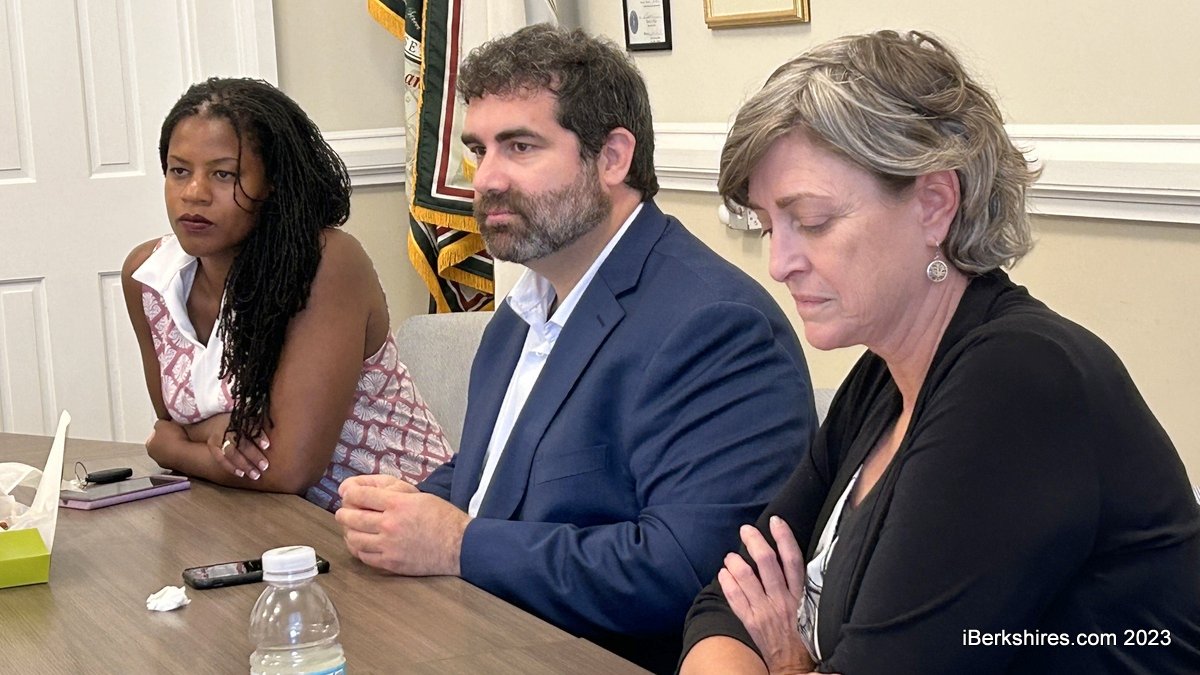
State Sen. Lydia Edwards, left, chair of the Joint Committee on Housing, and state Sen. Paul Mark and Berkshire Housing Development Corp. President Eileen Peltier.
A large part of the equation is money — prices are rising and wages are not.
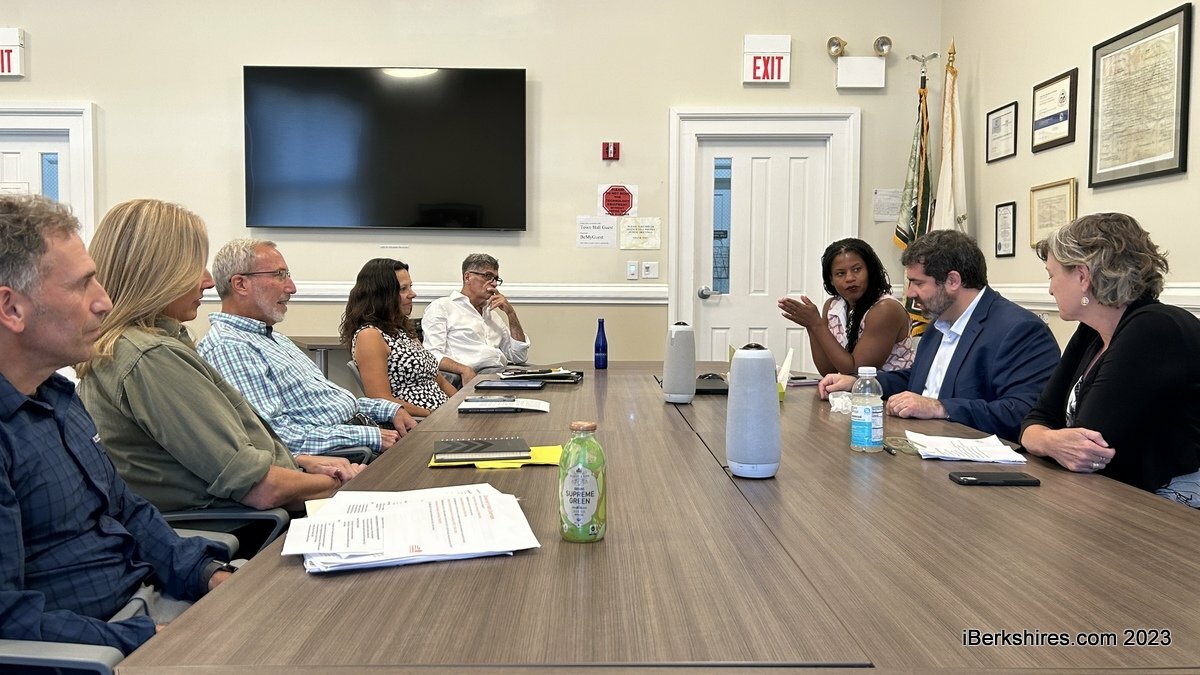
That was the message to state Sen. Paul Mark and his colleague Lydia Edwards of East Boston, Senate chair of the Joint Committee on Housing, who is on a listening tour of the state to better understand the issue.
Mark took Edwards on a tour of Chester Commons, a senior affordable housing complex in the former Chester High School, before the Berkshire County public session on housing at Town Hall.
"It's just really great to see how the conversation on housing is bigger than Boston," Edwards said.
"And now that the bond bill is coming with the governor committing — we're hoping — several billion dollars into housing that should last through her two terms and to build the level that we need, that bill comes to my committee first and so I thought it'd be great to know what that means for smaller towns and larger towns outside of Boston."
Gov. Maura Healey is expected to introduce a bond bill this month to address housing needs. A $1.8 billion housing bond passed in 2018 is nearing its conclusion.
Select Board Vice Chair Leigh Davis said Great Barrington's lack of affordable housing is causing people to be unsheltered and rental vacancy rate of 0 percent, along with a "millennial valley" of people have leave after high school and don't return until retirement.
The median price for an apartment in Great Barrington is $3,250 a month, meaning that a person would have to earn $28 an hour to afford housing. The average home goes for around $650,000.
"We're going to be the new Nantucket. We're going to be the new Martha's Vineyard. We're going to be the new Jackson Hole," Davis said.
"People are coming here and pushing out people that want to remain here in their homes, that have raised their families here, and there's the greater disparity every single day."
She said the town is trying to prevent this and hold on to its uniqueness. One of the ways is through a proposal for a real estate transfer fee that would impose a one percent fee on transactions over $1 million for the Affordable Housing Trust Fund.
"The solution to this is not going to be on the backs of the taxpayers of Great Barrington," Select Board Chair Stephen Bannon said. "It can't be. Seven thousand people can't solve the housing problem or, of course, the affordable, so there's got to be a better solution."
Robin Helfand, a member of the Community Development Corp. of South Berkshire and small-business owner, emphasized the importance of workforce housing.
"When [Davis] references that gap from the 20-year-olds who have to move out and can't afford to move back until they're in their 50s, a big part of that is they can't afford to live here. They can't afford to work here," she said, adding that the middle managers of Jane Iredale Cosmetics can't afford to live within a reasonable commute.
Helfand pointed to the effect that this has on the local economy.
"If we don't have the ability to house our workforce, we won't have a workforce," she said. "And that means we won't have small businesses because small businesses can't staff and so our economic engine, the private part of that public-private partnership that makes all of this work, it will collapse."
Mark explained that the arts are a big seasonal driver and he is hearing the same thing in that sector.
"They want to provide housing, some places, for people that come here," he said.
Stockbridge Selectman Patrick White said the towns are in a Dickensian moment where it's the best of times and the worst of times.
"There is so much well with seasonal residents, and there is so much poverty with full-time residents," he said.
"Twenty years ago, the median income in Stockbridge was $45,000, and the average home price sale was $235,000. Twenty years later, the median income is $45,000 and the average house price sale is $700,000 and my assessor tells me it's going up 15 percent this year. Great Barrington, sales are up 70 percent last five years. Lee, a working-class community, 86 percent sale prices last five years. Stockbridge is over 100 percent in the last five years. The fact is that prices are going crazy and income is not even gaining, let alone keeping up, with it."
He said it is fine to talk about a transfer tax for one town but would like to see tools from the state that can reach further.
Brad Gordon, executive director of the Berkshire County Regional Housing Authority, explained that a person can go from being a homeowner to homeless in the county very easily.
"I am 100 percent in on development but I also am a realist," he said. "And I know that we're not going to quickly develop our way out of this. We're just not. So if we don't understand that we're going to be in a lot of trouble."
He said keeping people housed is essential and there are many efforts that are not terribly expensive such as access to legal counsel and foreclosure-prevention programming.
Erin Forbush, director of shelter and housing at ServiceNet, explained that from the point-in-time count taken over the summer, the Berkshires has far outpaced other counties for homelessness.
The organization operates family and individual shelters and will be operating an emergency shelter for individuals in Great Barrington this winter with a hotel.
"We don't give enough credit to the trauma that happens for people, in general, that lose their housing and are housing unstable," she said, adding that you also have to factor in all of the other social ills that come into play.
She said that when talking about housing and support dollars, they have to be creative on what that support is.
"Everybody that I work with, there's a different way that I support that person," Forbush explained. "For some, in some senses, if it's purely economical there's some tools out there for that but more than not it's folks that have grown up in generational poverty that don't really see something different."
Last month, Healey declared that a state of emergency exists in Massachusetts due to rapidly rising numbers of migrant families arriving in Massachusetts in need of shelter and services and a severe lack of shelter availability in the state.
At the time there were nearly 5,600 families or more than 20,000 individuals in state shelter, including children and pregnant women.
Edwards spoke to the income disparity that exists in her district, with the largest concentration of billionaires and millionaires and of working-class immigrant communities.
"Housing is the No. 1 issue," she said. "I really believe the fundamental aspect of dignified housing is truly being able to choose where you live, having a choice at least, and having options."
The senator began her tour in Fitchburg, then went to Holyoke, Chester and Great Barrington.
She said it was her first time seeing infrastructure as part of funding for housing.
"It's vital, I think, for housing in small towns or rural areas. I've always seen them as separate like, if you want to do Wi-Fi, do Wi-Fi. If you want to make sure that we have clean water, access to water, be on wells, do that," Edwards said.
"But you can't have housing without that so the housing is going to actually lead up infrastructure conversation here where in larger cities and towns that just doesn't work that way."
Tags: affordable housing, housing,