image description
A maquette of the metalwork art piece Peter May is proposing for the pocket park on Eagle Street.

North Adams Arts Commission Give OK to Eagle Street Metalwork

By Tammy DanielsiBerkshires Staff
Print Story | Email Story

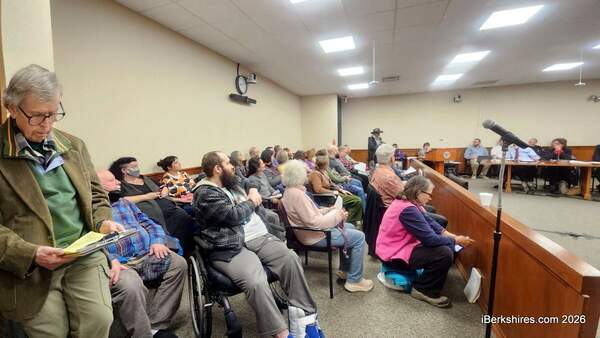
Peter May makes his pitch to the Public Arts Commission. 
NORTH ADAMS, Mass. — Peter May is hoping to add more art to the pocket park he made possible on historic Eagle Street. 
 
The Public Arts Commission is recommending that his metal work — "A Dream Come True" — be situated within the park or another suitable location. 
 
The commission's main concern was the placement of the piece, which would be about 8 feet long and nearly 5 feet high. May's presentation showed it in the middle of the pavers in the park and there was a suggestion it could be put farther to the side and into the grassy area. 
 
"My only concern about putting it forward on the grass is was when I went to hear the music, I sat right about over there," he said, noting other people would sit on the grass as well. The bands or musicians have been using the portable park as a stage so people tend to congregate in the pocket park to hear them. 
 
"You're going have gatherings there, people are going listen to music. They're definitely more in the front than the back. Then if you throw it in the back, it gets lost."
 
May did note in going smaller, it could be easier to fit into the park and would cost less. The piece, of which he has a version on his lawn at home, is estimated to cost about $18,300. That includes $4,000 in aluminum plate; $3,600 for cutting, welding, finishing and sanding; delivery, rigging, mounting, and sitework for the balance. 
 
Commissioner Bryan Sapienza pointed out that the city had done the foundation for the statue at the North Adams Public Library and might do the same for May since the piece is going into a public park. As to the cost of the work itself, May said, "I'm doing it the old-fashioned way, I'm going to appeal to the community and I'm going to go to friends and family and I'm going to write a grant."
 
May had owned the building at that location with Eric Rudd. It housed Tropical Gardens until a fire in 2008 after which it was demolished. Rudd and May donated the land to the city as secondary access to the Mohawk Theater and with the idea it would become an art park. 
 
That idea was rejected and the park itself didn't become a reality until the NAMAzing Eagle Street Initiative brought it to fruition a decade later with the help of a MassDevelopment matching grant. 
 
Commissioner Emily Johnson asked if he envisioned the piece in the Eagle Street park "because the park has significance to you?"
 
 "Yes, very much so," he responded. "Last thing I ever thought on this planet is I would be standing before an art commission asking for permission of an art installation of anything that I ever made. Sure it's meaningful for me to have it here, for sure. You got some better ideas ... ."
 
In his presentation to the commission, May said he had started working in metal a couple years ago and was using found items and later took some metal shop classes at the Old Stone Mill in Adams. 
 
"Over time I moved away from found art and starting to making things. It all started with a sheet of stainless steel metal that someone gave me," he wrote. "I am 70 years old and it's the first time in my life that I understand the meaning of the phrase: 'It's the process.' I don't know how long this acute onset of a creative streak may last but I'm having way too much fun along the way."
 
Chair Anna Farrington moved that the commission recommend the installation with notes that there were some questions about a more appropriate scale and but that the location in the park be preserved. 
 
In other business, Andrew Fitch came to thank the commission for its approval for the Eagle Street mural finally painted a couple weeks ago and inquired about the potential for painting electrical boxes, as has been done in Pittsfield. The commissioners advised that he find out if the city owns the boxes. 
 
The commission voted in Johnson as chair and Nina Keneally as vice chair. 
 

Tags: public arts commission,   
If you would like to contribute information on this article, contact us at info@iberkshires.com.

McCann Making Progress Toward MCAS Targets

By Jack GuerinoiBerkshires Staff

NORTH ADAMS, Mass. — McCann Tech Principal Justin Kratz told the Northern Berkshire Vocational Regional School District School Committee last week that because the school is making substantial progress toward its 2026 MCAS targets, there will be no Massachusetts Department of Elementary and Secondary Education (DESE) intervention.

"So long story short, we are not on DESE's radar for MCAS performance," he said. "At the end of the day, that is what is what we are after."

Kratz said McCann scored "a ton" of points, showing growth in most categories. He said they earned 75 percent of total possible points for all students and 83 percent of all possible points for lowest-performing students.

Kratz noted that DESE tends to change targets and formulas every year. But he drew attention to the year 2025, when a passing MCAS score was no longer a graduation requirement. In 2025, McCann received 33 percent of the possible points and 7 percent for the lowest-performing students. This equaled a score of 20 percent.

"That was the year where everything went off the cliff," he said. "We didn't do very well. This year was 79 percent, and that is knocking it out of the park. ... If we followed up with another 20, we would have been in rough water."

Kratz added this drop was typical across the state, saying he assumed students just took the test less seriously. He wanted to demonstrate how the scores and targets are "reshuffled" and gave a closer look at English scores over the years.

In 2024, the school had a target of 499.3 (average scaled score). The school scored 500.4. In 2025, McCann's new target was 502.5, but McCann scored 485.6. McCann's 2026 target was 487.7, and they scored 486.8.

Kratz said McCann is not scoring as high as they were in 2024, but they are getting more points. He said sometimes the scores needed to be taken with a "grain of salt."

He underlined that although MCAS is important in a vocational education, it only represents half of what a student does in a given school year. 

"There is no MCAS for 50 percent of their time here, which is their trade area," Kratz said. "They [DESE] don't assess that ... so this one little pocket is important, but it doesn't show the entire picture of a student."

Kratz moved from what he called the "good" section of his presentation to the "awesome." He said McCann was recognized as one of 55 schools that drastically improved chronic absenteeism by at least 5 percentage points. He said the school received a letter from DESE congratulating them that included a survey that asked how the school did it.

"It was a nice letter, but we kind of laughed and asked, 'What did we do?' " he said. "I say that sort of tongue-in-cheek because we didn't do any sort of targeted attendance improvement initiative."

He said the more he thought about it, the more he attributed the change to standardized grading and improving the school environment physically and culturally.  

"We didn't do all that wanting to improve attendance. We did it because we wanted to create more equity, and ... I think that is a byproduct of that," Kratz said. "Kids are more likely to want to go to school if that 62 they got on a test does not bury them for the rest of the year. They know they can dig their way out of it. And they are more likely to go to school if the building is a little brighter when they walk in in the morning."

Also, the importance of attendance is baked into the vocational school experience.

View Full Story

More North Adams Stories