Pittsfield Holds Bel Air Dam Removal Public Forum
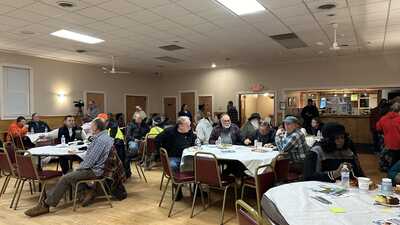 |
| The forum was held in early December. |
PITTSFIELD, Mass.—Community members gathered at the Polish Falcon Club last week to hear the proposed plans for the Bel Air Dam Removal.
The two-century-old dam has been an area of concern for over a decade due to its deterioration and contamination.
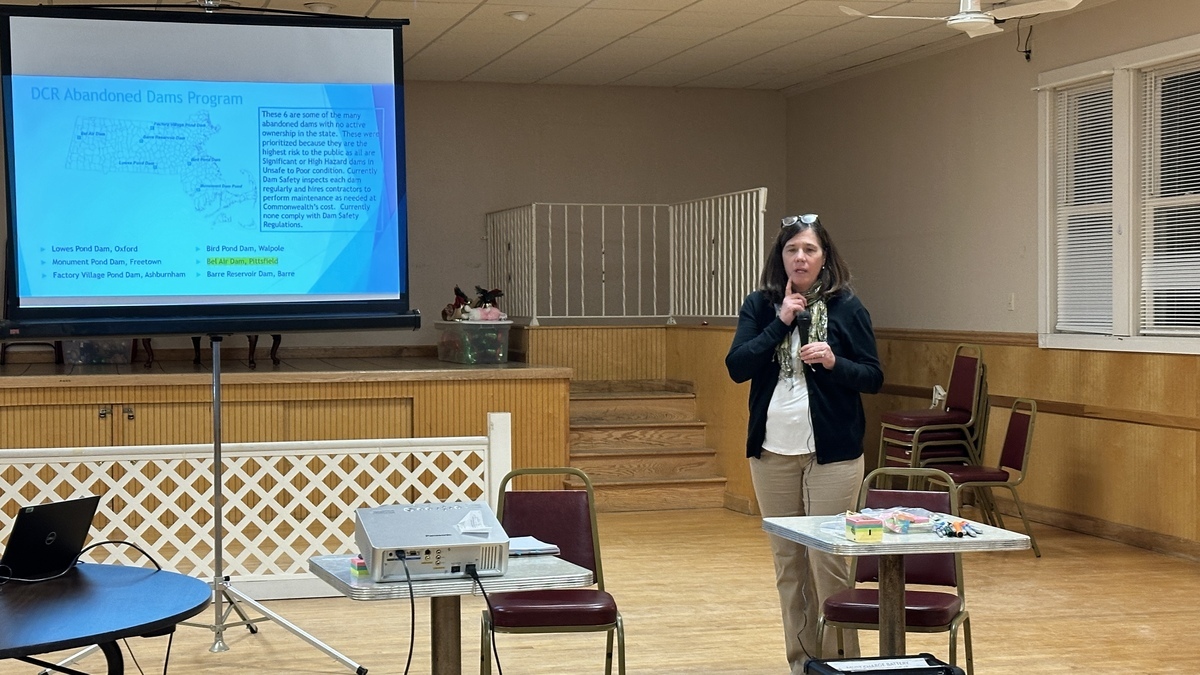
AECOM Associate Vice President and Project Manager Jennifer Doyle-Breen said if the structure collapses it could mean trouble downstream, creating hazardous conditions.
"It is upstream of several businesses, residents and roads and failure of the dam could cause loss of life in substantial damages to infrastructure due to what is downstream of it. So, for this reason, it's classified as a high-hazard dam," Doyle-Breen said, representing the engineering firm.
In addition, it could also expose residents to contaminated sediment.
She did add that the dam is continually inspected so an imminent failure can be prevented.
"So, if there is something critical going on, it is noticed and addressed in the short term. Not as a long-term repair but as a short-term measure so that the dam does not have catastrophic results of failure," Doyle-Breen said.
There is an emergency action plan in place to serve as a guide for first responders in the event of a possible failure.
The emergency action plan includes evacuation planning if needed, the process of notifying people if there is an imminent failure of the dam, and a description of possible flooded areas that may be impacted if the dam fails.
The state Department of Conservation and Recreation conducted inspections, maintenance, and repairs, but in 2020, it was identified as a high-priority project.
The proposed removal has a high price tag due to its deterioration, contamination, and size but some community members found relief in the fact that the city was granted $20 million in state American Rescue Plan Act funds to address the issues.
"This is life-saving for the community," DCR Commissioner Brian Arrigo said in a previous meeting.
Permitting for the project is going to be completed within the next eight months but optimistically, construction will start in the summer of 2025. Construction bidding will begin after the permits are issued. This is of course dependent on the weather and review time.
The dam will be removed and the contaminated sediment be dredged and transported off-site, Doyle-Breen said.
"There's a lot of sediment that would have to come out over 35,000 cubic yards of sediment which is a lot of sediment," Doyle-Breen said.
During construction, there will be some temporary sediment stockpiling since when the sediment is first excavated it will be very wet.
The soil will need to be treated to remove the liquid and add a solidifying agent so that it can be put in the trucks and transported out of state.
After the sediment is removed a stream channel would be restored from upstream, from the Wahconah Street culvert, to downstream, where the current dam is.
The sediment in the area is currently underwater and not considered soil. However, upon removal of the dam, the sediment will become soil.
Once it becomes soil it is subject to the state contingency plan, which outlines the procedures for addressing contaminated soils. The state contingency plan is going to require removing a lot of sediment.
The project's goal is to improve the area's safety while also restoring the wetland and wildlife habitat through a combination of planting, sediment control, and removal of invasive species.
"I think our feeling is that overall, the project provides an ecological benefit by removing the dam and restoring the connectivity of the stream channel. So there will be a change in habitat types. That's unavoidable as a result of the project but there is overall a benefit," Doyle-Breen said.
The contaminated material would be taken out, the elevation would be lowered, and cleaned topsoil would be brought back in so the newly planted seeds, shrubs, and trees could thrive.
Environmental scientists with AECOM's initial evaluations showed that there are "exceedances in the sediment for some chemical constituents" such as chromium, arsenic, lead, polycyclic aromatic hydrocarbons (PAHs), and environmental polycyclic aromatic hydrocarbons (ePAHS.)
"So the levels that are in the sediment are high enough that the sediment that comes out after the damage is removed, cannot be taken to a landfill in the state of Massachusetts," Doyle-Breen said.
Previous sampling has not identified polychlorinated biphenyl (PCBs) above the state contingency plan limits.
The city has more geotechnical data that needs to be completed to make sure that they are preparing the banks at the appropriate slopes with the appropriate armoring.
"After we get that additional data collection, we'll be able to finalize and submit the permit applications," Doyle-Breen said.
"The floodplain will change. One of the things that we need to do for the permitting of the project is to go through the process of getting what's called a letter of map revision from [Federal Emergency Management Agency] that will officially change the floodplain," Doyle-Breen said
During construction, there will be typical construction disturbances such as noise, air quality impacts, traffic disruptions, and sidewalk closures on Wahconah Street on the side next to the impoundment.
The project may require the need to take all or part of a traffic lane on Wahconah Street to make room for the trucks that come to collect the sediment. They will monitor the air quality impacts from the emissions of all the construction equipment and control dust to make sure there aren't dust impacts.
Doyle-Breen said that homeowners will be notified if they are in the affected area. A notice will also be published in local news sources.
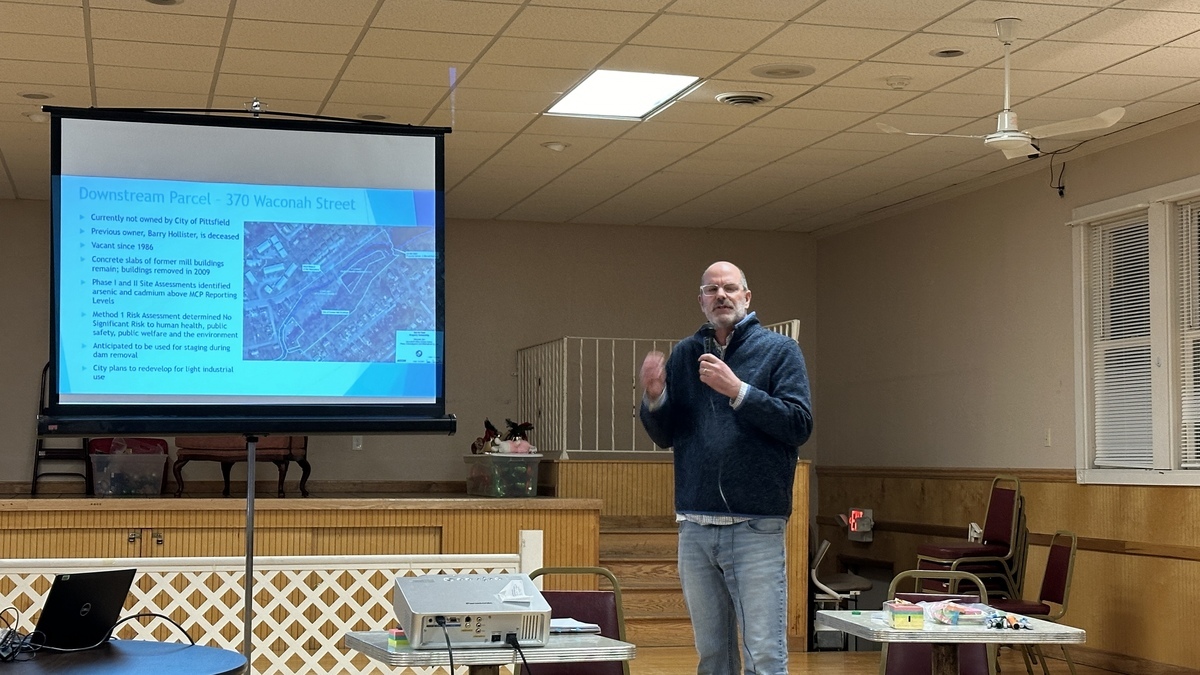
The city is in the process of looking into acquiring the parcel on which the dam is located. It formerly belonged to Joseph "Barry" Hollister who died in Nov. 2021.
"Currently, the property is also in severe arrears for tax payments. So, the city is looking at a pathway toward ownership of the parcel," Parks, Open Space, and Natural Resource Program Manager James McGrath. "...The construction project will wrap up and the city will have a seven-acre parcel along Wahconah Street, free and clear of a derelict dam."
The parcel has a history of industrial use and was a mill for many years. The city does not plan to use it for heavy industrial use but may use it for light industrial use as the zoning would permit, McGrath said.
The project is still in early planning and is subject to change.
Incoming Ward 7 City Councilor Rhonda Serre asked what mitigation processes will be available to homeowners who might have concerns regarding insurance changes or loss of equity or value.
Doyle-Breen said she is unsure at this time. The floodplain is going to increase somewhat, but they have not yet looked to see if there are any homes where it is increasing.
"I would like to just be on the record saying that when you do go to the point of the letter for the mapping in the increase. If you could, at that point, address the fact that there may be homeowners that are negatively impacted and what can be done," Serre said.
Doyle-Breen made a note of that concern.
Tags: dam removal,