image description
The new overlay district restricts where large battery arrays can be sited.

Pittsfield Council OKs Battery Energy Storage Regulations

By Brittany PolitoiBerkshires Staff
Print Story | Email Story

PITTSFIELD, Mass. — The city planner says battery energy storage guidelines will protect the land and residents and councilors agree.

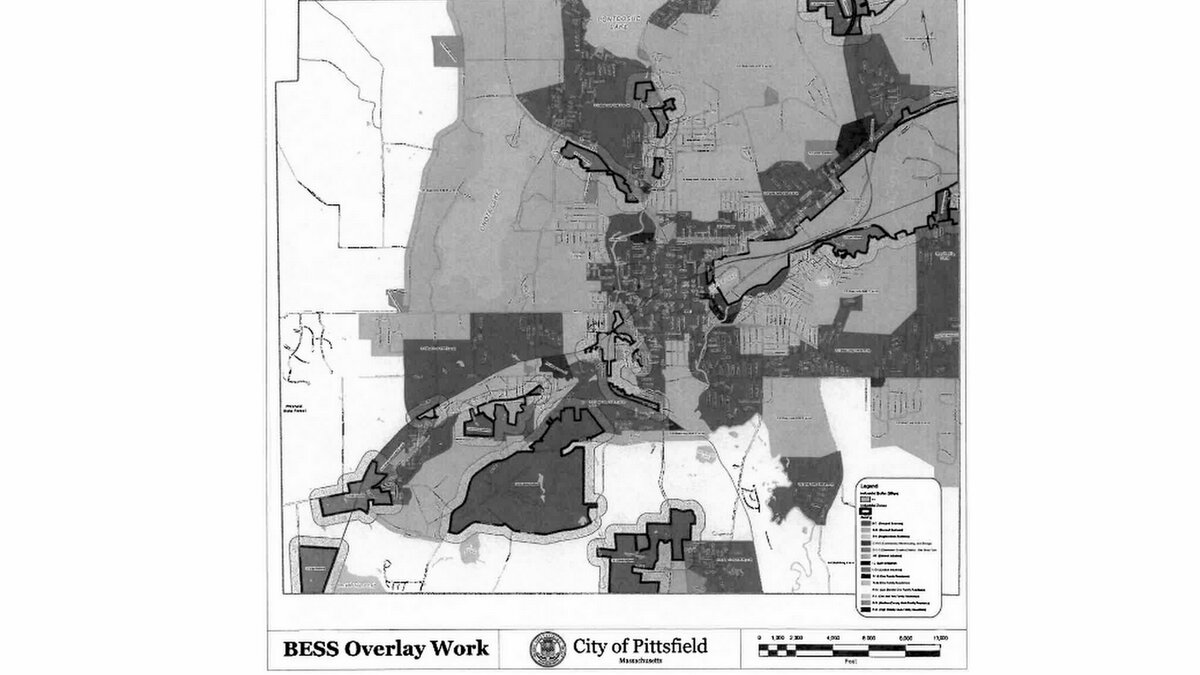
The City Council approved Tuesday a proposal to add a battery energy storage system overlay, or BESS, district.

City Planner Jacinta Williams said the district "seeks to protect the health, safety, and well-being of Pittsfield while allowing for responsible growth and development. ...

"Essentially, battery energy storage systems are just that. Storage systems that use batteries to store and distribute energy in the form of electricity for later use."

This provides regulatory procedures for BESS and BESS facilities, outlines the application process for site plan approval and special permit applications, specifies which districts are comparable with the use, discusses site requirements for each district where it is permitted, and requires that interested departments respond with comments and concerns within 14 days of the application.

It includes guidelines for residential-scale, small-scale, and commercial/industrial-scale BESS that fall within the boundaries of the overlay district. In the proposed ordinance, the infrastructure is not allowed in various places such as flood hazard zones, parks and open spaces, historical or indigenous land, and conservation areas.

"The overlay district that's being proposed, it is basically the industrial zoning district plus a 10th of a mile buffer zone and so if you want to know what a 10th of a mile is, that's about 528 feet or 176 yards and to answer a lot of the questions that a lot of residents have or had throughout these last couple of days, if your home has the unfortunate circumstance of being surrounded by industrial zones, which some people do, your home is protected," Williams explained.

"Let me put it this way: developers will not be able to put their large-scale battery energy storage systems next to your home. They are prohibited in residential zones and they are also prohibited from being in that tenth-of-mile buffer zone so residents are protected."

Currently, three developers are looking at parcels for BESS systems: one on Eagle's Nest Road near Kirvin Park, one on Williams Street, and another near the House of Corrections.

Williams said these are "not completely in the works" and would still have to go through the special permit process.

"But without this amendment, this developer would not have to adhere to any of the regulations that are proposed this evening. So they could put whatever they wanted there. They could do whatever they want, essentially. They don't have to have any restrictions because that part of the ordinance does not regulate very much so this is why what I'm proposing tonight is I think so essential," she cautioned.

"It's an amendment that is protecting Pittsfield's most valuable resources: its people and its land. And it's not saying 'no' to alternative energy, it's just saying 'This is how we would like to do it,' and of course, like all amendments, it's a living document. As we move forward with it and as we see how it plays out in the real world with real-world situations, we can always come back and amend it. We can always change it as the technology advances and as we learn more about how and where we'd like to see these in our community."


Commercial and industrial-scale facilities are prohibited from using ion batteries in the guidelines because of their high volatility and the heat that is generated if they are on fire.

"I have just decided that lithium-ion batteries are not allowed in the city of Pittsfield if you have a large commercial industrial scale facility," Williams said.

"They are developers, they're tech companies. As I keep telling them 'You're a tech company, innovate, figure it out.' Essentially you are allowed to come here but you are going to have to find another way to do what you're trying to do. So they are not allowed in commercial and industrial scale facilities and they are all relegated to the overlay district and the industrial zoning district."

She later explained that this was added to the document after residents came forward with concerns about this type of battery near their homes.

Berkshire Environmental Action Team Executive Director Jane Winn pointed out that lithium-ion batteries are the most popular and worry her less than fossil fuels.

"I am much more worried about natural gas explosions. I'm more worried about kids getting asthma from natural gas. I'm worried about the fact that I have CO2 detectors in my house because I have an oil furnace and it's a real risk for any of us," she said.

"So I'm less worried about lithium-ion than [Williams] is, specifically because right now that is the battery that is most commonly deployed. I agree we should be encouraging other forms of batteries but I think we ought to think carefully about banning them."

The special permit for BESS systems will be handled by the Community Development Board after being signed off by all of the appropriate departments.

Councilor at Large Earl Persip III would like to see a future amendment that requires the council to make the final approval for the permit.

"I'm still going to vote for this tonight but I find it interesting in Pittsfield, you need a special permit from the City Council to put a drive-through in and you don't need one for battery storage or other things or cell phone towers," he said.

"I think it's best when we're the second process and that is because we are elected by the residents and we listen to them a lot more than other boards and commissions do at times."


Tags: battery,   

If you would like to contribute information on this article, contact us at info@iberkshires.com.

BIC Sees $5.2M State Investment for Tech Hub

By Brittany PolitoiBerkshires Staff

PITTSFIELD, Mass. — The Berkshire Innovation Center's plans for an optics tech hub have been boosted by $5.2 million from the state. 

On Thursday, the Healey-Driscoll administration and the Massachusetts Technology Collaborative's Innovation Institute announced over $16.3 million in funding and designated 14 state regions as "TechHubs" through the Massachusetts (MA) TechHubs Program. The awards were announced at the Worcester Polytechnic Institute.

The BIC received a $5.2 million transformation grant — the largest allocation — for an Advanced Optics TechHub within the William Stanley Business Park. The innovation center, established in 2020, is looking to add a 7,000-square-foot Advanced Manufacturing for Advanced Optics Tech Hub to its 23,500-square-foot floor plan. 

Business Development Manager Michael Coakley said this is wonderful news for Pittsfield. 

"The City has been working with Myrias Optics, an advanced optics manufacturer, and EMA [Electro Magnetic Applications] to be the anchor companies for the hub," he reported. 

"The goal for the tech hub is to make Pittsfield the national leader in the testing and manufacturing of advanced optics." 

Mayor Peter Marchetti has proposed $1 million in Pittsfield Economic Development Funds to assist the
BIC with this expansion and for Myrias Optics to establish a manufacturing laboratory at the
 
"The AMAO TechHub places Pittsfield at the forefront of advanced manufacturing," said the mayor in a statement.  "The combination of state and local resources for the TechHub will create more job opportunities while we support entrepreneurs who want to grow their businesses in this community. I continue to appreciate the investments made in Pittsfield by the Healey-Driscoll administration, Rep. [Tricia] Farley-Bouvier and Sen. [Paul] Mark."
 
The AMAO Tech Hub is poised to bring more than 60 new, high-quality manufacturing jobs to Pittsfield. The project would allow Myrias to relocate to Pittsfield, create over 50 new job opportunities, and invest $10 million into its work in the region. EMA would be able to continue expanding in Pittsfield, adding a dozen jobs over the next two years. 
 
Through partnership with the University of Massachusetts at Amherst, this project is hoped to extend its reach beyond Pittsfield, creating bridges to other regions of the state and investing in the next generation of industry leaders.

The state's press release said this will also facilitate collaboration along the Boston-Rochester optics corridor, develop a pipeline of talent for advanced optics manufacturing, and facilitate the growth of startups, including Myrias Optics and Electro Magnetic Applications.  

"Massachusetts has always led through innovation, not just in our labs and universities, but through the strength and creativity of our people," Gov. Maura Healey said in the press release.  

"The TechHubs Program reflects our belief that every region should have the opportunity to shape the future of technology and to share in the prosperity it brings." 

The BIC is seeking $500,000 to expand, and Myrias Optics Inc. is seeking $500,000 to establish the manufacturing laboratory at the BIC. Both requests were referred to the Community and Economic Development subcommittee, which will meet on Monday, Nov. 10.  

Funds would go toward a specialized nanoimprint lithography (NIL) lab to support the Massachusetts-based photonics company that is currently reliant on space in Austria. 

Myrias Optics was born out of the UMass Amherst, and this facility is expected to "dramatically" advance the company's commercialization goals. The manufacturing lab would be modeled after the Austria facility and house NIL tooling, process engineering, and metrology operations. 

By 2028, the company plans to expand from 10 to 55 employees with an average annual salary between $112,000 $127,000, and the annual revenue growth from $1 million to $33 .7 million.

The BIC has more than 50 members and 14 academic partners. It has recruited and supported Pittsfield startups through the Stage 2 Accelerator Program tailored for hard tech ventures transitioning from prototype to commercialization. This program provides mentorship and facilities, as well as connections and funding pathways. 

"As the BIC continues to drive this growth, it has observed a clear shift in regional needs— from basic capacity-building to advanced research, development, and commercialization," the funding ask reads. 

"Today, the demand for lab space, prototyping tools, and startup support significantly exceeds available resources." 

The BIC currently has an advanced optics lab in partnership with EMA and UMass Amherst. In 2019, Pittsfield gave EMA $140,000 in economic development funds towards the purchase of a space environment testing chamber and a tax agreement that will curb the taxes EMA pays to the city from fiscal 2020 to fiscal 2026. 

"This funding is a big step forward in enabling the Berkshire Innovation Center and the City of
Pittsfield to plant a mustard seed into soil that has been cultivated at the BIC allowing for the next
critical step in the community’s economic revitalization and into the future," said Farley-Bouvier.

Worcester Polytechnic Institute also received $5.2 million for a Bioindustrial Manufacturing TechHub.  These grants are said to support regions ready to "execute large-scale projects that enhance innovation infrastructure, promote the development of local high-growth scaling companies, catalyze technology commercialization, and foster workforce development with up to $5 million in capital funds over a period of up to three years."


View Full Story

More Pittsfield Stories