Dalton Hazard Mitigation Plan Near Completion
DALTON, Mass. — The town's emergency management consultant Jamie Caplan Consulting presented goals on Friday for updating the hazard mitigation plan to fit the communities needs.
The town received a grant through the state Emergency Management Agency, part of which covers the cost of the consultant.
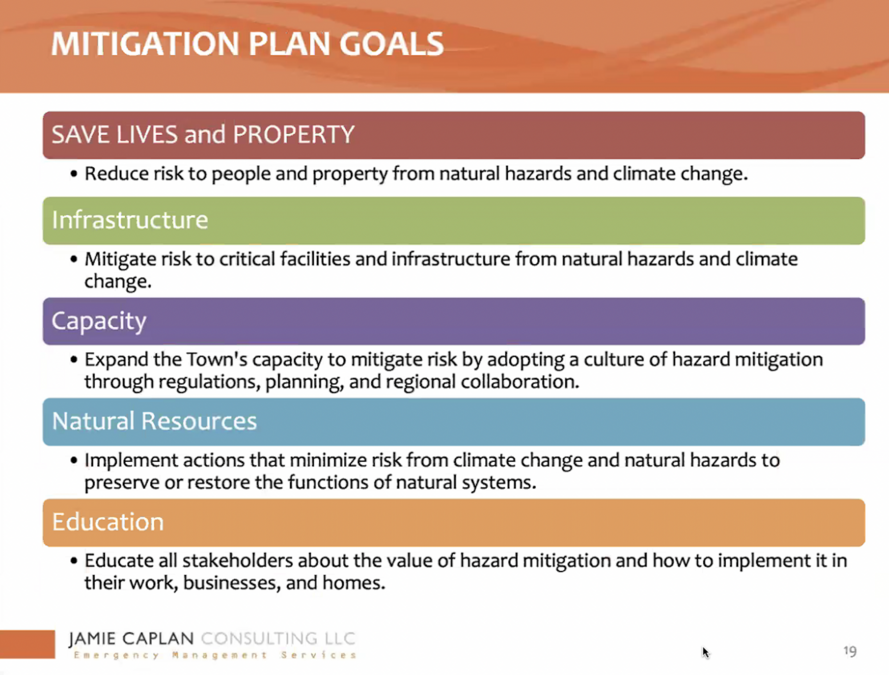
A number of town officials from various committees and departments have been working with the consultant to discuss the area's hazards and update the hazard mitigation plan to minimize the risk to people, property, and the environment.
In addition, the goal of the plan is to increase the town's capacity and promote a hazard mitigation culture in the community through education, regulations, planning, and collaboration with neighboring regions.
Departments and committees, or commissions, involved in this process included the Water, Building and Ground departments; Police, Fire, and Health departments; Conservation Commission members, town officials, and more.
They also requested feedback from residents during two public hearings. One public hearing occurred in the evening in December, and there was light attendance.
The second public meeting was held on Friday morning after the town received comments from residents expressing how they could not attend in the evening. The morning meeting did not have any attendees.
When approaching updating the hazard mitigation plan they try not to look too far ahead because they are required to update it every five years, However, they still take into consideration the effects of climate change, said the consulting firm's principle, Jamie Caplan.
When developing the plan, they inform it using a variety of things including zoning ordinances, the town's previous plans, town policies, and other plans in the surrounding area, she said.
They also look at what may have changed in the town or if there's been development or any kind of hazard occurrence.
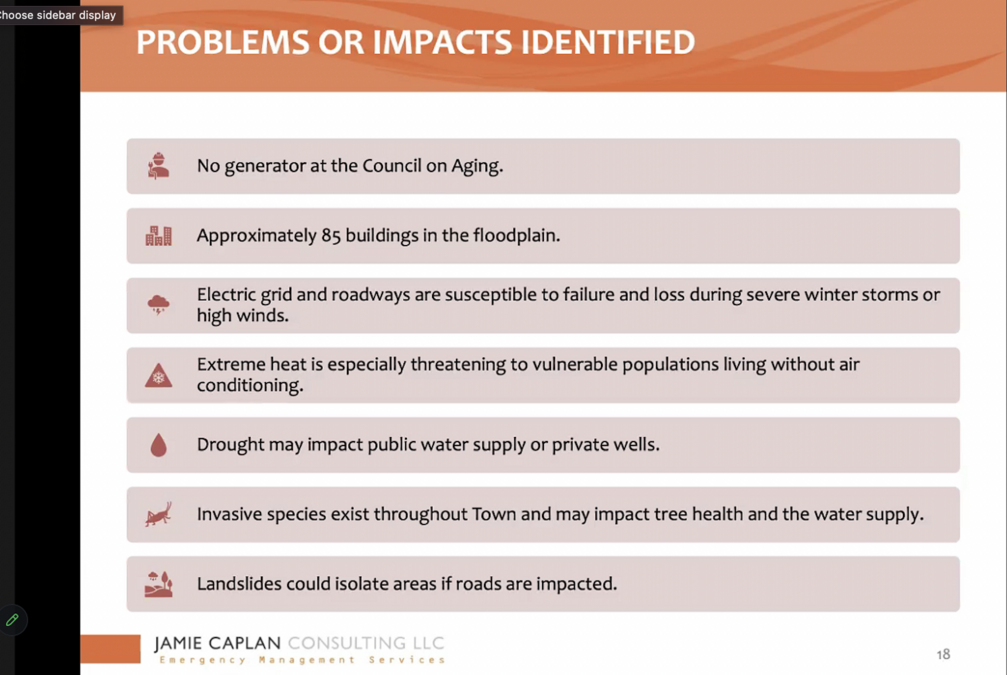
During the process, several actions were identified. These include mitigating the flood risk to Pomeroy Manor, adding a generator to the Senior Center, and determining what changes need to be made to Craneville Elementary School to use it as a shelter.
Additionally, it was found necessary to develop a system to educate and communicate with residents, upgrade or replace culverts based on annual inspection, and protect open space and water supply areas from invasive species such as the Nantucket pine tip moth, bark beetles, and forest tent caterpillars.
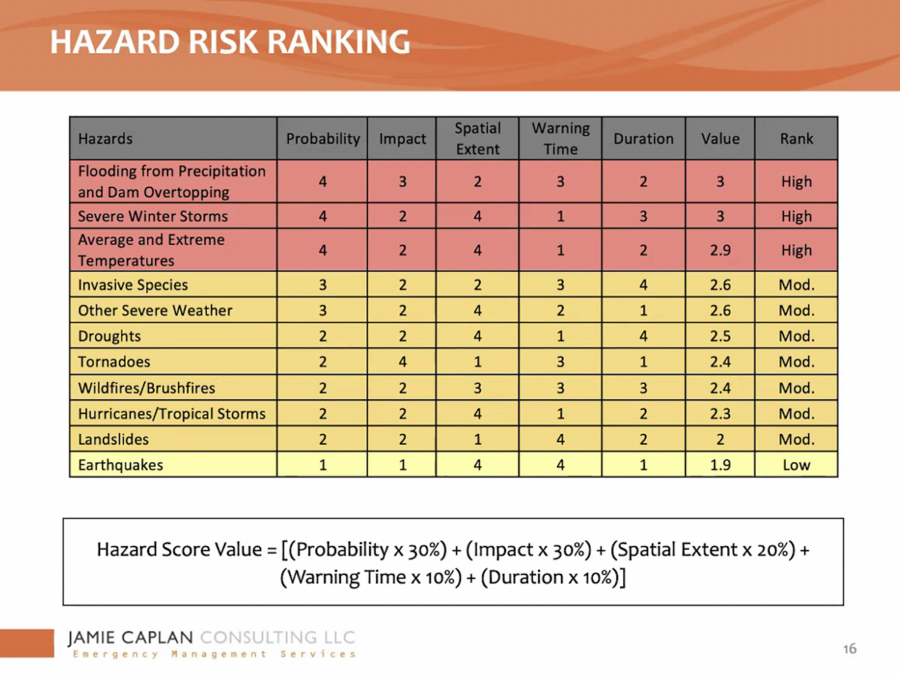
The committee ranked hazards based on its probability, impact, spatial extent, warning time, and duration.
Based on these parameters it was determined flooding from precipitation and dam overtopping, severe winter storms, and average and extreme temperatures are the towns highest hazards. Earthquakes has the lowest risk
Although the landslides are often associated with flooding it was the lowest of the moderate hazards because the typography of the town minimizes the probability and spatial extent.
The town is on schedule to finish the plan and get it to the Massachusetts Emergency Management Agency in April.
MEMA is required to review the proposed plan to ensure all state and federal requirements are met. Once approved, it is forwarded to the Federal Emergency Management Agency for approval before returning to the Select Board for adoption.
One of the biggest incentives to having a FEMA-approved hazard mitigation plan is that it saves lives and money, Caplan said. The approved plan also makes the town eligible to receive pre-disaster mitigation funding through the state.
The plan will have seven chapters, an introduction, planning area profile, planning process, risk assessment, capability assessment, mitigation strategy, and plan maintenance. The risk assessment chapter will be the longest chapter as it details all the hazards.
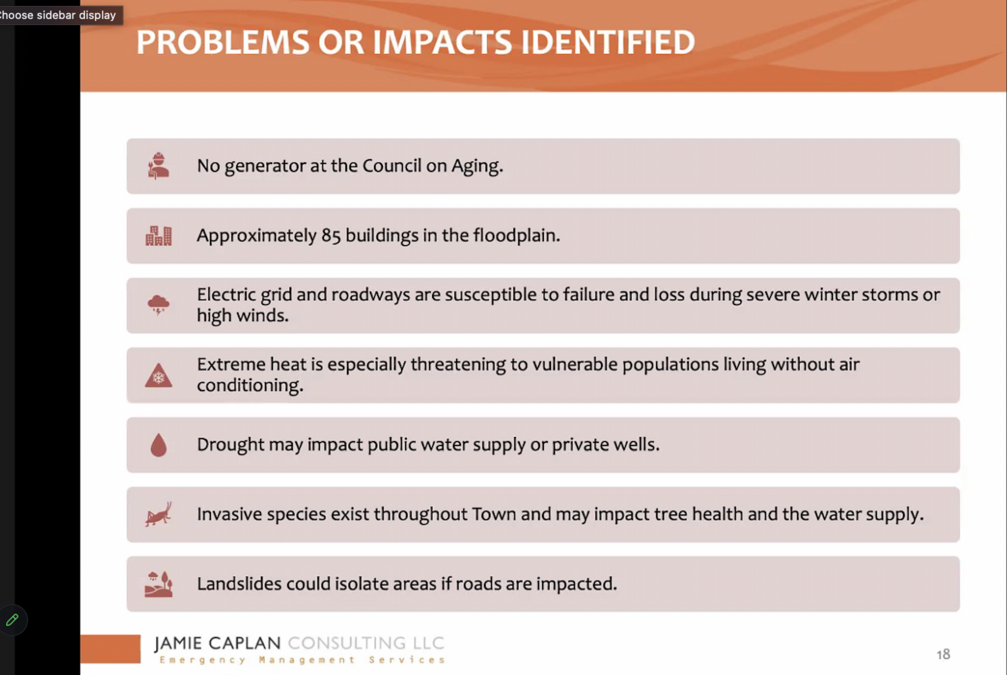
During the process, several problems and impacts were identified including that approximately 85 buildings are located in the floodplain and the susceptibility of the electric grid and roadways to failure during severe winter storms or high winds.
It also included the threat of extreme heat to vulnerable populations who live without air conditioning, potential impact to public water supply and private wells in cases of drought, the negative impact of invasive species on tree health and water supply, and the possibility of landslides that could isolate areas if roads are affected.
More information here.
Tags: hazard mitigation,