Berkshire United Way Celebrates a Century of Service
PITTSFIELD, Mass. — Berkshire United Way celebrated 100 years of service on Wednesday with hundreds of community members at the Colonial Theatre.
The organization has operated under a variety of names since its founding in 1924 but stayed true to its mission of meeting peoples' greatest needs, from economic hardship support during the Great Depression to emergency funding during the COVID-19 pandemic.
"I'm standing here right now feeling inspired and grateful," President and CEO Tom Bernard said to a crowd of more than 250.
"One hundred years of service is an incredible milestone for any organization and it is an honor to be part of the Berkshire United Way in this historic moment."
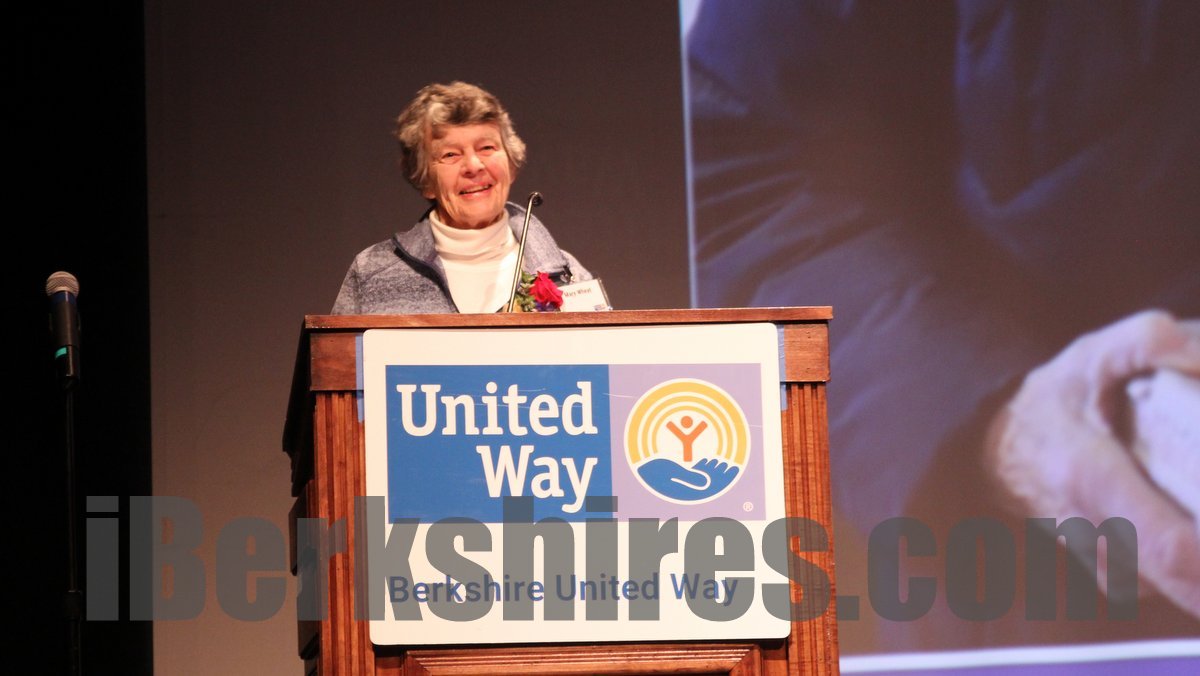
Mary Wheat of the South Community Food Pantry was presented with the Daniel C. Dillon Helping Hands Caring Heart Award for more than 20 years of volunteerism and leadership. She was called a "saint among people."
"Every week, the South Community Food Pantry serves more than 1,000 households. It's an amazing feat and it's one that makes us glad that Mary recognizes the incredible need for local food support and that she inspires so many of their volunteers to answer the call to service," 2023 recipient Alex Reczkowski said.
"Mary was also the founder and for many years the chair of the annual Thanksgiving Angels program. She was the driving force behind an effort that manages more than 300 volunteers annually and supplies thousands of Thanksgiving meals to people in Berkshire County every year."
A colleague said Wheat leads quietly and unflinchingly by example while inspiring others to serve and give back and "is a saint among the people."
Wheat accepted the award with a smile, saying it was a special honor and she was thankful.
"And thank you to all the people in the community which gives so generously to help their neighbors and to the volunteers who work so hard to put food on the shelves and organize it and give it to our hungry friends," she said.
"Without everybody's collective help, we could not feed all the people what you do and all the food pantries are thankful for your help and your donations."
Frances Jones-Sneed, professor emeritus of history and political science at Massachusetts College of Liberal Arts, took guests on a journey through 10 decades of the organization that began as the Pittsfield Community Fund Association supporting 13 member agencies.
"No matter the name, the organization has always stood for service to our community and its needs," she said, explaining that it has always focused on health, family and children, recreation, and social services for the community.
It was officially recognized as Berkshire United Way in 1984 after decades of service during the recovery from World War 1 in the 1920s, the Great Depression in the 1930s, World War 2 efforts of the 1940s, a baby boom in the 1950s, urban renewal in the 1960s, significant job loss at General Electric's Pittsfield plant in the 1970s, and the emergence of modern technology in the 1980s.
The organization reached $1 million of campaign monies raised in the 1980s and met the $3 million mark at the turn of the century.
"The 2000s was a decade of worldwide economic downturn. The outbreak of this global economic crisis sparked a global recession. Despite the recession, the Berkshire United Way met its $3 million campaign goal in 2000," Jones-Sneed said.
"It distributed 125 programs across 40 agencies and in the following years, they added four new agencies. It changed its mission and added a vision. The new mission said, 'to provide and improve people's lives by leading, collaborating, and mobilizing resources to address community needs and priority,' The vision was to enhance the quality of life in Berkshire County by creating sustained change in community conditions."
In 2010, the Teen Pregnancy Prevention Initiative was formed with a goal to reduce teen pregnancy by 10 percent. By 2015, teen pregnancy had been reduced by 52 percent countywide and 62 percent in Pittsfield.
A decade later, the COVID-19 pandemic led to a global economic recession, a sustained rise in global inflation for the first time since the 1970s, and a global supply chain crisis. BUW, the Berkshire Taconic Community Foundation, Northern Berkshire United Way, and the Williamstown Community Chest partnered to establish an emergency fund and distributed more than $3.4 million by 2021.
Mayor Peter Marchetti said BUW has been a staple in the community making a huge impact each and every day on positive youth development, early childhood development, and economic prosperity.
"Through increasing high school graduation rates, helping prepare children for kindergarten and reading proficiency by third grade, and building a stronger workforce for the local economy, the Berkshire United Way is committed to making a difference in Pittsfield, across Berkshire County, and across the world," he said.
Bernard shared the organization's priorities and vision for 2024 and beyond, which include school and career readiness, mental health, and household stability.
He said BUW will continue to be "laser-focused" on early childhood education and will promote and support pathways for young adults as "it's no secret what happens for young people after high school is a critically important question."
Mental health is a new priority and requires the most work, Bernard explained.
"We're going raise awareness of the systems not just here, but with our partners in the Mass 211 network to ensure that when people call or text, they get connected to the often life-saving support that they need," he said.
"And then we're going to conduct a landscape analysis to understand where we can help close the gaps in the network of groups and individuals focused on addressing substance misuse, treatment, and recovery."
Household stability helps to ensure that everyone in the community has equitable access to economic prosperity. BUW is exploring setting up a permanent targeted fund for basic needs and will continue to partner with experts and colleagues in the community to be a part of housing support and advocacy efforts.
"Because there is ample evidence demonstrating that when we focus on helping people meet their basic needs, meeting their higher order needs comes into focus and we're going to continue our work to help people become financially stable," Bernard explained.
"So we're going to continue investing in supporting career development and workforce training, we're going to build on our convening successes in the community navigation arena by inviting financial coaches to come together and build an even stronger and more robust network, and we're going to focus on supporting everyone making less than $75,000 a year annually."
He reported that these priorities resonated well with stakeholders and reflect the vision that when people have access to the services and support needed to be safe, healthy, and financially secure, they can achieve their goals.
"In some ways, this vision brings us full circle to our origin story of organizations banded together to support the community and it's a mark of how far we've come that this is a vision that centers individuals and families rather than funders at the heart of this work," he said.
The ceremony also included citations from state representatives, Gov. Maura Healey, and video messages from United Way Worldwide President and CEO Angela Williams and U.S. Sen. Elizabeth Warren.
The Youth Alive step and dance team opened the event with performances and former board member Warren Dews Jr. closed with "Happy Birthday."
Tags: Berkshire United Way, centennial,