Williamstown Town Meeting Passes Progress Pride Flag Bylaw Amendment
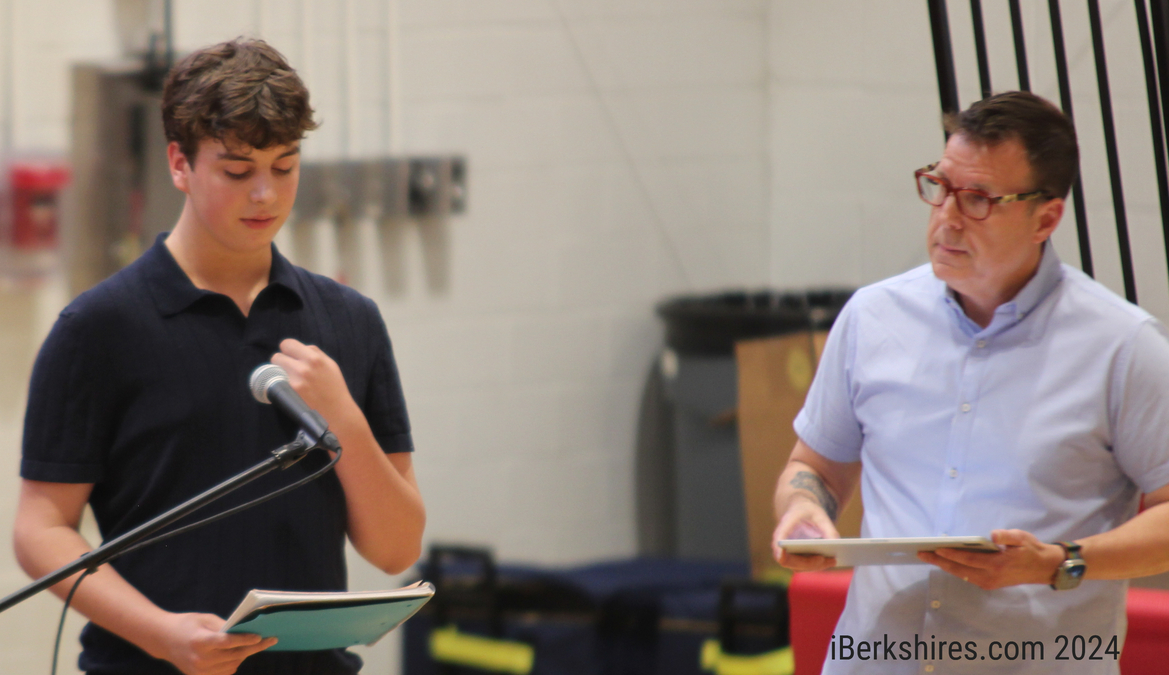
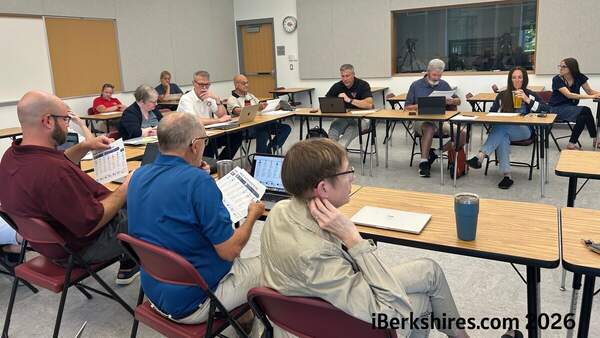
Mount Greylock sophomore Jack Uhas addresses town meeting on Thursday as Select Board member Randal Fippinger looks on.
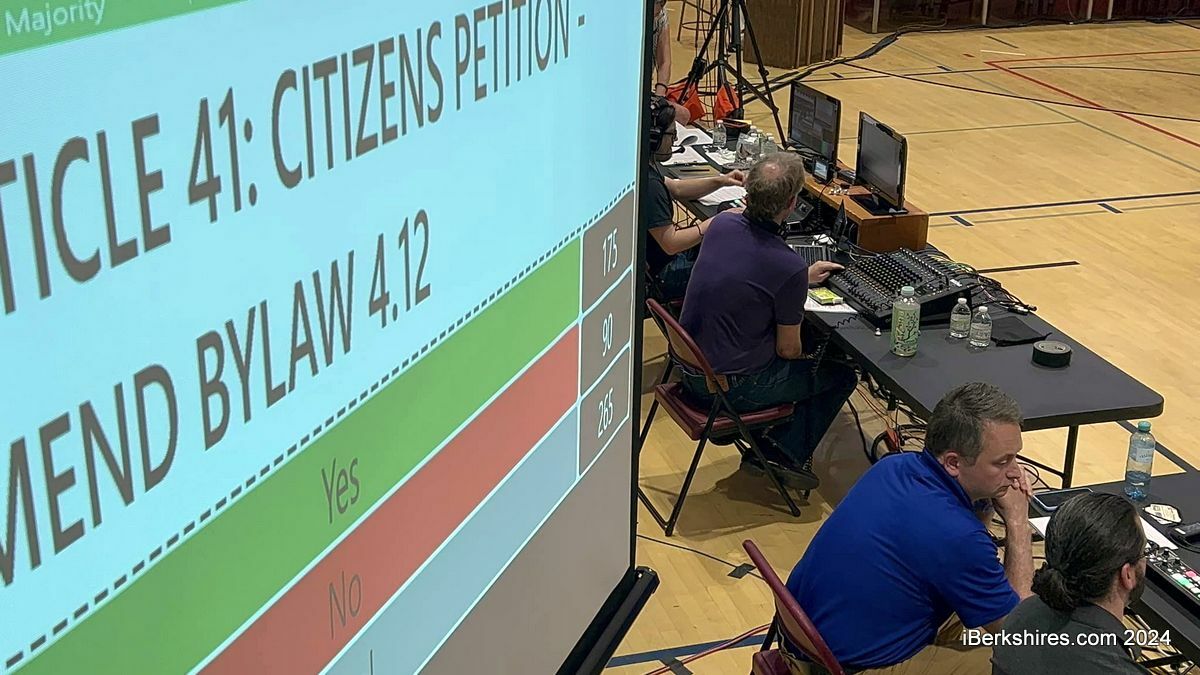
The most heavily debated article of the 40 that were addressed by the meeting was decided on a vote of 175-90, amending a flag bylaw passed at last year's town meeting.
Mount Greylock Regional School sophomore Jack Uhas of the middle-high school's Gender Sexuality Alliance opened the discussion with a brief statement, telling the 295 voters who checked into the meeting that, "to many, the flag is a symbol that, in our town, they belong."
The speakers addressing the article fell roughly in line with the ultimate vote, with eight speaking in favor and four against passage.
Justin Adkins talked about his experience as, to his knowledge, the only out trans individual in the town of about 7,700 when he moved to Williamstown in 2007.
"Most people, when I moved here, had never met a trans person," Adkins said. "Today, that is not the case. Today, many people in this room are free to say who they are.
"LGBTQ-plus youth still face a world where their basic being is questioned and legislated. … Flying a flag is, really, the least we can do."
Adkins said there were many LGBTQ families and families with LGBTQ youth who moved to Williamstown or were thinking of moving to Williamstown because they think it is a welcoming community.
"They are watching us tonight," Adkins said.
At the opposing microphone, Luana Maroja argued that a bylaw amendment to allow the Progress Pride flag would open the door to a request to fly any number of "advocacy" flags on town property.
"I could reasonably propose we fly the 'Back the Blue' flag — no, I don't think that's a good idea, by the way," Maroja said. "But 'Free Palestine?' 'Black Lives Matter?' Atheist flags?
"We must keep in mind that ideological flags never have a single meaning."
Robert McCarthy told the meeting that in his 83 years in Williamstown he never had any issues with a lack of diversity. And he argued that the town flag poles should be reserved for "sacred" objects like the American flag.
"We don't need 37 flags flying from a flag pole or 87 flag poles in Williamstown," McCarthy said.
"You have the right — every single group in this town has the right to put up any flag you want. You can put it on your home, on your lawn, on your business. I encourage everyone who has an agenda to fly a flag. Let's keep the American flag, the POW/MIA flag alone, and if you want to fly your own flags, that's wonderful, but not on municipal poles."
Rabbi Rachel Barenblat spoke on behalf of members of her congregation, telling the meeting that, in fact, there are issues of diversity for vulnerable populations in town and the occasional flying of a Progress Pride flag would be one measure to address them.
"It's not a place where all of us can belong as fully as we want to, as fully as we should," Barenblat said. "Until we reach that day, I think there is value in flying the Progress Pride flag."
Most residents who attended the meeting — about 6.3 percent of the town's 4,7000 registered voters — agreed with Barenblat.
They also agreed, by more than a 2-to-1 margin, with the Planning Board, which earned passage of a zoning bylaw amendment that generated the second longest discussion of the evening.
The Cottage Housing Bylaw passed on a vote of 194-56, easily clearing the two-thirds margin needed to approve zoning bylaws.
Under the new law, clusters of four to 12 cottage-sized single-family homes will be allowed on a single residential lot in the General Residence district. The homes are limited to a footprint of 900 square feet and a total floor area of 1,575 square feet or 175 percent of the footprint, whichever is less.
"At a broad level, the purpose is to increase the supply of modestly priced housing in the General Residence district," Planning Board member Ken Kuttner told the meeting. "The dwellings are small, make more efficient use of scarce land, are intrinsically sustainable and promote a sense of community."
Kuttner explained that the bylaw, the result of a couple of years of discussion by the Planning Board, was modeled heavily on similar cottage court bylaws in other communities.
That opened the door to one of the bylaw amendment's critics.
"Cluster housing development may be desirable in Portland, Oregon … but it may not be desirable, or even welcome, here in Williamstown," Joyce Harsch said.
Paul Harsch argued that the small, densely developed homes would not achieve the affordability the Planning Board seeks.
"Housing will be built and sold to the highest bidder," Paul Harsch said. "I'm in the real estate business. I understand market forces. These houses will be built by developers looking to achieve the maximum return."
Paul Harsch also noted that the proposed bylaw amendment did not specify a time frame for building homes in a cottage court and argued that neighbors could be subjected to a nearby construction site for "12, 14, 16 years."
On the other hand, Bette Craig told the meeting that she recently had visited a successful cottage development in Arkansas and found it to be the kind of development the town should welcome.
"There was a community center, a laundry center, there were 12 individual houses, all slightly different, with porches, and the people seemed to be very happy to be living there," Craig said. "I think it would be a great thing to have in Williamstown."
Most of the articles on the warrant passed with either unanimous or overwhelming voice votes. Two articles that appeared on the warrant required no action from the meeting. The Conservation Commission, which submitted a warrant article regarding the Spruces Park, asked that the meeting take no action. A citizen's petition regarding a 1.2-acre town owned parcel had no one present to speak on its behalf.
Tags: annual town meeting, fiscal 2025, flags, williamstown_budget,