image description
Award-winning artist Julie Bell's fantasy animals and realistic works are on view at the Berkshire Museum through September.

Berkshire Museum Opens 'The Wild Indoors' Exhibit

By Sabrina DammsiBerkshires Staff
Print Story | Email Story

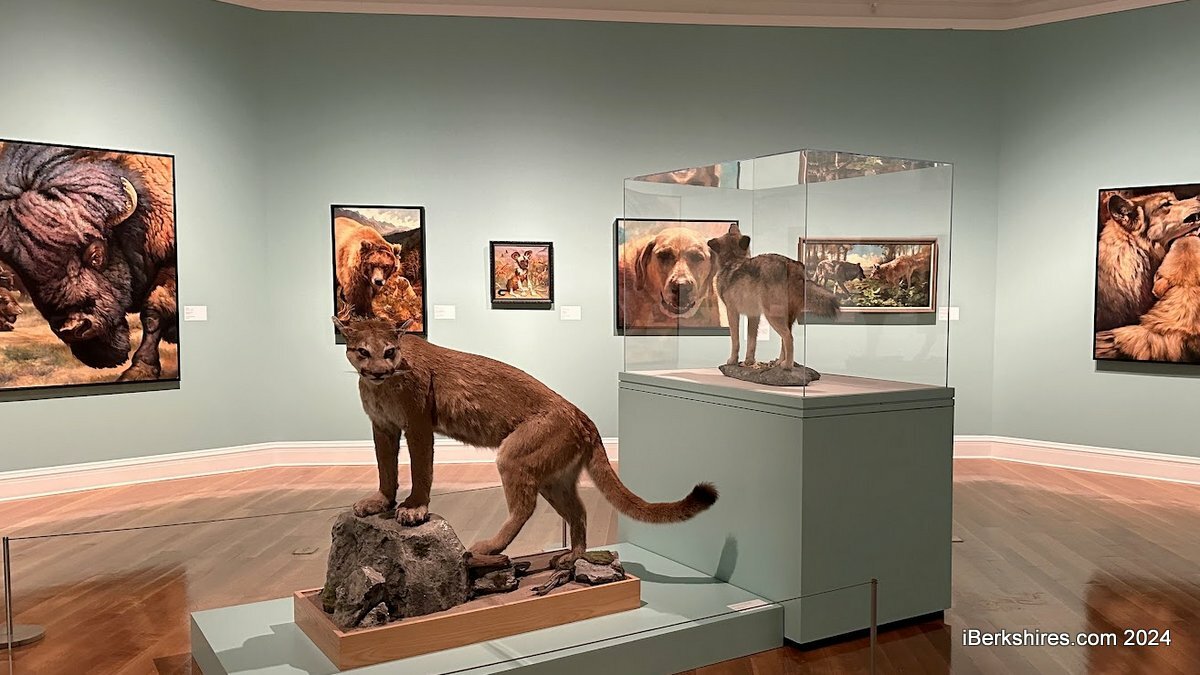
The pieces are displayed with some of the museum's collection of taxidermy animals. 
PITTSFIELD, Mass. — The Berkshire Museum has opened its newest exhibit, "The Wild Indoors," by award-winning artist Julie Bell. 
 
The exhibit runs through Sept. 29 and combines some of the museum's collection of taxidermy animals with Bell's fantasy art and realistic painting of the wild animals from across the united states. 
 
This is Bell's first solo museum exhibition for wildlife or fantasies. She uses oil painting to bring to life wildlife including a lion, wolves, bears, cows, bisons, a dog, and more. 
 
"It's the first solo show I've had in a museum. And I'm just really, really, very excited about this. I just appreciate it so much that you're there," Bell said. 
 
"I'm just very honored for this to be taking place. These paintings mean a lot to me. It's my personal work and and I'm just really, really so appreciative for you to come out and see it and for it to be in this beautiful museum."
 
The diverse pieces of work on view makes the viewing experience fun and interesting, Berkshire Museum's chief curator Jesse Kowalski said. 
 
"A lot of people gravitate towards different ones … it's a fun show. It's really beautiful artwork. And I think there's just something for everyone here," he said. 
 
A lot of people are attracted to the dog painting named "Big Oscar," which is of a neighborhood dog that would go from house to house when Bell was younger, Kowalski said.
 
She has always had a fascination about animals and spends a lot of time around wildlife. Animals also often appear in some of her fantasy work, such as a zebra in her fantasy painting "Behind the Veil," which won a Silver Spectrum Award in 2016. 
 
"She just loves animals. She just feels a real connection to them and for her a lot of the fantasy artwork, she talks a lot about dreams and the subconscious and her fantasy art is really a way of kind of bringing that to life," Kowalski said.
 
"She mentioned specifically the zebra painting, about when she was a child she would have a lot of nightmares about zebras chasing her and things, so [that] came out of that, these childhood dreams."
 
Bell has an eclectic background being commissioned to create advertising illustrations for well-known companies including Nike, Coca-Cola and The Ford Motor Company, her website says. 
 
She has also worked with major publishing houses in New York City to paint book covers and created album covers for artists such as Meat Loaf.
 
"She was the first woman ever paint Conan for Marvel Comics, which paved the way for many other commissions from Marvel, DC, and Image Comics to illustrate superheroes in fully rendered paintings," her website says. 
 
"Her first published cover for Heavy Metal magazine broke ground for other illustrators with the introduction of her now legendary Metal Flesh. Her hyper-realistic style is known for its sexy, powerful images of warriors and amazons and a sensitive, exquisite use of color and texture."
 
Bell usually works one piece at a time and they can take two to three weeks to complete, Kowalski said. 
 
She's lived in a dozen different locations and attended six colleges and universities to continue her artistic passion, focusing on the human figure and life drawings, Bell said. 
 
She took up weight training because of this love of the human body and became a nationally ranked competitive bodybuilder. 
 
It was this path that led her to meet her husband, Boris Vallejo. Vallejo is an award-winning science fiction, fantasy, and erotica genre Peruvian-American painter. She modeled for some of his pieces and they bonded over their shared love of art. They married in 1994 and live and work in Pennsylvania. 

Tags: animals,   Berkshire Museum,   exhibit,   

If you would like to contribute information on this article, contact us at info@iberkshires.com.

Berkshire Towns Can Tap State Seasonal Communities Resources

BOSTON — Governor Maura Healey announced that 18 additional municipalities across Massachusetts have been designated as Seasonal Communities, opening up new tools, support and grant funding to help them manage seasonal housing pressures. 
 
Created as part of the historic Affordable Homes Act signed into law by Governor Healey in 2024, the Seasonal Communities designation was designed to recognize Massachusetts communities that experience substantial variation in seasonal employment and to create distinctive tools to address their unique housing needs. The law also established the Seasonal Communities Advisory Council (SCAC).  
 
The Affordable Homes Act identified several communities to automatically receive the designation, including:   
  • All municipalities in the counties of Dukes and Nantucket;   
  • All municipalities with over 35 percent seasonal housing units in Barnstable County; and   
  • All municipalities with more than 40 percent seasonal housing units in Berkshire County. 
  •  
To identify additional communities, the Executive Office of Housing and Livable Communities (HLC) reviewed available data, specifically focusing on cities and towns with high levels of short-term rentals and a high share of second- or vacation homes.
 
In Berkshire County, Egremont, Great Barrington, Lee, Lenox, New Marlborough, Richmond, Sandisfield, Sheffield, West Stockbridge and Williamstown have been designated. 
 
"Our seasonal communities are a vital part of Massachusetts' cultural and economic fabric, but they're also home to essential workers, families, seniors, and longtime residents who deserve a place to live year-round," said Governor Healey. "That's why we're committed to supporting these communities with innovative solutions like the Seasonal Communities designation to meet their unique needs, and I'm thrilled that we're offering this opportunity to 18 additional communities across the state. Everyone who calls these places home should be able to live, work and grow here, no matter the season." 
 
As with the statutorily identified communities, acceptance of the designation for municipalities is voluntary and requires a local legislative vote. HLC will open an application for newly eligible communities that haven't accepted the Seasonal Communities designation to request consideration. 
 
The Affordable Homes Act created several new tools for communities who accept the Seasonal Communities designation to be able to:  
  • Acquire deed restrictions to create or preserve year-round housing 
  • Develop housing with a preference for municipal workers, so that our public safety personnel, teachers, public works and town hall workers have a place to live 
  • Establish a Year-Round Housing Trust Fund to create and preserve affordable and attainable housing for year-round residents 
  • Create year-round housing for artists 
  • Allow seasonal communities to develop a comprehensive housing needs assessment 
  • Permit tiny homes to be built and used as year-round housing 
  • Permit year-round, attainable residential development on undersized lots 
  • Increase the property tax exemption for homes that are the owners' primary residence 
 
View Full Story

More Pittsfield Stories