Marchetti: Pittsfield's Toter System Is a Good Change
PITTSFIELD, Mass. — Mayor Peter Marchetti said the city needed to get on board with a new trash system before it was too late.
He shared information and reflections on the process with host Shawn Serre during Monday's episode of "One Pittsfield" on Pittsfield Community Television.
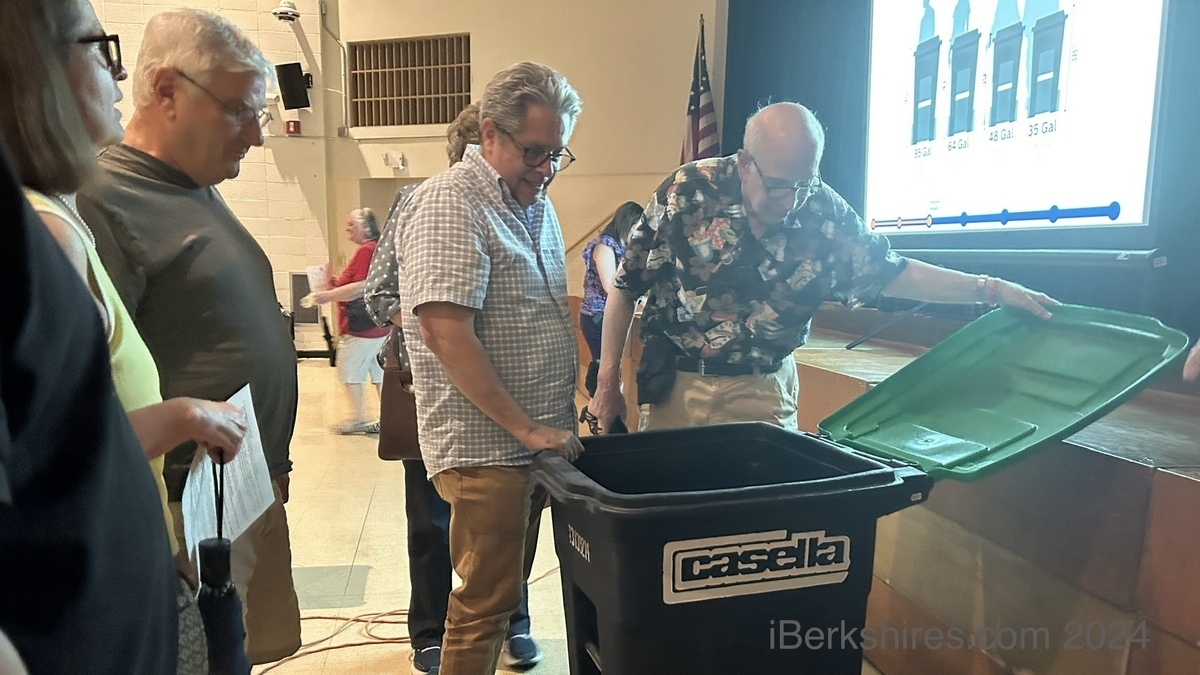
The city's 48-gallon toter system will roll out on Wednesday with the delivery of recycling containers for Friday routes and automated pickup begins two days later.
"I get it, this is changing the way that we've all done things, especially you and I. This is the way we've done things our whole entire life," Marchetti said to Serre.
"In fact, when I was a kid, the garbage man picked up your garbage at the back steps and put the pails back, right? So we don't have that anymore for obvious reasons and I think it's time to find new, innovative ways that have already been created for us to find the cash savings."
He explained that this isn't a new conversation for the city in "any way, shape, or form," since it goes back more than 15 years.
"We know that the cost of collecting trash and disposing of recyclables continue to skyrocket, and we need to find a way to make it through," he said.
"And we've been talking toters for a really long time in the city's history."
In 2018, after a series of community meetings for a toter proposal, former Mayor Linda Tyer trashed the plan that would have utilized 45-gallon containers for trash and 96-gallon containers for single-stream recycling.
She recognized that many still had "unresolved questions and concerns about the plan and its impact on the community."
Three years later, the City Council rejected a pay-as-you-throw proposal brought forward by (then President) Marchetti and Councilor at Large Earl Persip III. The program would have contracted with WasteZero, providing residents with 104 15-gallon bags free each year and any additional bags would be purchased for $1.50 per 30-gallon bag and $0.80 per 15-gallon bag.
Marchetti noted that this was "really not well received."
In June, the council approved draft five-year contracts with Casella Waste Management for the new trash system. It was a victory for the first-term mayor, who was able to push through in six months a new waste pickup model that had eluded his predecessors.
"It's the opportunity for the city to get on board before it's too late to get on board," he said.
"It's clear to me and those around that the industry is going to an automated trash collection system so whether it be this contract or the next, this is something that we are going to have to venture down that road."
There is a potential for more than $500,000 in cost savings through the program, Marchetti said, and most is through recyclables. Automation saves the city $80,000 per year and the city can see much larger savings if it steps up on recycling.
"Pittsfield recycling rates are currently about 9 percent. Our estimate for this fiscal year is to increase recycling from nine to 25 percent," he explained.
"So moving the needle slightly but nowhere near to where need to be, and if we can do that, that's half a million dollars plus in savings so let's think bigger."
The belief is that it will also enhance safety and cleanliness.
"If you think about it now, all of the Casella workers are lifting whatever pounds of trash are at people's doorsteps, and that allows for opportunity for folks to be hurt," Marchetti said.
"And having just a toter system, it's a neat, organized way. I know if you drive around town, you see some units with 50 bags of trash just sitting there and it's not really aesthetically pleasing to the city."
There has been a variation of public input about the 48-gallon containers. People with more trash needs say it is not big enough and the older population worries that it will be too large to cart to the curb.
The mayor sees this size as a compromise.
"I've heard it all. I've heard the large family concept and I've heard that the mayor is not compromising. That's one side of the spectrum, a large family. The other side of the spectrum is a single person, regardless of their age, living by themselves and how did you find a compromise?" he said.
"And so I look at it. There's 32, 48, 64, 95 (gallons.) The compromise is either 48 or 64. For all the people that wanted 32, we compromised on the closer side to them. For all the people that wanted 95 or 64, we didn't compromise."
Marchetti emphasized that this is about encouraging a change of behaviors and recycling, adding that the system is successful across the commonwealth and beyond.
Serre asked, "Do you really think this will impact the way that people recycle?"
The mayor said if residents spend more energy learning about what they can recycle and how to do it rather than how the system won't work, the city would be pleasantly surprised at the success.
"I think if folks spend a little bit of time reading up on what they can and can't recycle, you will probably find that more than 50 percent of what you throw out in trash is recyclable," he explained.
Tags: recycling, toters, trash,