Candidates for Third Berkshire Meet in Wide-Ranging Debate
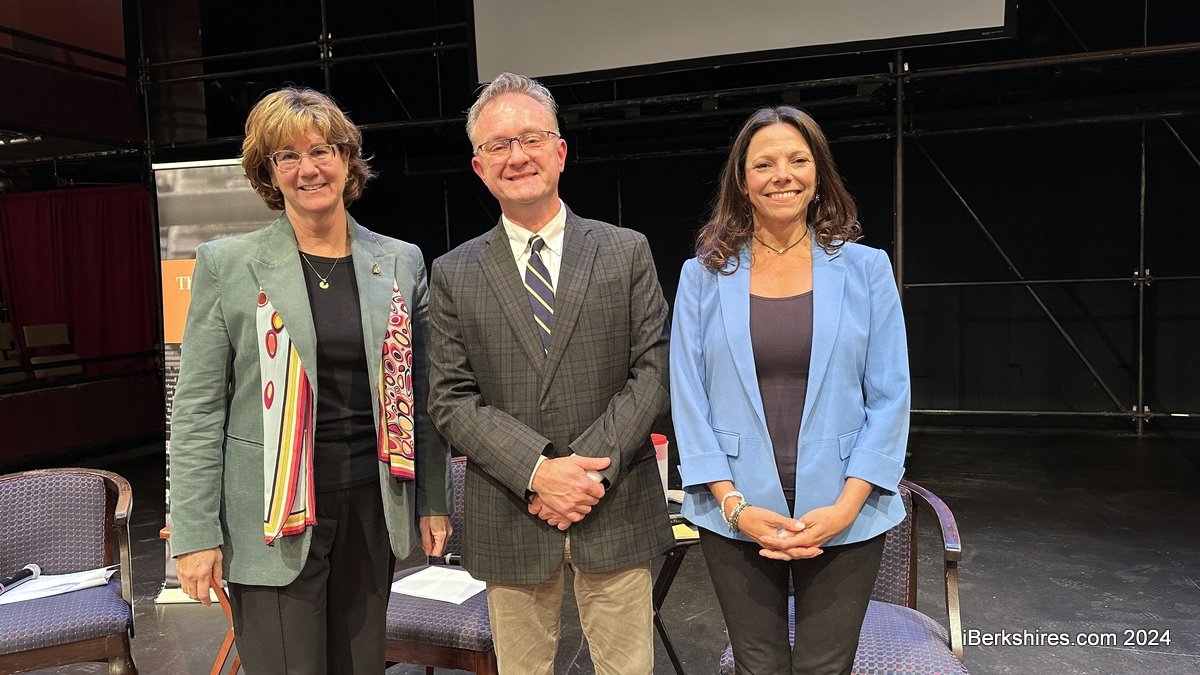
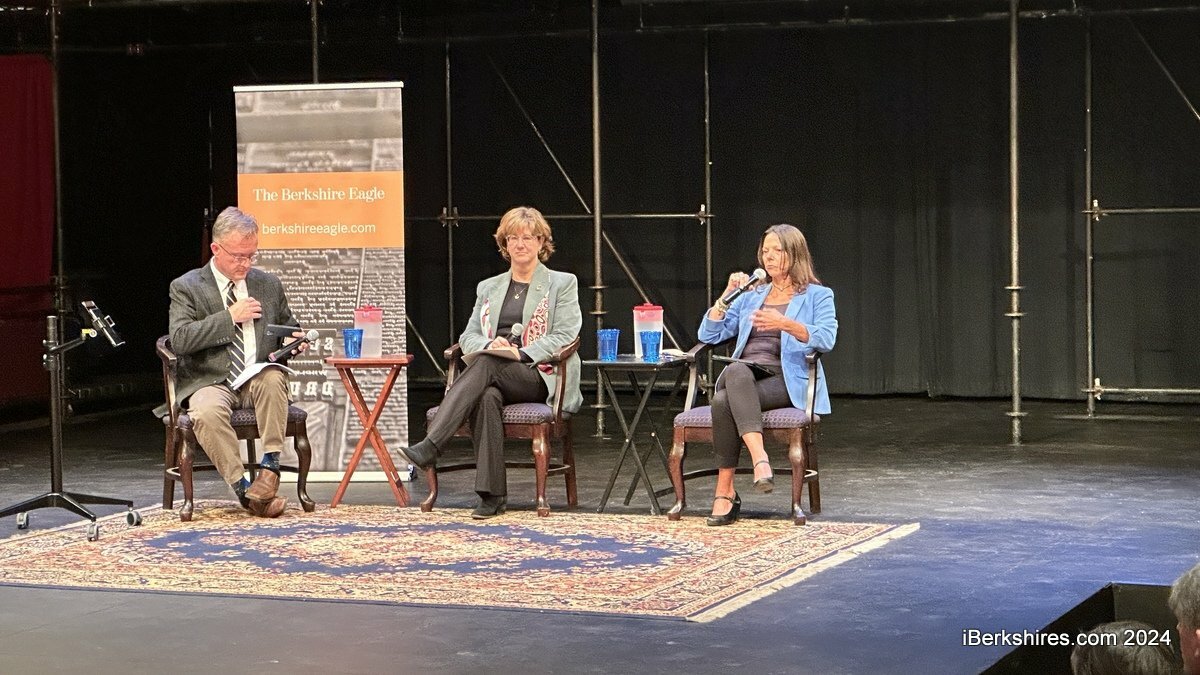
Kevin Moran, executive editor of The Berkshire Eagle, was moderator for the debate hosted by the newspaper. Marybeth Mitts, left, is running as an independent for the Third Berkshire and Leigh Davis is the Democratic candidate.
On Nov. 5, voters will decide who is most qualified to push the community forward as the next Third Berkshire District state representative.
Leigh Davis is running as the Democratic while Marybeth Mitts is running as an independent to fill the seat being vacated by longtime state Rep. William "Smitty" Pignatelli.
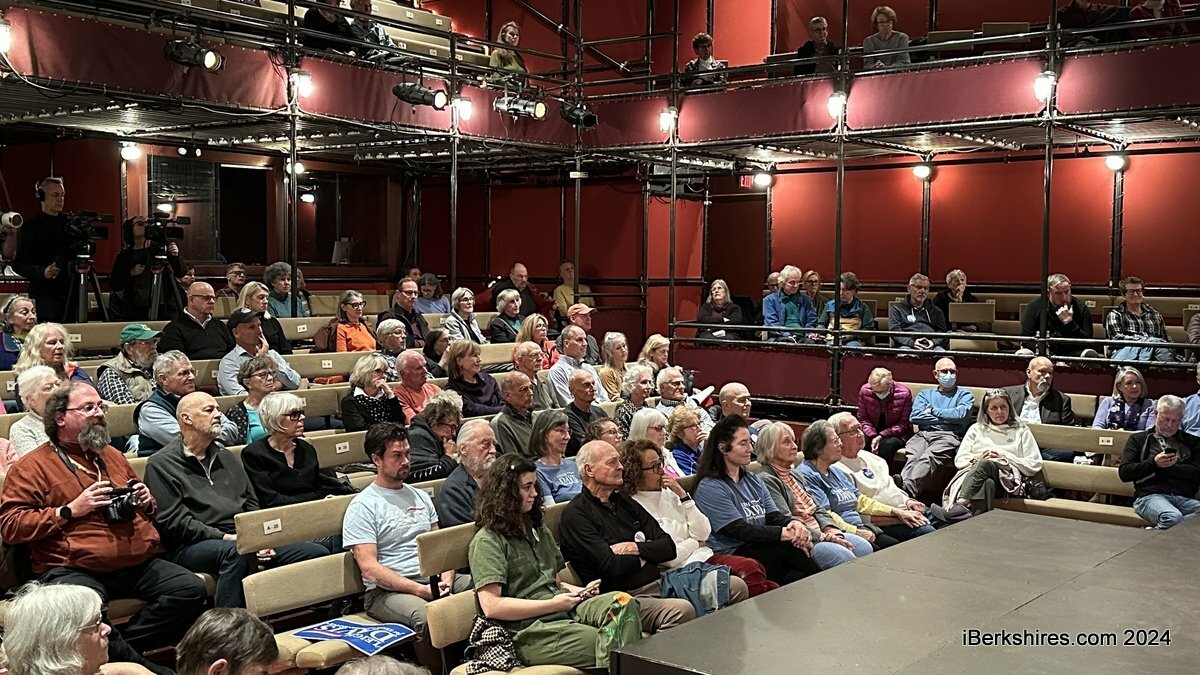
The two went head to head on Tuesday night for a debate hosted by The Berkshire Eagle at the Tina Packer Playhouse at Shakespeare & Company.
Davis has served on several boards and committees in Great Barrington, including the Finance Committee and, more recently, the Select Board.
She is the communications and community engagement director for Construct, the largest affordable housing nonprofit in Southern Berkshire, and has volunteered with and held leadership positions in numerous organizations.
"Public service is in my DNA … I was actually born and raised in a house full of civil rights activists," she said, explaining how her dad worked at the Martin Luther King Center and on the national holiday with Coretta Scott King, and her mother worked with Sargent Shriver, the founder of the Peace Corps, Job Corps and Special Olympics. "So, I was raised in a house that was giving back, and being a public servant was part of my core."
Mitts also has an extensive background in public service. She has served on the Lenox Select Board, School Committee, and the Affordable Housing Trust.
She showcased her decades of experience working in the military and the federal government. She said she has "delivered real results" in her town's local government and is running on her record.
"I have a track record, and as an independent, I'm not tied to party politics. I'm tied to you, the people of this district, and that is who I will serve," Mitts said. "As a professional, I believe in actions over words, collaboration over conflict, and results over promises."
Davis has also received endorsements from organizations focused on environmental issues, animal rights, unions, reproductive equity now, and health care.
"I am not beholden to these. These are values that I deeply hold. Values that are dear to working families, about making a living wage, ensuring that there's equity, [and] that there's social justice," Davis said. Prominent Democratic leaders have also endorsed Davis, including Lt. Gov. Kim Driscoll, Gov. Maura Healey and U.S. Sens. Elizabeth Warren and Edward Markey.
She highlighted her ability to build coalitions and her relationships with House leadership and believes these skills and connections will allow her to navigate the learning curve of state representation and effectively advocate for the district's needs.
Mitts has been characterized as "flip-flopping on party affiliations," said moderator Kevin Moran, executive editor of The Eagle.
In response, she explained that she had initially planned to run as a Democrat but missed the deadline to declare her party affiliation, so she ran as an independent instead.
Mitts started the debate off by saying democracy is a conversation.
"People have various opinions, and they should all be respected. So, as an independent, I'm happy to move forward in this race. I'm happy if I were to win this race to engage in that conversation on Nov. 6 [sic]. That we should all be in this together no matter what happens," she said.
"We need to represent our ideals and our values and continue to work toward making the Commonwealth of Massachusetts, as well as our nation as strong as it can possibly be, there are a lot of challenges ahead."
If elected, Mitts said she would certainly be caucusing with the Democrats, because that's the majority party.
"I spoke to Susannah Whipps, who is the other independent, and she caucuses with the Democratic Party. She's very effective for her district in Franklin County, and I believe that I can be effective as an independent," Mitts said.
"But I could also choose, when I get there to become a Democrat, should that be the case. I haven't taken that into account currently, but that's certainly an option."
Davis criticized Mitts' missing the deadline to declare party affiliation, emphasizing the importance of paying attention to deadlines when running for an office that will impact 40,000 people.
She said Mitts in previous interviews said she was running as an independent to represent everyone, but in this debate, she changed her story.
Davis was asked about the delay in addressing the discolored drinking water caused by manganese in the Housatonic.
The Great Barrington Select Board has been discussing it for over a year. However, little progress has been made, leading so many people to think the board's actions are just for show in an attempt to quell the public, Moran said.
The Housatonic Water Works serves about 850 customers in Great Barrington, West Stockbridge, and Stockbridge.
The water issue has been getting worse for at least 10 years, and now the Water Works wants Great Barrington to buy it. However, the town could also take it through eminent domain.
So, why is there a delay and if elected, what does she intend to do about this issue, Moran asked.
The Select Board has commissioned a feasibility study to assess the issues and determine the waterworks' value. However, Davis said the study has been delayed because the owners of the utility have not provided the needed financial details.
Once the feasibility study is completed and presented to residents in October, the true cost of acquiring the water works and addressing the infrastructure problems will be known, she said.
"If we had residents that were complaining of water that was unappealing or unattractive or possibly unsafe, carrying possibly carcinogenic products, we would have had it tested, possibly would have done a feasibility study, and gone through eminent domain to take the company over in order to make everything safe for our residents," Mitts said.
"Now, I am not part of the town of Great Barrington, and I cannot pretend to know exactly what they've done or have not done for this issue, but it sounds like they're starting to address it now, and hopefully, the residents of Housatonic, West, Stockbridge, and Stockbridge will begin to see some improvements with their Select Board in Great Barrington starting to take the reins on this particular issue."
There has been no investment in the piping of Housatonic waterworks, and it will take between $30 million and $50 million to rectify this, Davis said.
This is a two-step problem: one, lack of investment, and two, the town would have to go to town meeting to come up with that appropriation, she said.
The candidates largely agreed on other topics, including the need for regionalization, especially for emergency services, increased access to affordable housing in the area, and addressing aging and deficient infrastructure.
The two swayed slightly on possible solutions. Mitts advocated for relaxing the stretch building code to make it more affordable for developers to build new housing projects in the region.
Davis emphasized the need for zoning reform in the community, including allowing accessory dwelling units by-right and expanding financial assistance for first-time home buyers.
The one topic they disagreed on was book banning, citing the police investigation earlier this year of a Great Barrington middle school classroom involving the illustrated book "Gender Queer."
Davis took a firm stance against book banning, saying, "Book banning should not happen."
She said she met with the police chief for an hour to get an explanation. The chief explained that the department received two complaints, one of which included an allegation that a child was on the teacher's lap, which prompted the department to investigate.
"I absolutely support that book being in the school. This is something that we need for our students, especially for those that are feeling that their voices are not heard [and] are struggling with identity issues. So number one, I'm fully supportive of the teacher having this book," Davis said. "This is something that obviously, there were a lot of dropped balls, and I think that between the superintendent and the police chief, we have a lot of learning to do and the town.
"So, unfortunately, this is an incident that should have never happened. The teacher should have been supported. The students should have been supported. They lost teachers for many, many, many months. And absolutely [there] should never be a book ban."
Mitts, however, focused more on the need for clear policies and procedures to decide whether a book should be included in the school's library collection, similar to policies libraries have. She advocated for having those in place to evaluate books in schools to ensure they are appropriate and representative of the community's values.
"The town of Lenox has library policies for our public library for the review of books, any book, that goes into the public library, as well as any book that comes into the high school, middle school library," Mitts said.
"There are specific sections that are sort of geared toward middle schoolers and high schoolers. I don't know where that book may end up if it is a part of our collection, but I would presume that it would be evaluated by the librarian and our current policy."
Tags: debate, election 2024, third berkshire,