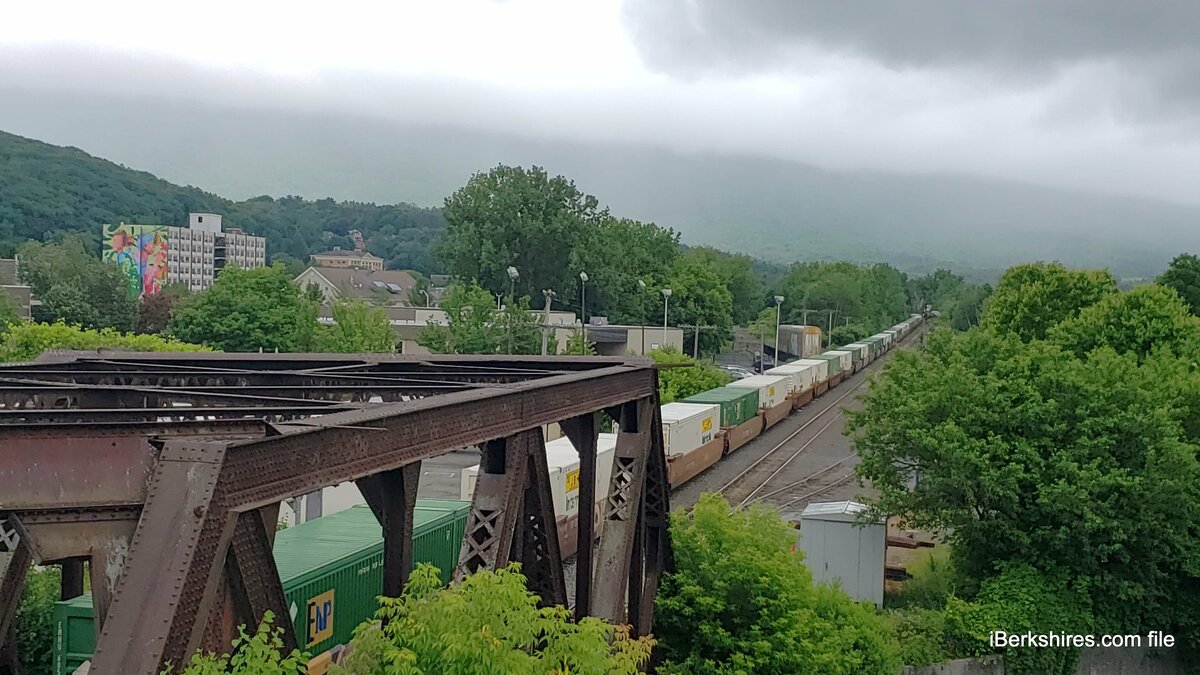
North Adams Council Endorses Northern Tier Rail
NORTH ADAMS, Mass. — The City Council endorsed the Northern Tier Passenger Rail plan on Tuesday, adding to a chorus of support from officials and community leaders along the proposed route.
"The completion of the Northern Tier Passenger Rail contributes to the economic development and emboldenment of communities throughout the state, allowing for North Adams to revitalize its tourism sector, create new avenues of revenue production and economic opportunities for all residents," the resolution introduced by President Bryan Sapienza and Councilor Andrew Fitch states.
The vote was unanimous, with Councilor Keith Bona absent, although Councilor Ashley Shade was wary of a full-throated endorsement this early in the scheme.
"The potential of this project could have a huge impact on the future of Western Massachusetts, especially Northern Berkshire," she said. "It would give us access to the eastern part of the state, which we are incredibly isolated from, and we haven't had in 70 years."
But it won't start, if at all, for years — possibly a decade, Shade added.
"So while I support a project like this, I wonder if we're pulling a trigger on a resolution too soon, without really having full details of what a project's going to be, what kind of investment the city will be required to put in, what kind of impact environmentally," she said. "There's six programs, and I believe they said four of them probably aren't even viable. So I support the project, and I think it's incredibly important for North Adams. I just wonder if we're jumping out a little too far ahead before we actually know what this thing is going to be."
The Northern Tier is one of several potential west-east rail services being weighed by state and federal officials. The study of west-east passenger rail, including from Pittsfield east, was made possible by an act of the Legislature in 2022 and some $16 billion is being targeted for the Northeast rail corridor by the Biden administration.
The six proposals for the Northern Tier include five trains a day with stops at minimum in North Adams, Greenfield, Fitchburg and North Station in Boston. The most ambitious would be an Albany, N.Y., to North Station line that would also add a Schenectady, N.Y., stop and an Albany layover.
The highest estimated ridership for the electrified service is about 200,000 to 300,000 a year; the full service is estimated at 168,000 to 255,460 riders a year. They would provide estimated cost savings of anywhere from $6 million to $8 million a year in transportation costs (parking, fuel, tolls, etc.) and reduce vehicle miles traveled by 12 million to 17 million annually.
The public comment period for the draft rail study closed on Saturday, Oct. 12. The draft study and public information sessions can be found here.
"My hope with this resolution was just to indicate that we're interested in moving forward and having a conversation about this," said Fitch. "My hope is also just to make sure that this does get to mass DOT and other stakeholders at the state level, that North Adams actually does want this, to make that really clear."
Councilor Peter Oleskiewiecz also did not see the resolution as committing the city to anything, funding or otherwise.
"I believe this is just a resolution showing that we're in support of this. I think there's no concrete plans as going through what city and town, from here to Boston, where impacts will be made, cost to each municipality they have to be incurred," he said. "So I think those will probably be later conversations as years go down the road as to what impacts it will have to each community and what cost we might have to bear.
"I think we're just passing a resolution showing support for the concept."
Sapienza pointed to the resurrection of passenger rail in Virginia and North Carolina, and the state of Florida.
"The state of Florida has also opened two lines, one called Brightline, which runs from Miami to Orlando, terminates at the Orlando International Airport and then has a another service called the, I think it's called SunRail, if I remember correctly, that runs from Western Volusia County to the city of DeLand down into Orlando," he said.
The full 61 miles of the SunRail line was recently completed, spanning four central Florida counties and connecting 17 stations. According to Global Railway Review, the construction has added some $2.4 billion in property growth along the line.
Sapienza said the idea in Florida was that the main highway between the Daytona Beach area and the Orlando area is very congested, but didn't think it was a matter of traffic here but rather distance.
Councilor Lisa Blackmer demurred, noting that traffic congestion around the Boston metro area can add an hour or more to travel times.
"As someone who's been driving back and forth from North Adams to Boston for years now, in my role with the Mass Municipal Association and other organizations, it is congestion," she said. "It's wasted time, at least if you're sitting on a train, you can work, or you can sleep, or you can relax, you're not like, totally stressed out waiting for someone not to hit you. So I do think it's important to have the west-east rail so that we can get into the city and back to do our business."
In other business, the council set a tax classification hearing for Tuesday, Nov. 12, at the request of the mayor. The assessor will give a presentation on the property valuations and options for the councilors for a split or single tax classifications. The city has historically had a split rate, with lean toward the commercial side in terms of tax burden.
Tags: passenger rail,