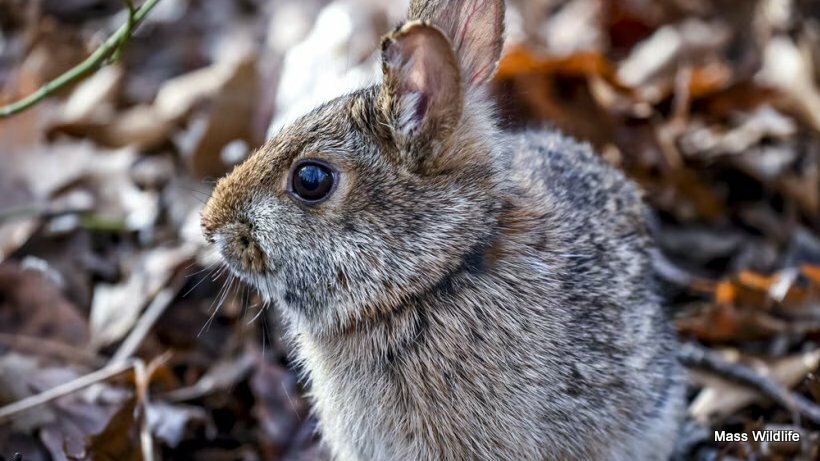
The New England cottontail, above, looks similar the eastern cottontail, a non-native rabbit introduced to Massachusetts in the late 1800s that is commonly seen in yards, parks, and fields.
Landowners Play Vital Role Creating Habitat for Declining Native Wildlife
Mass Wildlife is partnering with private landowners to create habitats for the native species, which is found in South Berkshire.
BECKET, Mass. — The New England cottontail, the only native rabbit in the region, thrives in dense young forests and shrublands.
However, this habitat is disappearing across Massachusetts, Maine, New Hampshire, Rhode Island, Connecticut, and eastern New York, putting the species at risk. Young forest habitats are areas of dense clusters of tree saplings and sprouts that provide abundant food and shelter for a wide range of wildlife including the New England cottontail.
New England cottontails are found in only a few areas including the Southern Berkshires, Cape Cod, and Nantucket, where thick areas of dense young trees and shrubs are more common.
MassWildlife, along with state and federal agencies, conservation groups, land trusts, universities, and private landowners, is working to preserve and create these vital habitats to bolster New England cottontail populations.
Across New England cottontail range, state biologists and other natural resource professionals work to benefit these rabbits by planning projects and connecting private landowners with financial resources and technical support. Since 2011, more than 17,000 acres of habitat have been managed to benefit New England cottontails across the region on both private and public land.
Thirty landowners have conducted habitat projects on 700 acres, primarily in the Southern Berkshires. By creating patches of young forest, landowners in Becket, Otis, Monterey, New Marlborough and Sandisfield, and in nearby Granville and Tolland in Hampden County, have made a significant contribution to the conservation effort.
Through the New England Cottontail Technical Committee, partners conduct research, manage land, and raise awareness about the rabbit's challenges. The Technical Committee has set ambitious habitat goals for 2030, but achieving them depends on continued collaboration with private landowners to manage their properties to maintain young forest habitats. Within the cottontail's range, more than 75 percent of land is in private, land trust, conservation organization, municipal, or tribal ownership.
The young forest habitat on which the rabbits depend rapidly grows back into more mature trees that shade out the shrubs. After approximately 20 years, these growing forests no longer provide the essential cover from predators or buds and twigs for food. While it is no longer suitable for rabbits, these maturing trees become valuable habitat for other species. Therefore, young forest habitat must continually be created in different locations so rabbits and other wildlife that use it have a new place to call home.
New England cottontails, along with other native wildlife, are making homes in these managed habitats that are now about 10 years old. Young forest habitats provide optimal cottontail cover from about 10 and 15 years after creation, meaning new patches must be established nearby for the cottontails to survive, as they don’t travel far.
MassWildlife biologists monitor New England cottontails and engage with landowners in prime cottontail country. By linking landowners with financial and technical support, MassWildlife can help landowners plan habitat management activities that bolster cottontail and other native wildlife that thrive in young forest areas.
Landowners living in New England cottontail range can contact Marianne Piché at marianne.piche@mass.gov to learn about options for habitat creation on their property.
Did you know? A wide variety of wildlife rely on the dense cover and abundant food provided by young forest habitats — American woodcock, ruffed grouse, white-throated sparrow, wood turtles, bobcats, and a variety of pollinating insects, to name just a few.
If you would like to contribute information on this article, contact us at info@iberkshires.com.
Your Comments
iBerkshires.com welcomes critical, respectful dialogue. Name-calling, personal attacks, libel, slander or foul language is not allowed. All comments are reviewed before posting and will be deleted or edited as necessary.
No Comments
Berkshire County Getting $4M Toward Housing Improvements
By Brittany PolitoiBerkshires Staff
Housing Secretary Ed Augustus has been a frequent visitor to the Berkshires and says a new rural designation for the Housing Choice Initiative grew out of conversations with small towns.
GREAT BARRINGTON, Mass. — Millions of federal Community Development Block Grant funds are coming to Berkshire County for housing and economic development.
On Thursday, Lt. Gov. Kim Driscoll said announced $33.5 million in federal CDBG funds, of which $5.45 million will be coming to the county.
Great Barrington, in conjunction with Egremont and Stockbridge, has been allocated $1.25 million to rehabilitate approximately 14 housing units.
"We really recognize the importance of having strong local partners who are doing that hard work every day, educating our kids, keeping our neighborhoods safe, investing in the best of what makes our community special, places we make memories, places that drive the economy," said Driscoll at the Housatonic Community Center.
"These dollars in particular can help do all of that, along with helping cure older housing stock and meet the needs of community members who might find a desire to have a new roof or make a housing unit more accessible, but don't always have the resources to do it. These dollars are really special, and we're really grateful."
The federal fiscal 2025 CDBG awards, funded by the U.S. Department of Housing and Urban Development and administered by the state Executive Office of Housing and Livable Communities, help small cities and towns undertake projects that benefit low and moderate-income residents.
The more than $33 million will be dispersed to 52 communities across the commonwealth. Hinsdale and Florida will share a total of $950,000 to rehabilitate 11 housing units; Lenox and Sandisfield will share a total of $1,050,000 to rehabilitate 12 housing units, and New Marlborough, Mount Washington, and Otis will see a total of $1,250,000 to rehabilitate 15 housing units. North Adams is getting $950,000 for the second phase of senior center improvements and road repairs.
The funds can be used for projects involving housing rehabilitation, sidewalk and road improvements, planning studies, public facility upgrades, and social services such as food pantries, youth programming, and homelessness prevention.
Town Manager Liz Hartsgrove said this reflects what is possible when federal, state, and local governments work together, and that the public investment shares significance beyond dollars alone.
"These programs and projects become instruments of stability, equity, and trust. It allows the government to meet real needs, strengthen neighborhoods, and ensure residents can remain safely and securely in their homes. Places where lives are built, memories are formed, and community identity is shaped for generations to come," she said.
"Investments like CDBG reduce uncertainties for families, provide reassurance for seniors, and create pathways for households to remain rooted in the communities they contribute to every day. When individuals and families are supported in this way, they are better positioned to thrive, and when people thrive, communities grow stronger, more resilient, and more connected."
Third-grade students in Brandon Boule's art class at Lee Elementary School showcased a diverse selection of men's apparel at Zabian's Clothing, located at 19 Main St.
click for more
State Secretary of Housing Edward Augustus visited Berkshire County on Tuesday to hear about the region's needs and see opportunities for adding more units. click for more
The Wildcats marched 84 yards in a drive that consumed 11 minutes, 17 seconds of the third quarter for a critical touchdown in a 48-36 win over Boston’s Cathedral High in the quarter-finals of the Division 8 Tournament. click for more
The Norman Rockwell Museum will showcase two new collections on Saturday: one highlighting a local artist and the other exploring publications from the Jazz Age. click for more
The awards were presented to John Toole, Kathleen DeVarennes, Laurie Norton Moffatt, Susie Brown and Joshua Bloom at the chamber's annual meeting held at Greenock Country Club.
click for more