Repairs Planned for Silver Lake's Underwater Cap
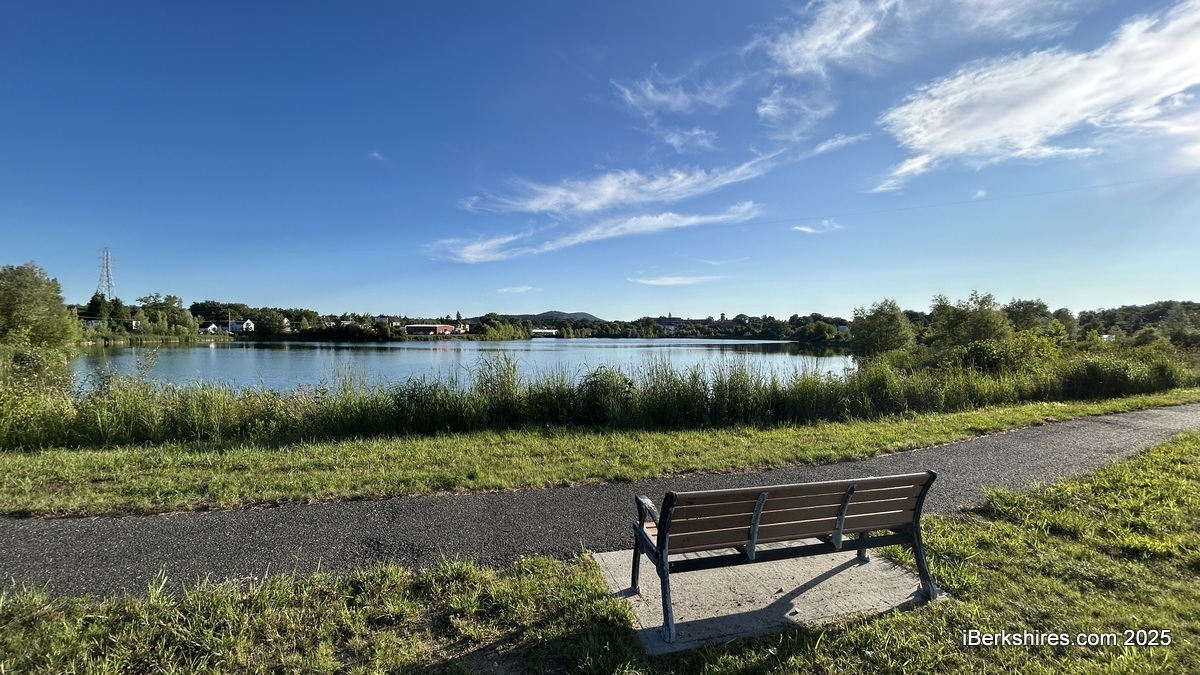
PITTSFIELD, Mass.— Starting next month, a thinning portion of Silver Lake's underwater cap will be repaired.
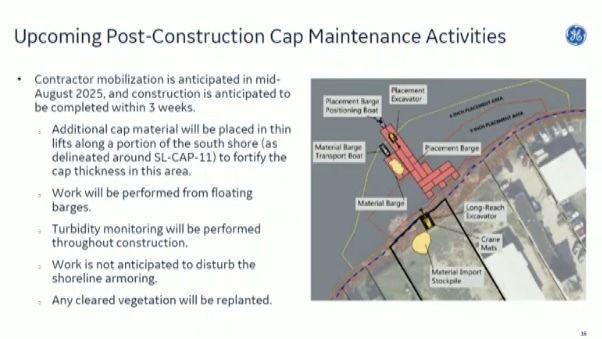
During a public hearing on Tuesday, members of the U.S. Environmental Protection Agency's New England Region 1 and General Electric detailed the three-week-long project beginning in August. An additional 6 to 9 inches of cap material will infill a three-quarter acre area of the lake, totaling about 810 cubic yards.
In 2023, monitoring required by the 2000 Consent Decree revealed that a southern area of the cap along East Street reduced to a thickness of 9.4 inches, down from 14. Work will be done behind the site of the former Kentucky Fried Chicken.
The cap is designed to sequester PCBs. It is composed of three years — 6 inches of capping materials, a 6-inch isolation layer that absorbs PCBs, and a 2-inch "mixing" zone.
"There are many reasons that can affect the thickness of the cap, and this is why we do monitoring, so we can see that it's still performing as we expect," design engineer Mark Gravelding said, pointing to consolidation of materials, sediment deposition, ecological activity, and other factors that can break down the cap.
"… We had a robust program to monitor what was being placed, but there can be variations, and that's why we monitor."
That program included four rounds of sampling from the cap's construction in 2013 to 2023. Gravelding reported there is "really no concentration" of polychlorinated biphenyls (PCBs) in the cap's top layer, and it's decreasing over time. Testing has shown a 63 percent reduction in surface water PCB concentrations following remediation and a 90 percent decrease in whole-body fish tissue concentrations.
"All these just show us that the cap is performing as we expect it to perform," he said.
Berkshire Environmental Action Team Executive Director Jane Winn said Silver Lake is an unlined "toxic waste dump" with very high levels capped, and is in the water table.
In 2000, GE entered into the Consent Decree with the EPA, Massachusetts, the State of Connecticut, and other affected parties that required GE to address PCBs and other hazardous contaminants in soils, sediment, and groundwater in several Removal Action Areas in or near the city.
Under the contract, GE was required to remove contaminated bank soils, remove and replace sediments near an outfall from the GE plant, cap the entire 26-acre lake bottom, and perform periodic reviews of the cap's effectiveness and integrity.
"Pittsfield got the real raw deal compared to everyone else," Winn said.
"I really object and feel totally betrayed that the last time, back in what, 2018, the depth of at least one of the places was below the 14 inches. I feel we were guaranteed that 14 inches, and it was a betrayal not to have it fixed back then. Being down to 9-plus inches now is unacceptable."
In the 2023 samples, five parts of the cap were 14 inches thick. She added that those "have to be below 14 inches now."
"To me, that's betraying the people of Pittsfield, and I think EPA and GE should be ashamed of that," Winn said.
The work area will be monitored one and five years after completion, and the lake's entire cap will be checked in 2033. In 2014, a 3,400-square-foot southern area of the cap was filled with an additional 45 cubic yards of cap material to reach the required cap thickness.
Winn wasn't the only community member to speak at the meeting, as several raised concerns about the capped lake's impact on the environment and human health.
Judith Herkimer, from the Housatonic Environmental Action League, said the negotiated settlement has "really little to do with the protection of human health and the environment."
"Silver Lake has been a particular thorn, has been a particular sadness, has been a particular atrocity at this site, and it continues to this day," she said.
"Although we will always say that we appreciate the engineers and what they have been able to do to contain as best possible under the provisions within the Consent Decree, it's not enough. It's not enough. You have never fully characterized all of the chemicals that even originally existed at that site."
Herkimer said the provided data was "essentially averaging," that is within the constraints of the Consent Decree.
"It's what was negotiated, and it's all variables of averaging. Whether it's on the land, whether it's in the water, whether it's in the air, you average everything out," she added.
"You called for this public meeting. People are here. Give them the information that they deserve, that they're kind of, in an indirect way, that their taxes pay for and people want to know."
A member of the project team said they could discuss a meeting or informational package to address concerns raised. Herkimer argued that HEAL has given plenty of comments, but there has been no action.
Jo Anne Kittrell, of the EPA's public affairs office, said Silver Lake is one of around 134 Superfund sites in Region 1, "but everybody on the team, this is just our No. 1 site."
GE 0167 Final EPA Silver Lake Fact Sheet by Brittany Polito
Tags: contamination, EPA, PCBs,