
Monument Mountain Building Project Advocates Warn Cost of 'No' Vote
Advocates of a yes vote would frame the question a little differently: Do the voters in the three member towns want to pay $457,339 to get a new school?
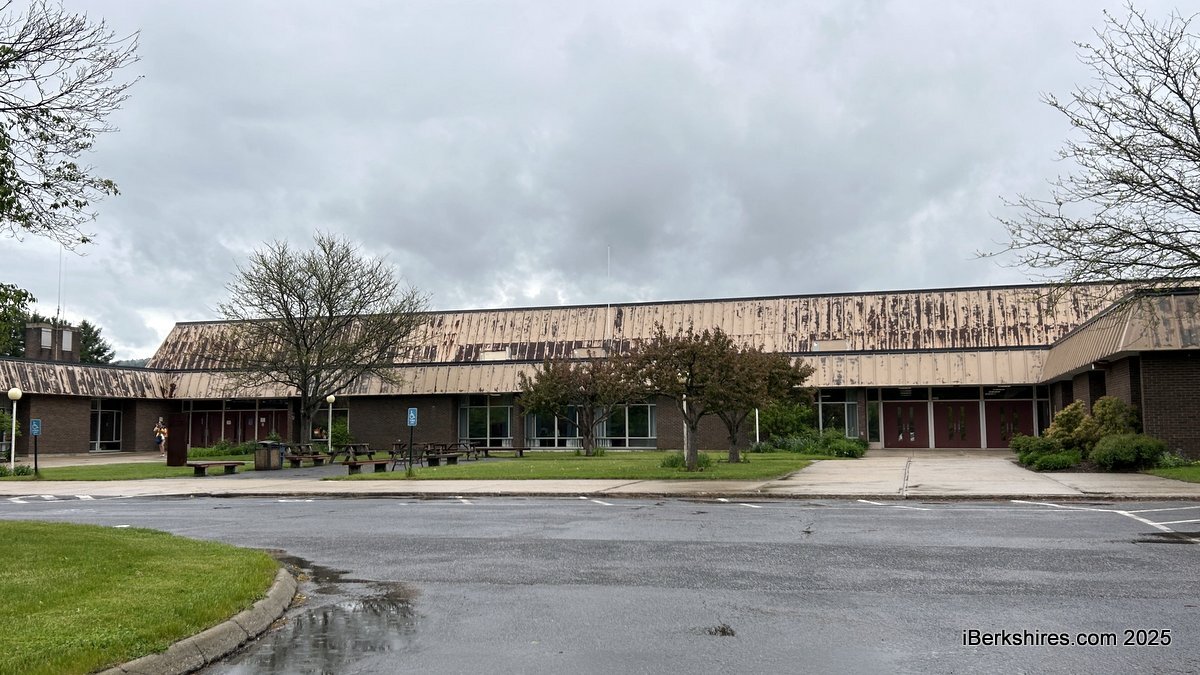
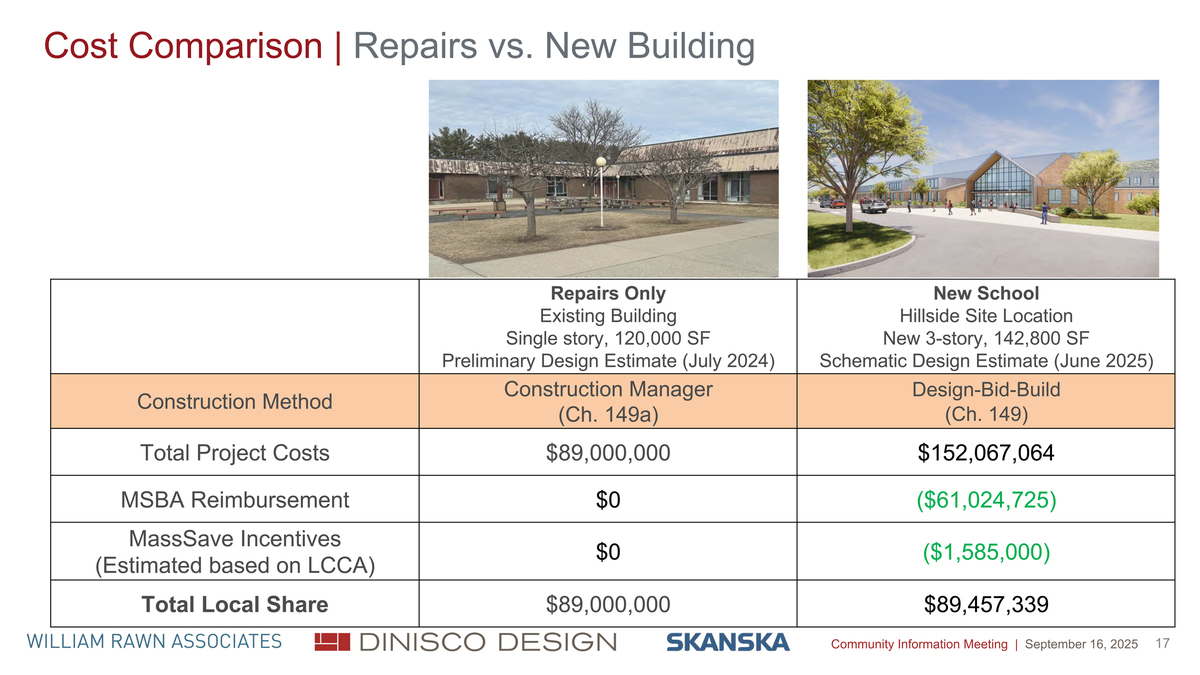
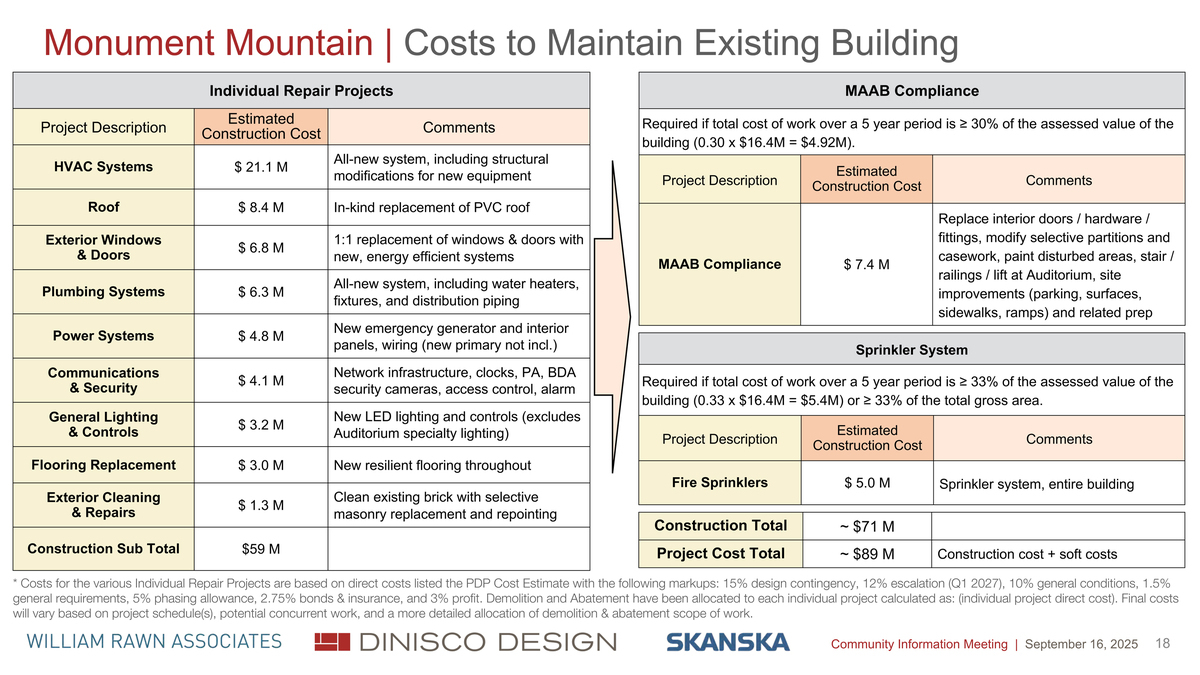
Because school officials will tell you that if the building project is defeated, the district faces a series of expensive repairs and renovations to the 1968 school building that will cost in the neighborhood of $89 million — more when you take into account the portable classrooms that will be needed as "swing space" during renovations.
And the latter $89 million bill would be borne entirely by local property taxpayers. The Massachusetts School Building Authority would not be sharing the cost, officials told a crowd of about 100 people who attended an information session on Tuesday evening in the high school's auditorium.
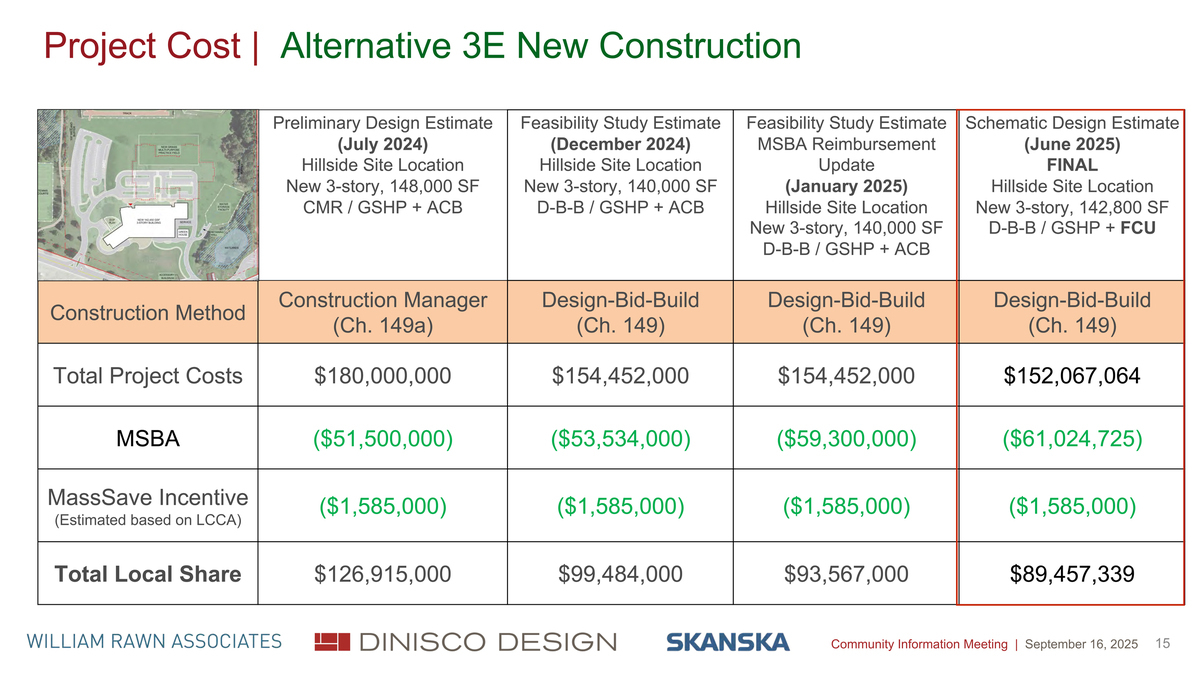
On the other hand, the MSBA is committed to contributing a little more than $61 million to a new Monument Mountain. That contribution, plus an expected $1.6 million incentive from MassSave, lowers the local share of the $152 million building project to the $89,457,339 that would be split between Great Barrington, Stockbridge and West Stockbridge if the project is approved in November.
School Building Committee members and administrators acknowledge that the $89.5 million price tag is a lot. And on Tuesday, in addition to offering tours of the current building and a more than two-hour presentation, the SBC added a new feature to its website, monumentbuildingproject.com: a tax impact calculator.
Residents now can easily plug in the assessed value of their homes and see the resulting property tax increase based on a 30-year bond at 5 percent interest, a rate that the district's superintendent Tuesday characterized as "conservative."
For a $500,000 home — a price point well below the medians of the three towns according to popular real estate sites like Zillow.com and Realtor.com — the impacts would be $722.50 per year in Great Barrington, $719 in Stockbridge and $632.50 in West Stockbridge.
"This is really an investment in the community's future," School Building Committee Chair and School Committee member Jason St. Peter told Tuesday's audience. "The kids need a school. It's not worth putting money into the one we have."
The list of what needs to be done to make the current Monument Mountain more usable is lengthy: $21.1 million to replace its heating, venting and air-conditioning, $8.4 million for a new roof, $6.8 million to replace exterior windows and doors with energy efficient systems and $6.3 million for a new water heaters and plumbing.
And that is just to start. The full list of needed repairs runs to $59 million.
Any one of the high-end projects would be enough to trigger additional renovations to bring the building into compliance with contemporary standards.
The current school's certificate of occupancy is based on "grandfathering" provision that allows it to have neither full compliance with the commonwealth's accessibility code nor a sprinkler or fire suppression system.
If the district spends 30 percent of the building's $16.4 million assessed value ($4.92 million) in a five-year period, it has to address the accessibility issues, at an estimated cost of $7.4 million. If it spends 33 percent of the assessed value in that five-year period ($5.4 million), it has to install a sprinkler system, at an estimated cost of $5 million.
That brings the total construction cost to about $71 million; factor in the industry standard "soft costs," and district architect DiNisco Design of Boston arrives at the $89 million cost to keep the current building in operation. And all of that is based on starting repairs in the first quarter of 2027; the multiple repair projects likely will be undertaken over a period of years and be further impacted by inflation.
"If we were to fail [on Nov. 4], we'd have to devise and fully phase a plan for repairs," Superintendent Peter Dillon said. "We'd have to pay for, borrow or bond that out."
Speaking from the floor of Tuesday's session, School Committee member Bill Fields, who also serves on the SBC, noted the added cost of acquiring portable classrooms to continue educating Monument Mountain's students.
"Basic repairs mean we're going to have to shut down portions of the building," Fields said. "Where do you put the kids? You'll need portable classrooms."
And at the end of the costly and disruptive series of repairs, the district will still have a building that does not meet its educational goals, officials say.
In answer to an audience member's question about how a new building will improve the educational experience, Dillon cited some of the deficiencies in the current high school.
"In the auto shop, the ceilings are too low for people to work under cars on lifts," he said. "The greenhouse has no ADA accessibility. The labs are out of date. Safety systems throughout the building are inadequate.
"The biggest concerns from an educational standpoint are the vocational spaces, the science labs, the special education spaces and the interior classrooms with no light."
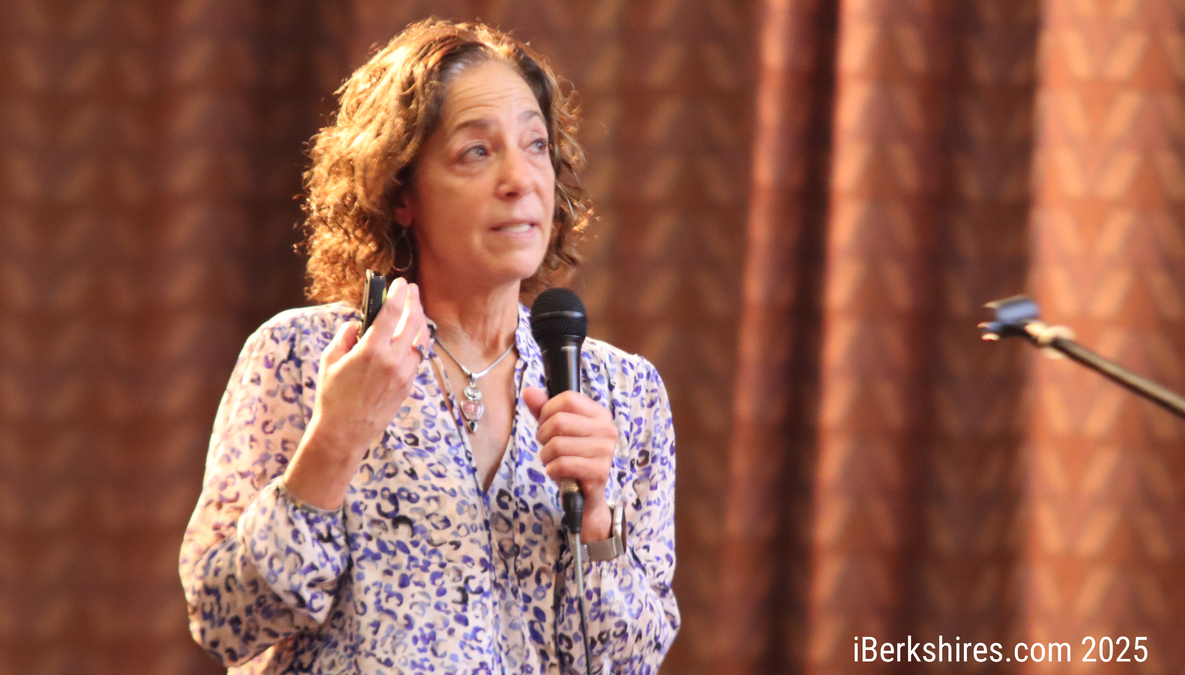
Donna DiNisco, a principal and president at DiNisco Design, walked the audience through a virtual tour of the planned new building, which will "open up the site and embrace the beauty of it."
The plan is to replace the current single-story Monument Mountain with a three-story building built into the hill in front of the current school. The main entry, gymnasium, auditorium, classrooms and offices will be on the middle floor. More classrooms and library will occupy the upper floor. The lower floor will be home to labs, science classrooms, art classrooms and the cafeteria.
The lower floor also will have access to the greenhouse, which currently is housed in a separate building down the hill from the high school near Stockbridge Road (Route 7).
Monument Mountain currently has three vocational technical education programs: automotive, horticulture and early childhood education. The new school would add a fourth, electricity, Dillon said.
Unlike the current school, which has many classrooms with no windows, the classrooms in the new school will be both bigger and have windows. And they will be arranged in such a way that they will be "flexible and adaptable," DiNisco said at a June presentation to the community.
Beyond the educational enhancements, the planned new configuration of the Monument Mountain campus will benefit the community by creating a separate bus entrance and bus loop apart from the current drive from Route 7, DiNisco said.
"We spent a lot of time talking to police and fire officials and the state police," she said. "All agreed it made sense to make two points of entry. This will significantly improve congestion at the end of the day."
And, while there are obvious upfront costs to a new build, it will pay dividends in terms of operation costs.
DiNisco told the audience that the district currently pays $245,000 per year for gas and electric. By using more energy efficient building materials and transferring to ground-source heat pumps, the all-electric building will operate at a cost of $209,000 per year, the architect projects.
And that number could drop dramatically. Though solar installations are not part of the $152,000 project, the building is being built "solar ready" and the district is looking into grant opportunities to acquire the PV arrays for the roof and parking lot that could make the new Monument Mountain a "net zero" building.
DiNisco said Tuesday the payback period for the district owning its own solar infrastructure is projected to be 23 years, after which the building's electricity costs would be negligible.
Of course, there is nothing negligible about financial commitment voters will be asked to make on Nov. 4.
And the local experience with such votes has not been good for the district.
Voters rejected a $56 million Proposition 2 1/2 debt exclusion for a renovation plan in 2013 and a $51 million debt exclusion a year later. A debt exclusion, or temporary override, means the financing cost is not calculated into Prop 2 1/2 levy limits and that it terminates upon the debt's repayment.
Officials fear that this is the district's last chance to access MSBA funding to address the building's deficiencies.
"If the project is not approved, we're probably never going to see funding from MSBA again in my lifetime," St. Peter said.
"Since the last vote, we worked tirelessly to get MSBA's ear," Dillon echoed. "I used to say it was a minor miracle, but it's a major miracle they let us back in. It's a very competitive process. They're going to pick another community."
As Tuesday's forum entered its third hour and attendees started to drift toward the exit, the veteran superintendent offered a final argument for a yes vote by residents who have no direct ties to the public schools.
"Part of the social contract is to invest in resources whether you immediately take advantage of them or not," Dillon said.
"I'm nervous that if we do piecemeal repairs, we'd end up in 10 years with a 70-year-old building that doesn't meet our needs."
The School Building Committee currently has five more public forums planned in the run-up to the Nov. 4 vote:
- Oct. 6, 6:30, West Stockbridge Public Library.
- Oct. 7, 4:30, Mason Public Library, Great Barrington.
- Oct. 7, 6:30, Stockbridge Public Library.
- Oct. 15, 4:30, Ramsdell Public Library, Housatonic.
- Oct. 16, 12:30, Claire Teague Senior Center, Great Barrington.
Tags: BHRSD, Monument Mountain, MSBA, school project,